AI in the classroom is the planned teaching of how artificial intelligence works, where it can assist learning, and when its output must be checked or rejected. The goal is not to put a chatbot in every lesson; it is to build sound judgment, protect students, and keep teachers responsible for instruction.
What Is AI in the Classroom?
AI in the classroom means using artificial intelligence as part of teaching and learning while deliberately teaching students about its abilities, limits, and risks. That can include a teacher using a system to draft practice questions, a student comparing an AI explanation with a textbook, or a class studying why a chatbot can sound certain and still be wrong. The tool is not the curriculum.
Generative AI systems produce new text, images, audio, or other material in response to prompts. They may help with brainstorming, translation, feedback, or practice, but they do not reliably distinguish truth from a convincing error. A fluent answer is not proof of understanding. Students still need to check sources, explain their reasoning, and make decisions themselves.
The distinction between teaching with AI and teaching about AI matters. Teaching with AI means using a system to support a particular lesson; teaching about AI means learning how such systems work, what information they use, how they can fail, and who is accountable for their effects. Schools should address both, but only when they serve a stated learning outcome. A novelty is not a pedagogy.
The National Parents Union’s September online survey of 1,528 parents offers a useful snapshot of one public debate. It found that 77% wanted K–12 public schools to teach students how to use AI tools effectively, while 85% supported instruction about AI safety. The findings describe surveyed parents’ views; they do not prove that a particular AI program improves learning. Further details about the survey’s representativeness are not reported here. The organization is the National Parents Union.
The same survey points to a gap between interest and confidence: 46% of respondents thought their state was handling technology use in schools well enough. Parents also favored measured approaches and more teacher training. That is a sensible distinction. Teaching responsible use is not the same as buying every available tool, and caution is not the same as refusing to teach a technology students may encounter outside school.
Core Benefits and Importance
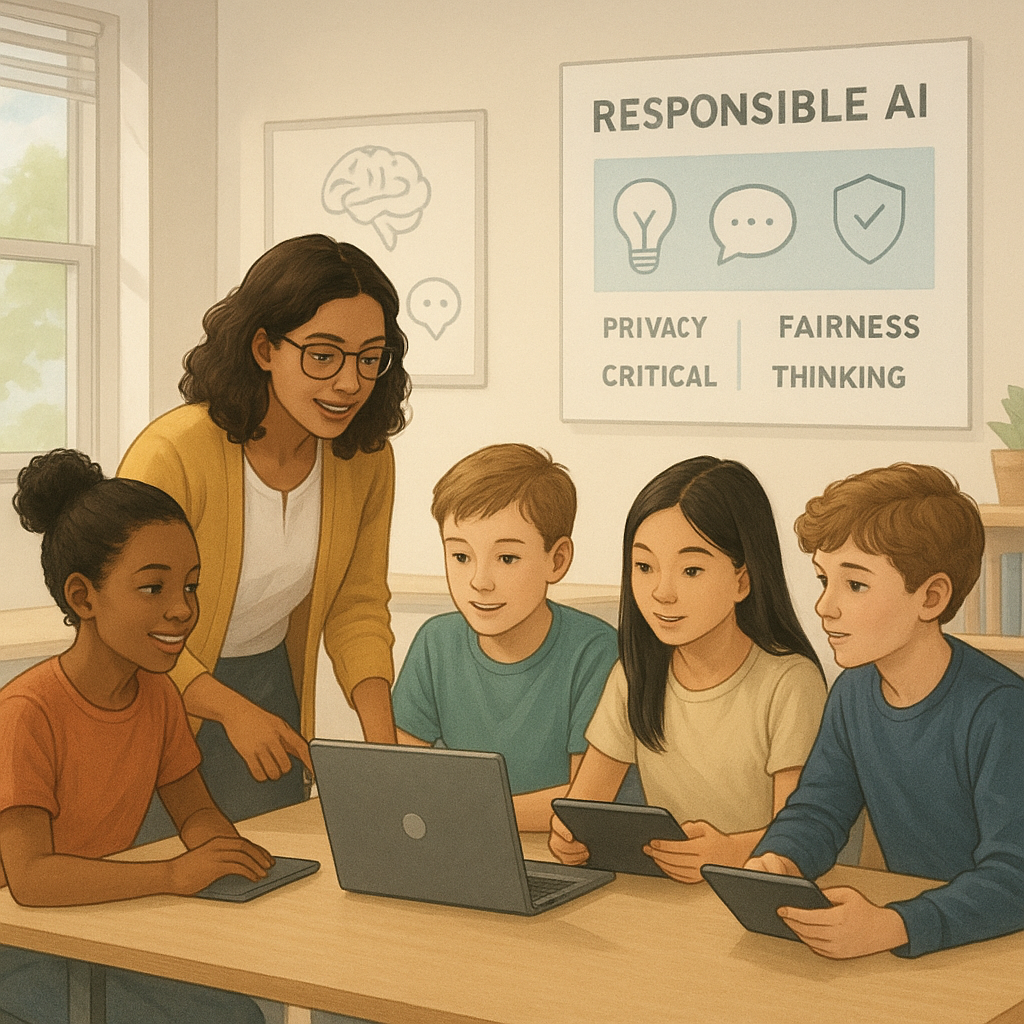
AI literacy is becoming a basic part of digital literacy. Students need to know how to ask useful questions, inspect an answer, identify missing evidence, and decide when a tool should not be used. Those habits matter across subjects, from science research to writing and mathematics. Knowing where the generate button sits is the least demanding part.
Better judgment, not just faster work. When students compare an AI answer with a reliable source, they practice evidence checking and intellectual humility. They learn that confidence, clean formatting, and a polished tone do not guarantee accuracy. That lesson transfers well beyond AI. It is useful whenever a claim arrives with more certainty than support.
More targeted practice. Used carefully, AI can help a teacher draft extra examples, create alternative explanations, or prepare questions at different levels of difficulty. The teacher checks the material and chooses what fits the class. That can save preparation time, but it does not remove the need to diagnose misconceptions or give thoughtful feedback. A system can produce more exercises; a teacher decides which exercise is worth a student’s time.
Clearer student agency. A student who must explain how AI was used, verify its claims, and revise the result has more responsibility than one who simply submits generated work. That expectation can make the learning process visible. It also helps teachers distinguish a student’s own understanding from a tool’s output. The distinction matters for honest assessment and useful support.
Safer participation. Safety instruction gives students concrete ways to protect privacy, recognize unreliable output, and ask for adult help when a tool produces troubling material. It should include rules about personal information, account access, age limits, and approved school systems. Safety is not a one-time assembly or a button in a settings menu. It is a routine practice.
Preparation for further study and work. Young people may meet AI tools in higher education, jobs, and daily life. Schools can prepare them to use such tools with care without treating automation as inevitable or always desirable. The point is not to train children to serve software. Education should develop knowledge, judgment, character, and the ability to contribute to human flourishing.
There is a practical benefit for schools, too: a shared curriculum is more consistent than leaving every decision to an individual teacher. The U.S. Department of Education’s report on AI and the future of teaching and learning stresses human-centered design and the importance of keeping educators involved. UNESCO’s guidance on generative AI in education and research likewise raises concerns about privacy, human agency, and appropriate safeguards. Neither document says that every school should adopt the same tool. That is the kicker: useful policy sets boundaries and goals, not a shopping list.
Step-by-Step: How to Implement Responsible AI Instruction
- Start with the learning outcome. Write down what students should know or be able to do without a tool before deciding whether AI belongs in the lesson. If the goal is to learn multiplication facts, generating answers may undercut the practice. If the goal is to evaluate explanations, comparing a generated answer with trusted material may help. I would begin with the outcome, not a vendor demonstration. What is the student meant to learn?
- Set age-appropriate boundaries. A primary-school lesson about recognizing a machine-generated answer does not need to look like a high-school research project. Decide which students may access which tools, whether adult supervision is required, and what content is off limits. Rules should reflect children’s developmental needs, school policy, and the terms of the tools being considered. UNESCO’s guidance is a useful reference for thinking through safeguards and age considerations, but local rules still need to be explicit.
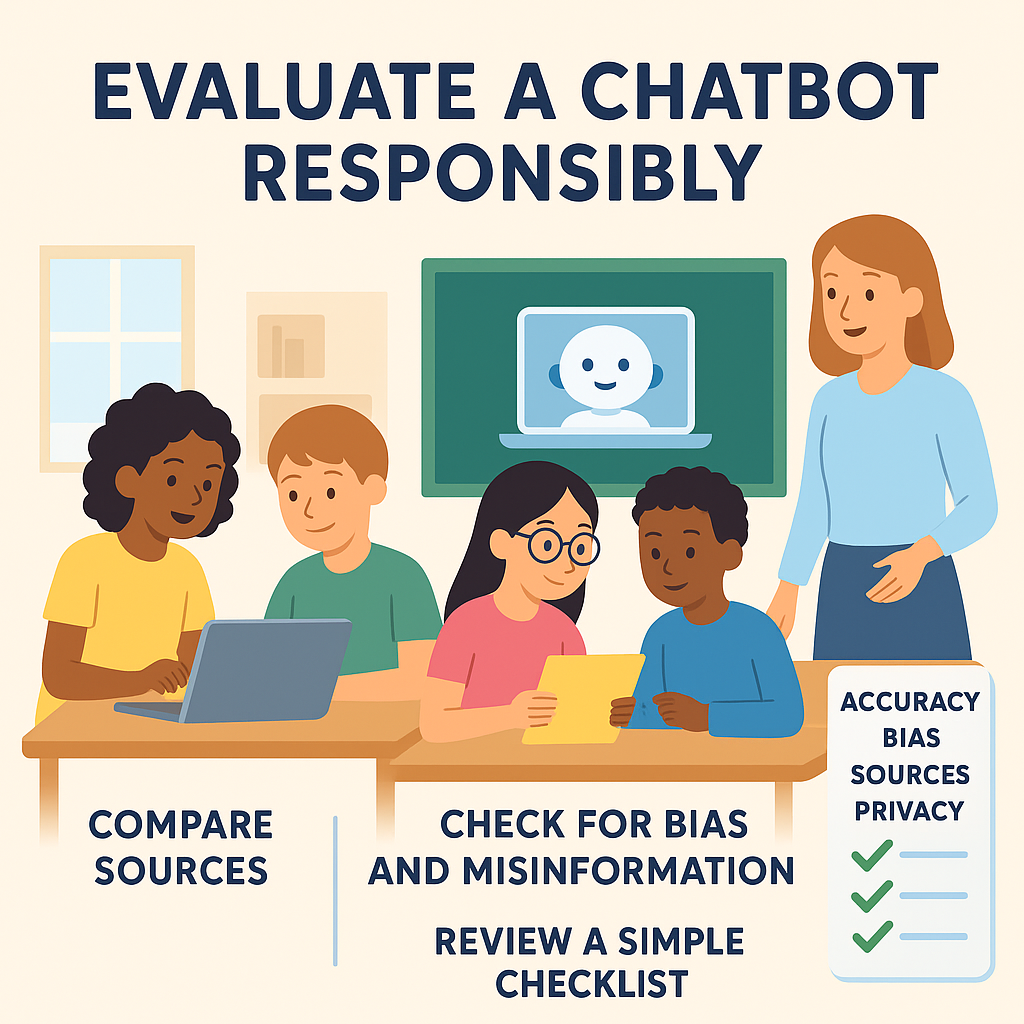
- Teach a small set of repeatable checks. Students should ask: What claim is being made? What evidence supports it? Can I confirm it in a dependable source? What might be missing or biased? Would I still be able to explain this answer in my own words? These questions work better than vague instructions to use AI responsibly. A good routine is easy to remember and applies across subjects. Students need practice using it, not just a poster on the wall.
- Model safe prompting and privacy. Teachers can show how a prompt affects an answer, then demonstrate why students should not enter names, addresses, private family details, school records, or other sensitive information into an unapproved system. Use fictional examples for classroom demonstrations. Explain that deleting a prompt from a screen may not mean that all copies or records have disappeared. When the rules are unclear, the safe choice is not to enter the information.
- Choose tools through a learning-and-safety review. Before purchasing or assigning a system, ask what student information it collects, how that information is stored, whether the tool is suitable for the students’ ages, and how the school will handle errors or harmful output. Review accessibility, language support, cost, and teacher workload, too. The NPU survey found that 81% of respondents supported prohibiting public schools from buying technology not proven safe and effective for learning. That is a call for evidence and due diligence, not a claim that every product has already been tested adequately.
- Train teachers and provide time to plan. A policy on paper will not teach a class. Teachers need practical training in AI and digital literacy, classroom examples, privacy procedures, and ways to adapt assessments. In the NPU survey, 79% supported requiring public-school teachers to receive training in digital and AI literacy and responsible technology use. Training should include subject-specific practice: a history teacher needs ways to teach source evaluation, while a mathematics teacher may need to check whether AI explanations expose or hide the reasoning students should learn.
- Design assessments that reveal understanding. Pair a permitted AI-assisted task with work that shows the student’s own thinking: a short oral explanation, a handwritten outline, a reflection on revisions, or an in-class problem. State which uses are allowed before students begin. If a student uses AI to generate a draft, ask them to identify what they accepted, changed, and checked. This is more informative than trying to guess whether every polished paragraph was written by a person or a machine.
- Review outcomes and revise. Track whether students meet the stated learning goals, whether teachers can manage the workflow, and whether safety concerns arise. Ask students what helped and what confused them, but do not treat enthusiasm as evidence of learning. Compare performance on AI-assisted tasks with independent work where appropriate. The Institute of Education Sciences practice guide on organizing instruction and study discusses strategies such as spacing and retrieval practice; those established approaches remain useful whether or not AI appears in a lesson. If the tool adds friction without improving the work, remove it.

Comparison: AI Literacy Versus Blanket Restrictions
A blanket restriction is the strongest competitor to classroom AI literacy. It may be reasonable in a particular lesson, with younger students, or when a tool fails a privacy or safety review. But treating every use as identical leaves little room to teach students how to assess tools they may encounter elsewhere. The opposite policy—unrestricted use—is no better. It can blur authorship, weaken practice, and expose students to risks the school has not addressed.
| Approach | Main purpose | Potential strength | Main risk | Better use when |
|---|
| Responsible AI literacy | Teach careful, limited use and critical evaluation | Builds judgment, verification habits, and safety awareness | Requires staff training, clear rules, and ongoing review | A tool fits a defined learning outcome and has passed school review |
| Blanket restriction | Prevent or limit student access | Can reduce exposure to unapproved tools and protect time for independent practice | May prevent guided instruction and treats different tasks as if they were the same | Students are too young for the tool, the activity requires unaided practice, or safety is unresolved |
| Unrestricted access | Let students use AI with few limits | Gives students broad access to emerging tools | Encourages dependence, unverified answers, privacy risks, and confusion about authorship | Rarely appropriate as a schoolwide default |
The survey figures do not settle the policy question. They show that many surveyed parents want both instruction and safeguards: 77% backed effective-use teaching, 85% backed safety education, and 81% supported blocking purchases of technology not proven safe and effective for learning. Those positions are not contradictory. They describe a demand for careful teaching rather than a reflexive yes or no.
New York City and Los Angeles illustrate why local rules matter. The reported New York City restriction on student-facing generative AI covered preschool through eighth grade, while high school students were to receive AI literacy modules twice a year. Mayor Zohran Mamdani said the approach was intended to help younger students build skills with peers, form relationships with educators, and wrestle with difficult problems on their own. In Los Angeles, the restriction applied to kindergarten through grade 12, and a committee was meeting during the school year to discuss recommendations. Those details describe different policy choices, not proof that either approach improves learning. The real test is whether policy protects students while teaching them what they need to know.
Common Mistakes to Avoid
Mistake 1: Treating access as learning. A student can generate a report without understanding the topic. A tool can also provide a useful explanation without guaranteeing that the student remembers or can apply it later. Ask for evidence of learning: an explanation in the student’s own words, a new example, or an independent attempt. Speed is not mastery. That should be obvious, but shiny tools often distract from it.
Mistake 2: Banning a tool without teaching the underlying skill. There are sound reasons to prohibit AI during a specific assessment or when a system does not meet safety requirements. A blanket rule, though, can leave students with no practice spotting errors, checking claims, or protecting their information. Schools can teach those skills with demonstrations, sample outputs, and supervised activities even when students cannot use a live tool. A restriction should have a reason and a review date, not just a scolding tone.
Mistake 3: Treating AI output as neutral or authoritative. Generative systems can reproduce errors and reflect gaps or bias in their data. Teachers should not present their output as a reliable answer key. Compare it with trusted sources and invite students to find weak claims, missing context, or assumptions. The U.S. Department of Education and UNESCO both stress human responsibility and safeguards in their guidance. A confident machine is still a machine.
Mistake 4: Relying on a detector to prove misconduct. Automated detection can be uncertain, and an accusation based only on a score can damage trust. Design assignments with visible stages—notes, drafts, conferences, and reflections—and explain what help is allowed. If a concern arises, talk with the student and examine the work in context. Fair assessment needs evidence and a chance to respond, not a guess dressed up as certainty.
Mistake 5: Giving teachers training without time or support. The NPU survey found broad support for teacher training, but a workshop alone will not produce a coherent curriculum. Teachers need time to plan, access to approved tools, a person to contact about privacy questions, and clear guidance when a system gives harmful or false output. Schools should also let educators say when a tool does not fit a lesson. Responsibility without support is a poor plan.
Mistake 6: Making the debate only about cheating or jobs. Academic honesty and future work matter, but education is larger than either. Students also need curiosity, patience, discernment, and respect for other people’s work. If every discussion centers on productivity, schools risk teaching children that efficiency is the highest good. It is not. Knowledge should help students seek truth and use their abilities well.
Mistake 7: Assuming all students have equal access. Some students may not have a suitable device, reliable internet, or an approved account outside school. Others may need accommodations or assistive technology. A curriculum that requires home access can quietly widen gaps. Check whether a learning activity works for students with different needs and resources, and provide a school-based alternative. Fairness is part of sound design, not a footnote.
Frequently Asked Questions
Should schools teach students to use AI?
Schools should teach AI literacy when it serves learning goals and when the school can provide age-appropriate safeguards. The NPU survey found that 77% of responding parents supported teaching students how to use AI effectively, and 85% supported AI safety instruction. Those figures show strong support among survey participants, not a guarantee that any particular course or tool will work. Instruction should cover verification, privacy, authorship, and when not to use AI. Students also need plenty of work that builds skills without automated assistance.
How can teachers prevent AI from doing students’ work?
State what kinds of AI help are permitted before an assignment begins. Use drafts, brief conferences, in-class tasks, and explanations of reasoning to make learning visible. Ask students to disclose AI use and describe how they checked or revised its output. Avoid relying on detection software as the sole evidence of misconduct. The aim is not to catch every tool-assisted sentence; it is to assess what the student knows and can do.
At what age should students start learning about AI?
There is no single age that fits every tool and task. Younger students can learn simple ideas such as the difference between a person’s judgment and a computer-generated response, and why private information should stay private. Older students can examine sources, bias, accuracy, and appropriate use in academic work. Access to a specific system should depend on its age terms, school policy, student readiness, and a safety review. Teaching about a technology does not require giving every child an account.
Does AI improve student learning?
AI can assist some learning activities, but access alone does not show that learning improved. Schools should measure the stated outcome, compare it with independent work, and check whether students retain and apply what they practiced. A tool that drafts examples may help a teacher prepare; a tool that supplies every answer may remove the practice a student needs. The right question is not whether AI is impressive. It is whether this use helps these students learn this material safely and well.
Parents are not asking schools to choose between blind enthusiasm and blanket fear. The National Parents Union survey suggests that many want students to learn about AI while also expecting safety rules, evidence, and trained teachers. That combination is not a contradiction; it is the ordinary standard we should apply to any powerful classroom tool. If a system affects student work, privacy, or attention, educators and families deserve clear answers about why it is being used.
Schools should begin with sound teaching: define the learning outcome, decide what students must practice unaided, and then consider whether AI adds something worth the cost and risk. Make the rules plain. Teach students to check claims and protect personal information. Give teachers time to prepare, and review whether students are actually learning. When a tool fails those tests, set it aside. There is no prize for adopting technology just because it is new.
Above all, keep the human purpose of education in view. Students need knowledge, but they also need judgment, responsibility, and respect for the truth. AI can sometimes support that work; it cannot take responsibility for it. The most useful classroom policy will be neither a sales pitch nor a prohibition for its own sake. It will help young people become capable learners who can use tools wisely—and know when to close the screen and think for themselves.