<strong>High-impact tutoring</strong> is frequent, personalized academic instruction delivered by a consistent tutor, usually during the school day and in...
Can High-Impact Tutoring Survive Post-Pandemic Funding Loss? What Schools Can Preserve
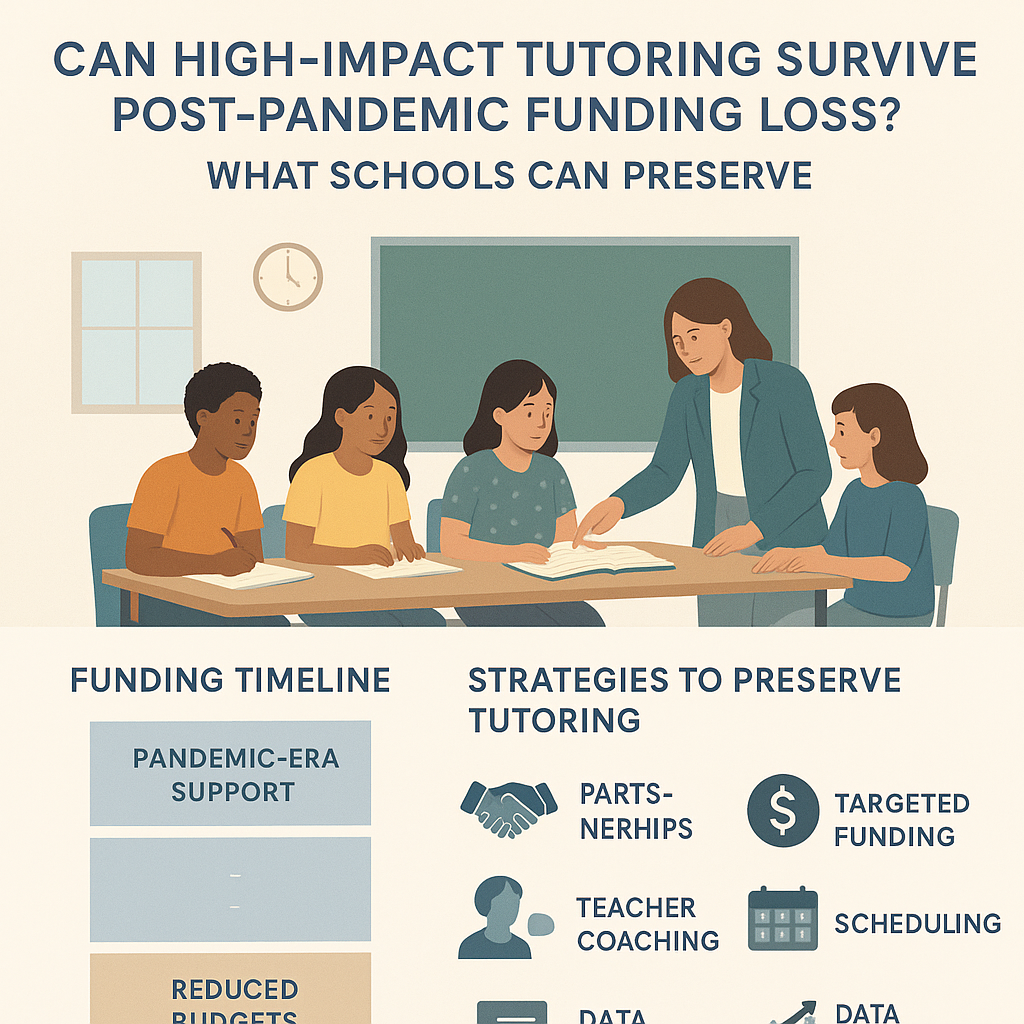
High-impact tutoring is frequent, personalized academic instruction delivered by a consistent tutor, usually during the school day and in small groups. It can improve learning, but it costs more than occasional homework help. As pandemic relief funding ends, schools face a hard question: can they keep the parts that matter without keeping every temporary program exactly as it was?
Key Takeaways- Strong tutoring depends on consistent tutors, frequent sessions, small groups, and alignment with classroom instruction—not the program label.
- Federal relief funding helped many districts start or expand tutoring, but long-term continuation requires recurring money and realistic staffing plans.
- Schools can preserve impact by focusing on students with the greatest need, protecting tutoring time, and using evidence to refine programs.
- Replacing a well-designed program with sporadic, large-group help may save money on paper and lose learning time in practice.
The funding debate is not simply “keep tutoring” versus “cut tutoring.” Districts need to decide which students need support, which tutoring features produce results, and how to pay for those features once temporary grants run out. That means reviewing schedules, staffing, student participation, and learning evidence—not assuming that a short-term pandemic response can become permanent without adjustments. A smaller, dependable program may be more useful than a broad one that cannot consistently staff its sessions. The aim is to protect meaningful instruction, not preserve a line item for its own sake.
What Is High-Impact Tutoring?
High-impact tutoring, often called high-dosage tutoring, is a structured academic intervention in which students meet regularly with the same tutor, typically one-to-one or in a small group. Programs commonly provide sessions several times each week, with a focus on a specific subject such as reading or mathematics. Lessons are connected to classroom content and guided by student needs, rather than built around generic worksheets or occasional drop-in assistance.
The key word is not “tutoring.” It is “high-impact.” A program does not earn that description because its name appears in a grant proposal. Its design has to make sustained teaching possible. That usually means consistent tutor-student relationships, a manageable group size, protected time in the school schedule, appropriate materials, and communication between tutors and classroom teachers. The National Student Support Accelerator’s tutoring resources describe tutoring quality in terms of practical features such as frequency, group size, instructional materials, and tutor support. Those features are not decorative extras; they shape how much useful teaching students actually receive.
This approach also differs from a quick fix. A student who misses a session every week, sees a new tutor each time, or receives lessons unrelated to current classwork may not get the intended dose of instruction. Attendance matters. So does the tutor’s preparation. A capable tutor who knows what the student is studying can explain a concept, check understanding, and adjust the next lesson. A tutor working without useful information may spend the session guessing.
The research is encouraging, but not a blank cheque. A meta-analysis of tutoring studies by Nickow, Oreopoulos, and Quan found positive average effects on student learning, with results varying by program design and context. That is a reason to use tutoring thoughtfully—not to claim that every tutoring model works equally well. When I assess a program, I look past the branding and ask whether students receive regular, well-targeted teaching and whether the district can show that they are participating and learning.
High-impact tutoring belongs within a wider curriculum and pedagogy, not beside them as a disconnected service. Classroom teachers remain responsible for instruction; tutors add targeted practice and explanation. Assessment helps identify needs and monitor progress, while learning outcomes clarify what students should know or be able to do. The point is to help students rejoin and advance in classroom learning, not create a parallel curriculum that no one coordinates.
Why Tutoring Matters—and What It Cannot Do
The strongest case for tutoring is straightforward: individual feedback is difficult to deliver in a crowded classroom, and students do not all need the same explanation at the same time. A tutor can listen closely, identify a misconception, and give a student another opportunity to practise. That is ordinary good teaching, delivered with more attention per learner.
Research reviews have found tutoring can improve academic outcomes, though effects vary with age, subject, tutor type, program quality, and how the tutoring is delivered. The NBER review by Nickow and colleagues synthesizes evidence from randomized evaluations and reports positive average effects. Other evidence summaries, including the U.S. Institute of Education Sciences practice guide on mathematics intervention, emphasize using evidence-based instruction and regular checks of student progress. In plain terms: the promise is real, but implementation determines whether students get the benefit.
Here are the practical advantages districts should weigh:
- More responsive instruction. Tutors can slow down, ask a student to explain their thinking, and revisit a specific skill without holding up an entire class.
- Regular practice. Frequent sessions give students repeated chances to retrieve and apply important knowledge. A single session before a test is not the same thing.
- Earlier identification of gaps. Short assessments and tutor observations can reveal when a student is stuck on prerequisite knowledge, not simply “bad at math” or “behind in reading.”
- A dependable adult relationship. A consistent tutor can help students feel noticed and willing to attempt difficult work. That relationship complements, but does not replace, sound instruction.
- Useful feedback for schools. Patterns in student errors can tell educators which concepts need clearer classroom teaching or a better sequence in the curriculum.
Frankly, the most tempting claim is also the one districts should resist: tutoring will not repair every problem associated with disrupted schooling, unstable attendance, under-resourced classrooms, or a weak curriculum. It is not a substitute for effective core instruction, trained teachers, or support for students’ broader needs. It is one tool in a larger system.
Nor should “catching students up” become permission to lower expectations. Good support gives students access to demanding, grade-appropriate work while supplying the instruction needed to participate. Education should form knowledge, judgment, and character together; students deserve to be treated as learners with dignity, not as deficits on a spreadsheet. That requires making decisions from evidence while still seeing the person in front of the data.
A useful program also tracks more than test scores. Districts should look at attendance, how many scheduled sessions students actually receive, student participation, tutor continuity, and progress on targeted skills. If a student is assigned three sessions a week but attends one, the written plan and the lived experience are two different things. That distinction matters when leaders decide what to keep.
How Districts Can Preserve the Effective Parts
There is no single budget trick that makes a high-quality program cheap. Schools can, however, make careful choices about who receives tutoring, when it occurs, and what supports staff need. The following steps are a workable starting point.
- Define the instructional purpose. Name the skills and students the program is meant to serve. “Improve achievement” is too vague to guide lessons or spending. A clearer aim might be strengthening foundational reading skills for identified students or addressing specific gaps in mathematics. Use current assessment information and teacher knowledge together; a score alone rarely explains why a student is struggling.
- Protect the essential design features. Decide what the district can sustain, then be honest about the trade-offs. Frequent sessions, a consistent tutor, small groups, aligned materials, and tutor preparation are commonly emphasized in high-impact tutoring guidance. A district may need to serve fewer students to keep these features intact. That is a hard choice, but a program with the right name and the wrong dose is not an effective compromise.
- Build tutoring into the school day where feasible. Before- or after-school programs can help, but attendance may be less reliable when families face transportation, work, or caregiving constraints. In-school scheduling can improve access, provided students do not repeatedly miss essential classroom lessons. Principals and teachers should decide how tutoring fits the timetable, not tack it onto the day and hope it works.
- Use a stable, supported tutor workforce. Tutors may be teachers, paraprofessionals, trained community members, or other staff, depending on the program and local rules. Whoever teaches needs clear materials, training, coaching, and a way to ask for help. A hiring plan that assumes a plentiful pool of qualified tutors without checking local availability is wishful thinking. Pay, preparation time, and manageable caseloads affect whether tutors stay.
- Connect tutoring to classroom instruction. Set up simple, regular communication between tutors and classroom teachers. Share the skills being taught, upcoming classroom work, and information about student progress. Tutors should not be expected to replicate a teacher’s full curriculum, but they should know enough to reinforce relevant learning. Keep the process practical: brief updates and shared materials are more likely to happen than elaborate reporting systems.
- Measure delivery as well as results. Track scheduled and attended sessions, tutor continuity, group size, and progress on the skills being taught. These are implementation measures; they help explain results. Compare student progress with the program’s goals and examine whether access is fair across schools and student groups. When I review a tutoring plan, I want to know what a student actually received, not just what a grant promised.
- Plan the funding mix before the deadline. Identify recurring costs such as tutor wages, training, curriculum materials, supervision, and scheduling. Then examine possible sources—district funds, state initiatives, federal programs where allowable, or community partnerships—without assuming any source will cover every expense. Funding rules change, and districts should verify eligibility with current official guidance. A grant can pay for a start; a durable program needs a credible plan for year two and beyond.
- Review, adjust, or stop. Set a review date and decide in advance what evidence would prompt a change. Perhaps some sessions are poorly attended, a group is too large, or a target skill is not improving. Fix delivery problems before declaring tutoring ineffective. Conversely, do not keep a weak model forever because people worked hard to launch it. Respect for students includes being willing to improve a program—or end it—when evidence warrants.
The National Student Support Accelerator’s implementation resources offer practical guidance on designing and supporting tutoring. The RAND Corporation has examined how districts implemented tutoring and the operational challenges involved. Those resources are useful because they foreground the unglamorous details: scheduling, recruitment, training, and actual participation. That is where promising ideas either become dependable instruction or stall out.
High-Impact Tutoring Versus General Academic Support
The comparison is not meant to sneer at homework clubs or broad intervention programs. Those services can help students, especially when they provide a safe place to work and access to a knowledgeable adult. But they are not automatically equivalent to high-impact tutoring. The distinction is instructional design and consistency, not a moral ranking of staff or programs.
| Feature | High-impact tutoring | General academic support |
|---|
| Main purpose | Targeted instruction on identified learning needs | Homework help, study time, or broad academic assistance |
| Schedule | Frequent, planned sessions, often multiple times weekly | May be occasional or vary with staffing and attendance |
| Group size | Usually one-to-one or a small group | Often larger or less consistent |
| Tutor continuity | A consistent tutor is preferred | Students may work with whoever is available |
| Lesson alignment | Connected to curriculum and student data | May depend on the task a student brings that day |
| Progress checks | Regular checks tied to defined skills | May be informal or focused on homework completion |
| Cost and capacity | Higher per-student cost; harder to scale | Often able to serve more students at lower cost |
| Best use | Intensive support for students with specific needs | General practice, supervision, and help with assignments |
There is a real budget trade-off. A district may reach more students with a lower-intensity model, while a more intensive approach provides deeper support to fewer students. It should not pretend those are identical services. The sensible choice depends on student needs, staffing, the evidence available, and the outcomes the school is trying to improve.
Some districts may use both. General academic support can provide broad access, while targeted tutoring is reserved for students who need more frequent, structured instruction. That blended model only works if eligibility is clear and students can move between levels as their needs change. Otherwise, the supposedly targeted program can become a permanent label, or students with serious gaps may wait too long for help.
The blunt version: count the instruction, not the program title. If a school calls a weekly homework room “high dosage,” the label does not change how often students meet, the size of the group, or whether lessons target a skill. Conversely, a modest program with stable tutors and disciplined lesson planning may deliver more of the core ingredients than a larger program with glossy materials and frequent cancellations.
Common Mistakes to Avoid
Keeping the program but cutting its defining features. If budget pressure means fewer sessions, larger groups, high tutor turnover, and no preparation time, leaders should say plainly that the service has changed. It may still be useful, but they should not assume it will retain the same impact. Calling a reduced service by its old name can hide the actual trade-off from families and school staff.
Spreading money thinly to avoid difficult choices. Serving every student a little may feel fair, but it can leave students with the greatest need receiving too little support to make a difference. On the other hand, narrowly targeting support without transparent criteria can exclude students who need it. Use clear, revisable rules and review who is being served. Equity is not achieved by making the program’s purpose impossible to understand.
Treating attendance as a student character flaw. Students miss sessions for many reasons: transport, competing school activities, family responsibilities, illness, or scheduling conflicts. The program needs to identify barriers and respond. A perfect tutoring curriculum is no help to a student who cannot attend. Check attendance by school and group; ask families and students what is getting in the way before changing the lesson plan.
Assuming technology can replace a relationship and a schedule. Digital lessons and tutoring platforms can expand access or support instruction, but a platform does not ensure that students show up, receive appropriate teaching, or get useful feedback. Technology is a delivery choice, not an intervention by itself. Evaluate what students do with it and what human support surrounds it.
Calling any test score change proof of success—or failure. Scores fluctuate, and short-term results can be influenced by many factors. Pair outcome data with implementation evidence and other relevant information. Were sessions delivered as planned? Did students attend? Were assessments appropriate to the skills taught? Small samples and uneven participation call for caution. Make claims that match the evidence, not the press release.
Failing to budget for supervision and planning. Tutor wages are visible. Coaching, coordination, materials, and time for teachers to communicate may be less visible, but the work still has to happen. If every dollar goes to direct sessions and no one has time to coordinate them, the program may become fragmented. A realistic budget includes the conditions that make instruction coherent.
Keeping a program because it once received a grant. Temporary funding can be a useful start, not a permanent endorsement. Leaders should review quality, cost, student reach, and outcomes before replacing a grant with recurring local funds. Conversely, ending every program as soon as relief dollars disappear ignores useful experience and makes students bear the cost of poor planning. Evidence should guide continuation, redesign, or closure.
Relying on slogans about “learning styles.” Students may have preferences, but the popular idea that each child must be taught through a fixed visual, auditory, or other personal style is not a reliable basis for instructional decisions. Use clear explanations, examples, practice, and checks for understanding. Adapt teaching to the content and the student’s demonstrated needs, not a label that sounds personalized but may tell the tutor very little.

Frequently Asked Questions
What makes tutoring “high-impact”?
It is generally frequent, delivered by a consistent tutor, kept to a small group, aligned with classroom learning, and guided by student needs. The exact design should fit the students and setting. A name alone proves nothing; schools should check what instruction students actually receive.
How many times a week should students receive tutoring?
Many high-impact models meet several times a week, but there is no universal schedule that suits every student or program. Frequency should be based on the instructional goal and the evidence behind the model. Schools should also track attendance, since planned sessions do not count as delivered instruction if students rarely attend.
Can high-impact tutoring continue without pandemic relief funds?
Sometimes, but usually not at the same scale without a recurring funding source. Districts may prioritize students with the greatest need, adjust delivery, and combine allowable funding sources. They should verify current funding rules and protect the program’s essential features rather than making an unsupported promise that every student will receive the same service.
Is tutoring better than hiring more classroom teachers?
That is a false choice in many situations. Tutoring offers targeted instruction in a smaller setting; strong classroom teaching reaches students across the school day and is foundational to learning. Districts should consider staffing needs, student outcomes, and costs together. Tutoring cannot be a permanent substitute for adequate core instruction.
Final Thought
High-impact tutoring can survive the end of temporary funding, but not by pretending that a costly, staff-intensive program can be maintained unchanged on a smaller budget. Districts need to decide what they are trying to accomplish, which students most need the service, and which features are essential to useful instruction. Then they need to tell families and staff what will continue, what will change, and how they will know whether the revised model is helping.
The responsible answer may be a smaller program with consistent tutors, protected time, and clear learning goals. It may be a blended approach that offers broad academic support alongside more intensive tutoring for students who need it. Or it may be a decision to stop a model that cannot be delivered well and redirect resources toward stronger classroom teaching. None of those choices is painless. But scale alone is not a measure of success, and a temporary grant does not make a weak design sound.
When I weigh a program, I come back to a plain question: what meaningful instruction did the student receive this week? If leaders can answer that with evidence—and can explain how the work will be funded next year—then they have something worth protecting. If not, the hard work is still ahead. The aim is not to preserve a fashionable intervention. It is to help students gain knowledge, confidence, and the habits of mind that serve them well beyond a test. That is a worthwhile use of public money, provided the teaching is real and the promises are honest.