How Small Rural Districts Are Tackling Chronic Absenteeism—and What Others Can Learn
Small, rural school districts may have fewer staff and longer travel distances, yet some are finding practical ways to improve attendance. The likely advantage is not a miracle program: it is close knowledge of families, quicker communication, and the ability to solve a barrier before missed days become a habit. The headline describes a study, but supplies no author, sample, methods, or figures, so its specific results cannot responsibly be repeated here.
Attendance is not a character score. A student may be absent because of illness, unstable transport, anxiety, caregiving duties, housing problems, or a family’s work schedule. Those causes call for different responses; a stern letter cannot fix a bus route, and a ride cannot resolve untreated anxiety. When I analyze attendance strategies, I look first for the gap between the number on a dashboard and the life behind it. That distinction matters in any district, but it is especially important in rural communities, where distance and limited services can turn an ordinary obstacle into a repeated absence. The useful question is not simply, “How do we make students show up?” It is, “What is preventing this student from getting to learning, and what can the school realistically change?”
What Is the Attendance Struggle?
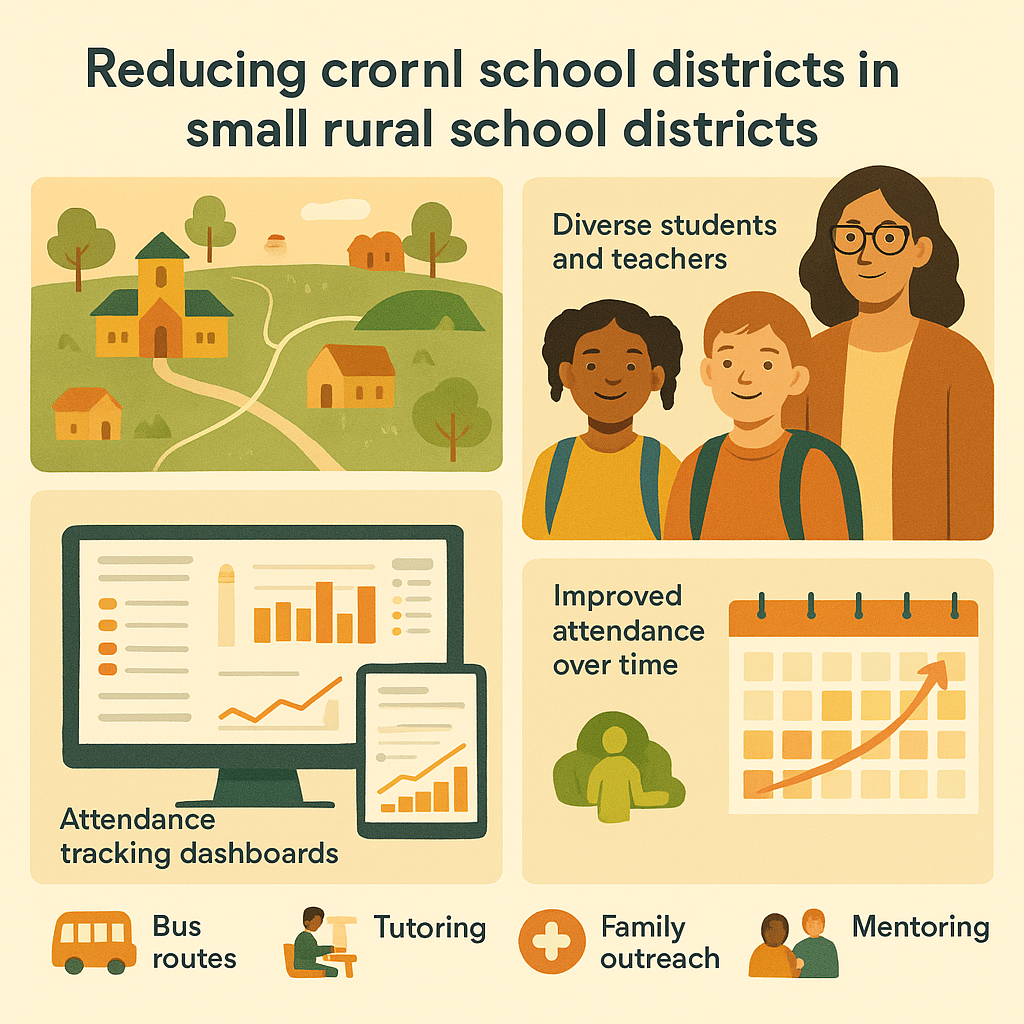
Schools usually describe chronic absenteeism as missing 10 percent or more of enrolled school days, whether the absences are excused or unexcused. In a 180-day school year, that threshold is about 18 days. It is a measure of how much instruction a student misses, not a diagnosis of why they miss it. The U.S. Department of Education’s chronic absenteeism resource explains why schools and communities treat the problem as an important educational concern.
That distinction is easy to lose. Attendance offices count days; educators need to understand patterns. Ten absences scattered across a year may signal something different from a student missing every Monday, regularly arriving late after a long bus transfer, or disappearing for two weeks during seasonal work. The data can flag a concern, but it cannot interpret it on its own. A useful response joins attendance data, student voice, caregiver knowledge, and staff observations.
The headline says a new study finds small and rural districts leading the fight against absenteeism. That is a promising claim, not enough information to establish a general rule. Without the study’s title, location, comparison group, definition of “leading,” and methods, readers cannot tell whether it reports lower chronic absenteeism, faster improvement, or strong local practices. Nor can they know whether district size or rural location caused the result. Frankly, that is a reason to ask for the source, not a reason to dismiss the possibility.
Rural schools are not interchangeable. Some serve close-knit towns; others cover wide territories, rely on long bus routes, and have few nearby health or social services. A small enrollment may make it easier for adults to notice a change in a student’s routine, while lean staffing can leave no one with time to follow up. Pedagogy and curriculum matter here because attendance is the doorway to instruction, but students also need meaningful lessons, a sense of belonging, and appropriate help once they arrive. The aim is not perfect compliance. It is reliable access to learning and a school response that treats students as people, not warning lights.
Why Strong Attendance Work Matters
Students cannot learn lessons they repeatedly miss. That sounds obvious, but the practical implications are less tidy: lost instruction can weaken foundational skills, disrupt friendships, make it harder to complete work, and leave a student feeling increasingly out of step with classmates. The Attendance Works overview of chronic absence describes chronic absence as a signal that a student is missing opportunities to learn and may need support. It is a warning indicator, not a verdict on a child or family.
Attendance work also helps districts see where their systems are failing. If absences cluster around a particular route, school transition, season, or grade, the pattern may point to a fixable barrier. When several students are missing school for similar reasons, the answer may involve transport, health access, communication, school climate, or scheduling—not a string of individual reprimands. The kicker is that aggregate data can expose a problem adults have normalized because each case looked isolated.
Small rural districts may have a few practical strengths. Staff may know caregivers by name, students may encounter the same adults in classrooms and community settings, and school leaders may be able to convene local partners without layers of approval. Relationships can make an early check-in feel human rather than bureaucratic. But proximity is not magic. In a small community, privacy concerns may be sharper, and a student can feel watched rather than supported if adults discuss personal circumstances casually.
Good attendance practice therefore serves two goals at once: improve access to instruction and preserve dignity. The second is not optional decoration. Education is more than seat time; it forms habits of thought, responsibility, and care for others. A student’s worth does not rise or fall with a percentage. A school can hold a clear expectation that learning matters while also asking what keeps a particular student from participating.
What should districts watch? More than the overall rate. Review chronic absence by grade, disability status, student group, route, and time of year, while protecting privacy and avoiding labels. Monitor whether students feel connected and whether they can catch up after an absence. Learning outcomes and attendance inform one another, but neither replaces the other. If students attend and still cannot access instruction, the school has more work to do.
A Practical Guide for Improving Attendance

There is no single attendance program that fits every district. Start with a small set of routines that make the problem visible, make outreach useful, and make follow-through possible. When I assess what works in practice, I favor a process staff can repeat in October as reliably as they can in August. A heroic campaign that collapses after the first month is not a strategy.
- Agree on what the district measures. Define attendance, chronic absence, partial days, and the time period used in reports. Make sure staff know the difference between an absence count and an explanation for those absences. Check that the student information system records days consistently, including transfers and schedule changes. A messy denominator can create confident but misleading conclusions. Share a short, plain-language description with families so they know what the school is counting and why.
- Find patterns early, without turning data into a label. Review attendance regularly—weekly is often more useful for intervention than waiting for a report card—and look for emerging patterns before a student crosses the 10 percent threshold. Use an early-warning flag as a prompt for conversation, not as proof that a family is careless. A simple list of students with rising absences, a named staff contact, and a follow-up date can be more useful than an elaborate dashboard nobody checks. Protect access to sensitive information; small-town familiarity is no substitute for confidentiality.
- Ask the student and caregiver what is getting in the way. Contact families in the language and channel they can use: phone, text, email, or a conversation at school. Open with concern and curiosity. “We’ve noticed Jordan has missed several mornings; is there something making it hard to get here?” is more likely to produce useful information than “You need to fix this.” Ask about illness, transport, anxiety, bullying, sleep, caregiving responsibilities, housing changes, and whether the student feels safe and welcome. Do not assume that an excuse code explains the whole story.
- Match help to the barrier. If the problem is an unreliable ride, explore route adjustments, a safe transport arrangement, or a partnership with a local provider. If health is the issue, connect the family with a school nurse, telehealth option, or community clinic where available. If a student is avoiding a class or peer group, investigate safety, relationships, and instructional fit rather than treating avoidance as defiance. When a student has missed key content, build a manageable catch-up plan; a pile of overdue assignments can make returning feel pointless. Rural districts may have fewer services close by, so a named liaison who coordinates referrals can save families from repeating their story to several offices.
- Make school a place students can re-enter. A student returning after absence should be greeted, oriented, and told what matters most to catch up on. Teachers can identify essential work instead of handing over every missed worksheet. Schools can use a trusted adult check-in, consistent routines, and engaging instruction to strengthen student engagement. This is not about bribing students to attend. It is about ensuring the school offers a meaningful, safe place to learn when they do arrive. Ask students directly what would make returning less stressful.
- Coordinate with community partners, with clear boundaries. Rural districts may work with libraries, health providers, youth organizations, tribal or county services, faith communities, and local employers. Partnerships can connect a family to support the school cannot provide alone. Set expectations first: who contacts whom, what information can be shared, how consent works, and who follows up. A community network is only helpful when it reduces the burden on families rather than creating a new maze of referrals.
- Check whether the response changed anything. Set a realistic review date and compare attendance patterns before and after support, while also checking whether the underlying barrier improved. A student who attends more often but feels unsafe has not received a complete solution. Track participation, belonging, and access to missed instruction alongside attendance. If an approach does not help, revise it; do not keep a failed intervention merely because the district has already printed the posters.
These steps need leadership, but they do not require a costly campaign to begin. A school can establish a weekly review, a warm first-contact script, a referral map, and a return-to-class routine with existing staff. Still, “use what you have” should not become a polite way of ignoring inadequate transport, staffing, or mental-health support. Data can show where resources are needed; it cannot manufacture them.
Comparison: Small Rural Districts and Large Urban Districts
There is no honest basis for claiming that small rural districts are always better at attendance than large urban districts. District size and geography shape the work, but neither guarantees results. The headline’s study may identify rural districts doing particularly well; without its methods and figures, the safest comparison is between common operating conditions, not between supposed winners and losers.
| Factor | Small or rural district | Large urban district |
|---|
| Staff knowledge | Staff may notice a student’s pattern quickly and know whom to contact. | Large teams may bring specialized expertise, but information can be spread across offices. |
| Transport | Long distances, limited routes, and few alternatives can make a missed ride a serious barrier. | Transit access may be broader, but transfers, cost, safety, and route reliability can still disrupt attendance. |
| Services | Community partners may be close-knit, but specialist services can be far away. | More providers may exist, though families can face waitlists, complex referrals, or fragmented services. |
| Privacy | Familiarity can build trust, but it can also make confidentiality harder to protect. | Larger systems may offer more formal privacy processes, while contact can feel impersonal. |
| Useful strength | A direct relationship can support quick, individualized follow-up. | Dedicated attendance teams and larger data systems can support specialized, coordinated intervention. |
| Common risk | Lean staffing and geography can leave barriers unresolved. | Scale and bureaucracy can slow communication or obscure individual needs. |
The comparison points to a practical lesson: borrow methods, not assumptions. A large district may learn from a rural school’s consistent personal outreach; a rural district may adapt specialist roles or data routines developed in a larger system. Either way, the measure is whether students gain better access to instruction, not whether the district resembles somebody else’s organizational chart.
Common Mistakes to Avoid
Treating every absence as defiance is the first mistake. A student may be ill, anxious, caring for a relative, or stuck without transport. Punitive responses can make families less willing to share what is happening, while leaving the actual barrier in place. Clear expectations matter, but a rule is not a diagnosis. Ask what changed before deciding what response is fair.
Waiting for a student to become chronically absent is another avoidable error. If a district only intervenes after the 10 percent threshold, it has turned an early-warning measure into a late alarm. Several small absences can build a pattern quickly. Respond proportionately: a brief, supportive check-in may be enough at first, while a persistent pattern calls for a more careful assessment and coordinated help.
Assuming one incentive will solve the problem is wishful thinking. Prizes, competitions, and perfect-attendance certificates may create short bursts of participation, but they can also reward students whose health and circumstances already make attendance easier. They may shame students who cannot control a barrier. Use recognition thoughtfully, and do not mistake a temporary bump for a durable change in access or belonging.
Overlooking the school’s own contribution is particularly tempting. Schools sometimes frame attendance as a family duty while ignoring bullying, an unwelcoming classroom, inaccessible instruction, or a schedule that clashes with local realities. Attendance data should trigger questions about the institution as well as the student. The CDC’s resource on school connectedness describes how feeling cared for and supported at school relates to student well-being. That does not mean every absence is caused by school climate, but it makes belonging worth checking rather than assuming.
Confusing more tracking with better support is a trap. A dashboard can flag risk, but it cannot ask a student what happened or arrange a ride. Collect only data that serves a clear purpose, limit access, and explain how it will be used. Avoid public rankings and simplistic labels. In a close community, even a well-intended attendance campaign can expose a student’s private circumstances.
Finally, do not announce that a strategy worked because attendance improved once. Compare similar periods, examine who benefited and who did not, and consider other changes that may have affected results. The truth is less tidy than a press release: improvement can coexist with gaps, and a good program can need repair. Schools owe families honest reporting, not victory laps.
Frequently Asked Questions
What counts as chronic absenteeism?
A commonly used U.S. definition is missing at least 10 percent of school days, for any reason. That is about 18 days in a 180-day school year. State and local reporting rules can vary, so check the definition used in a particular report. The measure describes missed learning time; it does not explain why a student was absent or establish fault.
Why might a small rural district improve attendance?
A small district may be able to spot a change in a student’s routine and contact a caregiver quickly. Staff may know which local partner can help with a specific barrier. Those are possible advantages, not guarantees. Long bus routes, limited staff, few nearby services, and privacy concerns can make the work harder. The useful question is which local conditions help or hinder a particular school.
What is the most effective way to reduce chronic absenteeism?
There is no single intervention that works for every student. Districts should define and review attendance measures, identify emerging patterns, ask families about barriers, and respond with support matched to the cause. For one student that might mean transport help; for another, health care, a trusted adult, a safety response, or a manageable plan to catch up. Check whether the support actually improved access and attendance.
Should schools punish students for missing school?
Schools need consistent expectations, but punishment alone does not resolve illness, transport problems, anxiety, or unsafe conditions. Begin by understanding the reason for absence and follow applicable law and district policy. Use supportive outreach and proportionate intervention, with stronger action only where appropriate and after the circumstances are understood. A student’s dignity and right to learn should remain central.
Final Thought
A district does not win the attendance struggle by making a chart turn green. It makes progress when fewer students are shut out of learning by solvable barriers, when families can ask for help without being treated as suspects, and when a missed week does not become a permanent break with school. That work takes attention to details—bus schedules, phone calls, classroom welcome, health referrals, and assignments a returning student can actually complete.
The headline’s claim about small, rural districts deserves attention, but it also deserves evidence. Readers should look for the study itself, ask how it defined success, and examine whether the comparison accounts for local conditions. A modest, well-described improvement can teach more than a sweeping claim with no numbers attached. Schools should share what helped, what failed, and which students still face barriers.
The deeper purpose is not attendance for its own sake. Regular participation gives students more chances to seek truth, build knowledge, practice responsibility, and contribute to the life around them. That formation requires both high expectations and compassion. Be clear that learning matters. Then do the unglamorous work of helping students reach it.