Electronic medical records can improve continuity and coordination, but installing software is not the same as completing a digital transition. A study in six...
Tanzania’s Electronic Medical Records: Why Going Digital Takes More Than Software
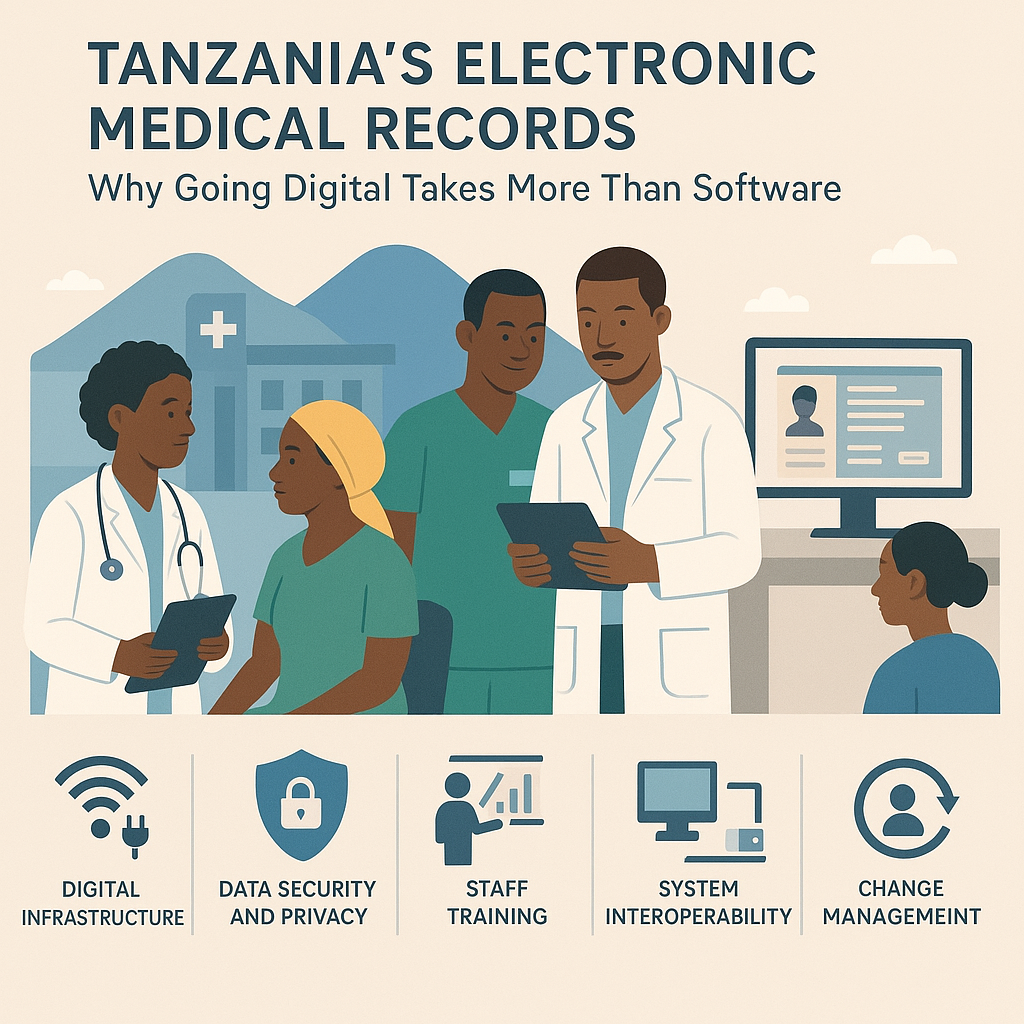
Electronic medical records can improve continuity and coordination, but installing software is not the same as completing a digital transition. A study in six health facilities in Iringa Urban and Manyoni districts found that unreliable power, networks, hardware, system failures, organisational limits, and short training leave Tanzanian health workers managing paper and electronic records side by side.
The study, published in the Records Management Journal, examined the Government of Tanzania Hospital Management Information System (GoT-HoMIS) in six health facilities. Researchers from Muhimbili University of Health and Allied Sciences and the University of Dodoma collected evidence from 41 healthcare professionals in Iringa Urban and Manyoni districts. They considered practical issues such as access to computers, electricity, and internet connections, alongside the barriers workers face and the country’s digital health policies.
That scope matters. The findings offer a close look at specific facilities, not a national estimate of every hospital’s readiness. Still, the problems they describe are familiar to any organisation that has tried to replace a paper process while the old process remains in use. A login screen is not a finished workflow. And a paper form does not vanish simply because a ministry or hospital has adopted software.
What Does a Digital Medical Records Transition Actually Mean?
An electronic medical record (EMR) is a digital system for recording and using patient information within a health service. It can support the capture and retrieval of clinical information, but the exact functions depend on the system and how a facility configures it. The important distinction is between having an electronic system and carrying out routine work through a dependable digital process.
A facility may have GoT-HoMIS available and still rely on paper for some or all steps. Staff might enter information electronically, then write it again in a register because a procedure requires a physical record, because the system is unavailable, or because workers do not trust it to remain accessible. In that case, the facility has introduced an electronic tool without fully replacing the paper workflow.
The Tanzanian study makes that distinction plain. Researchers assessed use of GoT-HoMIS alongside access to computers, power, and internet, rather than treating software installation as proof of successful adoption. They found that infrastructure failures, system problems, organisational constraints, and gaps in staff capacity were all part of the transition challenge. More than half of reported challenges were technical; organisational constraints accounted for around a third, while staff capacity gaps were also common.
Those figures describe reported challenges in the facilities studied. They should not be read as percentages of all Tanzanian health workers or all health facilities. The sample comprised 41 professionals at six facilities in two districts, useful for understanding local experience but too narrow to stand in for the entire country. I read the study as evidence about implementation conditions, not a verdict that digital records cannot work.
A successful transition therefore means more than logging in. It means staff can use the system for the tasks required of them, relevant information can be accessed when needed, and a sensible backup procedure exists for interruptions. It also means workers know which record is authoritative, who can see it, and how to correct an error. That is a workflow question as much as a technology question.
Why Does the Transition Matter?
The case for electronic records is not that computers are automatically superior to paper. The case is that well-designed digital systems may help health workers record, retrieve, and coordinate information more reliably. If a system works as intended, teams can spend less time searching through folders or copying the same details between documents. That is the promise. It is not a result to assume before measuring.
Continuity of care is one reason records matter. When a patient’s information is available to the appropriate care team, staff may have a clearer view of previous encounters and documented decisions. But availability depends on reliable equipment, access controls, accurate entries, and a process that people actually follow. A computer in a locked room, a dropped connection, or an incomplete record can defeat the purpose.
Data quality is another. Re-entering information creates more opportunities for missing fields, inconsistent dates, transcription errors, or mismatched versions. Joseph Makaranga, lead author and a lecturer in the Department of Information Systems and Technology at the University of Dodoma, warned that keeping paper and electronic records in parallel adds to staff workload and may affect the quality of health data. The concern is practical: duplicated effort uses time, and competing records can leave staff unsure which one to trust.
There is a necessary qualification. Paper may still be needed when an electronic system is unavailable or when established procedures require physical documentation. A backup is not inherently wasteful. Uncontrolled duplication is the problem. Facilities need a clear rule for when paper is used, who later enters or reconciles that information, and how staff prevent two versions from quietly diverging.
Staff time and confidence count too. Short training may show a worker how to use today’s version of a system, but Makaranga says upgrades require renewed skills and new employees also need instruction. Without continuing support, a software change can turn familiar tasks into guesswork. That is not a personal failure by the worker; it is a predictable weakness in how training is planned.
The World Health Organization’s global digital health strategy places digital systems within health-service planning, including the people and structures needed to use them. The WHO guidance on digital interventions also stresses that their suitability depends on context, resources, and how a service is organised. These principles fit the Tanzanian findings: purchasing software is one decision, while sustaining its use is a broader institutional responsibility.
And there is a human reason to get the details right. A medical record represents a person receiving care, not merely a data field. Good digital practice should protect confidentiality and support sound clinical judgment; training should form responsible habits alongside technical competence. Fancy dashboards cannot substitute for that.
A Practical Step-by-Step Guide to a Safer Transition
No facility can fix every constraint with a training session. A workable plan starts with the actual tasks staff perform, then matches the system, training, support, and backup procedures to those tasks. Here is a sequence grounded in the problems identified by the study and in cautious implementation practice.
- Map the current workflow before removing anything. List the steps involved in registering a patient, recording information, retrieving it, and completing required documentation. Include the handoffs between staff roles and the points where a paper record is created or copied. Ask workers what happens when the network drops or a computer is unavailable. A process map often shows that the same information is being entered more than once, but do not assume every paper document is redundant; some may be required or may serve as a documented contingency.
- Check the basics at the point of care. Count functional computers, not just devices on an inventory. Check whether electricity is dependable where staff need to use the system, and test network access at different times of day. Record how failures are reported, who responds, and how long workarounds remain in place. If the equipment is shared or poorly located, staff may be forced to wait or return to paper even when the system itself is functioning. A transition plan should assign responsibility for repair, replacement, connectivity, and routine maintenance.
- Build digital health into professional education. Makaranga called for health-training curricula to include digital health. That need is broader than teaching someone where to click. Training should cover the purpose of the system, accurate data entry, privacy, safe access, error correction, and procedures for outages. Students should practise common tasks before facing real workload pressures. Curriculum designers should review content when systems change, rather than treating a single course or orientation session as a permanent solution.
- Make staff development continuous and role-specific. A nurse, records officer, clinician, and technical support worker may use different parts of a system and encounter different problems. Give each role training tied to its daily tasks, then provide refreshers after upgrades. New employees need a clear onboarding path, not a folder of old notes and an expectation that colleagues will teach them in the middle of a busy shift. Short sessions can help, but they need reinforcement, practice, and someone to answer questions when the real case does not match the training example.
- Set an explicit rule for paper use and reconciliation. If paper is needed during an outage or for a required procedure, say so plainly. Identify where the paper record is kept, who enters or reconciles information later, and how completion is checked. Tell staff which record is authoritative in each circumstance. Without these rules, an emergency workaround can become a second permanent system. The goal is not to shame people for using paper when the digital service fails; it is to prevent undocumented duplication and missing follow-up.
- Provide visible institutional and technical support. Someone must own the practical work: troubleshooting, permissions, user accounts, repairs, staff questions, and communication about system changes. Facilities should know whom to contact and what information to provide when reporting a fault. Managers also need to listen to recurring complaints rather than treating them as resistance. When several workers report the same failure, that may point to a system or process problem, not a dozen individual mistakes.
- Set milestones, then measure whether they hold. Makaranga argued for a firm deadline to complete the transition and phase out paper records across health facilities. A deadline can focus attention, but it should not become an excuse to declare success while power, hardware, training, or support remain inadequate. Pair any target date with readiness checks and staged milestones. Track practical measures such as system availability, unresolved faults, training completion by role, duplicate-entry requirements, and data-quality checks. Review the results with frontline staff, then adjust the plan.
This sequence is deliberately ordinary. There is no secret software setting that makes a weak process dependable. When I analyze the study’s reported barriers, the most useful question is not “How do we persuade staff to use the system?” It is “Can staff complete the work accurately, with the tools and support they actually have?” That question puts responsibility where it belongs: across the institution, not on the individual worker alone.
Comparison: Fully Digital Workflows, Hybrid Records, and Paper-Based Work
The comparison below describes common operational trade-offs; it is not a measured scorecard from the six facilities in the study. Real outcomes depend on system design, staffing, infrastructure, procedures, and the kind of care being delivered. A digital workflow is not automatically better simply because its records are electronic. It has to work under ordinary conditions and have a safe response for extraordinary ones.
| Dimension | Fully digital workflow | Hybrid paper-and-electronic workflow | Mostly paper workflow |
|---|
| Routine record keeping | Information is entered and retrieved through the electronic system for defined tasks. | Staff may enter the same information in both formats or switch between them. | Information is recorded and retrieved mainly through physical documents. |
| Main operational need | Reliable power, functioning devices, usable connectivity, trained staff, and support. | All digital requirements, plus clear rules for paper use and later reconciliation. | Secure storage, document handling, and reliable access to physical files. |
| Potential benefit | Less routine copying and quicker electronic retrieval when the system is available. | A fallback may remain available during an outage or where procedures call for paper. | Staff can continue without a functioning electronic system, where paper processes are established. |
| Common risk | A failure can interrupt work if there is no tested contingency plan. | Duplication increases workload and may produce inconsistent or incomplete records. | Retrieval and coordination can be slower when documents are dispersed or difficult to access. |
| Transition question | Can staff complete required work accurately and reliably in the system? | Which record is authoritative, and who reconciles the two? | What is the realistic path to improve access, accuracy, and coordination? |
The hybrid column is the uncomfortable one. It can be a sensible bridge while a system is being made dependable, but it can also become a permanent arrangement that asks workers to do twice the recording. The difference is whether the facility treats paper use as a defined contingency or lets it continue by habit because nobody has fixed the underlying barrier.
A paper-only process is not an ideal answer to unreliable infrastructure, either. It may keep some work moving, but it does not solve the longer-term questions of access, coordination, or data quality. The point is not to declare one format virtuous and the other backward. It is to select a process that matches available capacity while steadily addressing the weaknesses that prevent safer, more consistent records.
Common Mistakes to Avoid
Mistake 1: Treating installation as adoption. A system can be installed, accounts can be issued, and reports can be generated while staff still depend on paper for everyday work. Those are different milestones. Managers should ask whether the essential workflow is being completed in the system and why workers still need the old forms. A launch announcement is not evidence that the transition is finished.
Mistake 2: Offering one short training course and calling the workforce trained. This is exactly the weakness Makaranga describes: training is short-term, systems are upgraded, and new employees arrive. Training has a shelf life when software changes. Make it recurrent, practical, and available to new staff, with a way to check whether people can carry out tasks correctly. Attendance alone does not show competence.
Mistake 3: Blaming workers for infrastructure failures. It is easy to label staff reluctant when a system is slow, unavailable, or difficult to access. That explanation is convenient—and often lazy. The study found that technical problems accounted for more than half of reported challenges, including unstable connectivity, power outages, inadequate hardware, and system failures. Those conditions need operational fixes, not another motivational speech.
Mistake 4: Banning paper before the fallback is ready. A target for phasing out paper may help keep a transition on schedule, but an abrupt ban can leave staff without a safe way to document care during outages or meet established procedures. Define limited fallback rules, test them, and make sure information is reconciled when service returns. Keep the contingency narrow and documented; otherwise, it simply becomes a second workflow.
Mistake 5: Measuring logins instead of useful work. A login count tells a manager that someone opened a system. It does not show whether information was complete, accurate, retrievable, or entered without unnecessary repetition. Measure system availability, common task completion, unresolved problems, data-quality checks, and the extent of duplicate entry. Use the results to find barriers, not merely to rank staff.
Mistake 6: Assuming findings from six facilities represent the whole country. The study gives context-specific evidence from 41 healthcare professionals in Iringa Urban and Manyoni districts. That is useful, but it is not a national census. Other facilities may have different resources, workflows, staffing, or support. Policymakers can use these findings to ask better questions, then gather evidence across varied settings before applying a one-size-fits-all solution.
Mistake 7: Treating curriculum as a one-time fix. Adding a digital health module to a course is worthwhile, but it cannot replace ongoing professional development, user support, or system maintenance. Students need sound foundations; practising staff need refreshers when tools and procedures change. The lesson is not “train harder and infrastructure will take care of itself.” Both parts matter, and neither excuses neglect of the other.
Frequently Asked Questions
Why are Tanzanian health facilities keeping paper and electronic records at the same time?
The study identified unreliable network connectivity, power outages, inadequate hardware, system failures, organisational constraints, and staff capacity gaps. Paper may also remain necessary when electronic services are unavailable or established procedures require physical documentation. The study does not identify one cause for every facility; the mix of barriers can differ by site and task.
What did the Tanzanian study examine?
Researchers from MUHAS and the University of Dodoma examined GoT-HoMIS use among 41 healthcare professionals in six facilities in Iringa Urban and Manyoni districts. They considered access to computers, electricity, and internet connections, as well as practical challenges and digital health policies. The findings describe those study settings; they do not establish a national rate of readiness or system failure.
What training helps health workers use electronic medical records?
Training should match workers’ roles and real tasks, cover accurate record keeping and privacy, and explain what to do when the system is unavailable. It also needs to continue after initial orientation, because upgrades require updated skills and new employees need onboarding. Health-training institutions can teach digital health foundations, while employers provide practical refreshers and support.
Should hospitals eliminate paper records completely?
Not until the electronic workflow is dependable and any required documentation and outage procedures are addressed. Paper can serve as a controlled fallback, but uncontrolled parallel entry increases workload and may weaken data quality. Facilities need clear rules about when paper is used, how information is reconciled, and which record is authoritative. A deadline is useful only if readiness is real.
Final Thought
The Tanzanian study describes a problem that is easy to misdiagnose. When workers keep paper records after an electronic system arrives, the instinct may be to blame resistance or to assume that one more training session will solve the issue. But a system that cannot be reached reliably, equipment that does not work, unclear procedures, and training that expires after an upgrade are not minor inconveniences. They shape whether staff can do the job the system was meant to support.
Makaranga’s call for better training, stronger infrastructure, and institutional support points to a broader lesson: a digital transition is a change in everyday practice, not a purchase order. Curriculum development matters because health workers need skills that last beyond a single software version. Technical support matters because skills alone cannot restore a broken network. Management matters because staff need clear instructions for ordinary work and outages alike.
A firm transition deadline may help focus attention, as the study’s lead author argues. It should be paired with checks that show whether facilities can maintain accurate records without forcing staff into hidden double work. Frankly, counting computers or announcing a paperless target is the easy part. The harder test is whether a health worker can record, find, and trust the information needed to care for a patient on a busy day.
Education in health care should form sound judgment as well as technical skill, because good record keeping serves truth and the dignity of the person receiving care. Digital tools are valuable when they support that work. The patient—not the software, the paper form, or the target date—must remain the reason for getting the transition right.