Teaching methodologies are the methods teachers use to help students learn, while curriculum development is the design of what gets taught, when, and why...
Teaching methodologies are the methods teachers use to help students learn, while curriculum development is the design of what gets taught, when, and why. Learning optimization is the practical business of making those methods and that curriculum stick, so students gain real knowledge, not just a pile of activity sheets and cheerful slogans.
Key Takeaways:- Strong teaching starts with clear learning outcomes, not trendy add-ons.
- Curriculum should align content, assessment, and student work.
- Learning optimization depends on feedback, retrieval, spacing, and practice.
- AI tools can help, but only when they prove value with evidence.
- Character and intellect both matter; education should form the whole person.
What is Teaching Methodology, Curriculum Development, and Learning Optimization?
Teaching methodology is the set of approaches used to explain, model, question, and practice knowledge. Curriculum development is the process of deciding what knowledge, skills, and habits matter enough to be taught in a sequence that makes sense. Learning optimization is the part everyone likes to talk about and few people do well: reducing wasted effort, making practice matter, and using assessment to improve instruction rather than merely sort students.
Frankly, most education buzzwords are decoration. A method is not good because it sounds modern, and a curriculum is not strong because it contains a few glossy projects and an AI widget with a bright logo. I have analyzed enough programs to know the usual pattern: schools buy tools first, then search for evidence later. That is backward. Prove the thing works first.
Good pedagogy rests on truth, order, and attention to the learner. Not every child learns the same way, despite what the old “learning styles” industry tried to sell. The better question is simpler: What helps this student understand, remember, and use the material? That question leads to clear instruction, purposeful review, and assessment aligned with the outcome.
A strong curriculum also does more than list topics. It expresses a view of human flourishing. If you believe, as much of the classical tradition does, that education should shape both mind and character, then curriculum is never just a spreadsheet of standards. It is a moral document, quietly forming what students will notice, value, and become.
For a practical look at evidence-based classroom planning, see WWC practice guides, and for deeper reading on curriculum structure, review curriculum development guidance. If you want a broader frame on how instruction and assessment fit together, this overview from ASCD on backward design is useful.
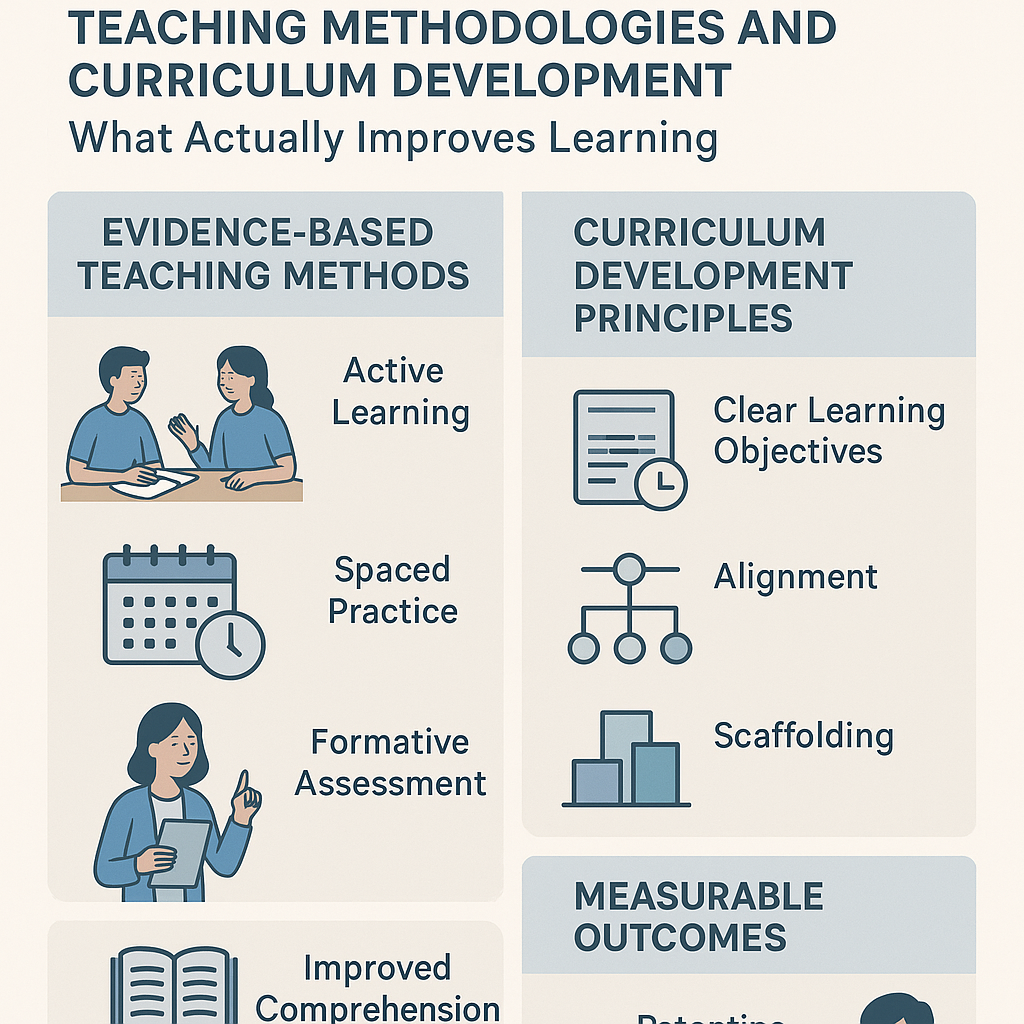
Core Benefits and Why It Matters
Strong teaching methods and careful curriculum work improve learning in ways that are plain to see and hard to fake. Here is the kicker: many schools praise innovation while quietly tolerating weak results. That habit wastes time, money, and student attention.
- Better retention: Students remember more when instruction includes retrieval practice, spaced review, and meaningful feedback.
- Cleaner alignment: When standards, lessons, and assessments match, teachers stop guessing and students stop playing test-day roulette.
- Less wasted effort: Clear sequencing prevents the same topic from being taught three times badly.
- Higher student engagement: Engagement is not noise, novelty, or gadget use. It is attention directed toward meaningful work.
- Stronger equity: A coherent curriculum gives every student access to essential knowledge, not just the ones who already know how school works.
- Smarter use of AI: AI can speed drafting, practice generation, and data analysis, but it should never replace judgment, content expertise, or human care.
Let's be real. The loudest claim in edtech is usually not the best claim. When I look at successful schools, I see disciplined teachers, clear routines, and a curriculum that respects cognitive load. I do not see magic. I see craft.
This matters because education should serve both competence and character. A school that graduates clever but careless students has failed in a deeper way than its test scores admit. Knowledge without wisdom is a thin meal.
For practical methods that actually improve study habits, you may also want APA guidance on learning and teaching and retrieval practice research.
Step-by-Step Implementation Guide
Start with the outcome.
When I analyze strong classrooms, they begin with a concrete target, then build backward from it, because vague goals produce vague lessons, and vague lessons produce bored students who memorize nothing.
- Define learning outcomes precisely. Say what students should know, do, and explain by the end. If you cannot state the target plainly, you do not have one.
- Map prerequisite knowledge. Find the facts and concepts students need before the main lesson. Skipping prerequisites is how confusion gets introduced with a smile.
- Select a teaching method that fits the content. Direct instruction works well for new material and complex procedures, while discussion, inquiry, and projects fit better once students have enough knowledge to think clearly.
- Plan checks for understanding. Use quick quizzes, oral questioning, exit tickets, worked examples, and error analysis. Do not confuse student participation with student comprehension.
- Build retrieval and spacing into the curriculum. Review over time, not once. Memory is stubborn, and it does not respect wishful thinking.
- Use assessment as feedback. Good assessment tells teachers what to reteach and students what to practice next. Bad assessment is just paperwork with a number on it.
- Add AI only where it serves the plan. AI can draft questions, sort data, and generate practice sets, but a human must review everything for accuracy, tone, and fit.
- Revise from evidence, not fashion. If students still miss the same concept, change the lesson. If the tool looks fancy but does not move results, cut it loose.
I have taught enough to know the ugly truth: many classrooms confuse activity with learning. A lively debate can still fail if students have no facts, no vocabulary, and no frame for judgment. Give them the scaffold first. Then let them climb.
For structured planning models, see Bloom’s taxonomy guide and backward design examples.

Comparison Table
Here is the comparison that gets glossed over.
Most schools claim they are choosing between evidence-based teaching and AI-first edtech hype, but the real choice is between instruction that improves learning and software that flatters administrators.
| Factor | Evidence-Based Teaching and Curriculum | AI-First EdTech Hype |
|---|
| Primary goal | Improve learning outcomes through proven methods | Sell features and speed adoption |
| Role of teacher | Professional judgment, modeling, feedback, adaptation | Reduced to a supervisor of software |
| Role of assessment | Diagnose gaps and guide instruction | Produce dashboards and activity logs |
| Curriculum quality | Sequenced, coherent, aligned | Fragmented, tool-driven, inconsistent |
| Student engagement | Attention, practice, discussion, recall | Clicking, prompting, and novelty |
| Evidence standard | Research, classroom results, refinement | Marketing claims and demos |
| Risk | Slower adoption, more planning | Shallow learning, wasted budgets |
The pattern is obvious.
AI can support learning, but only after a school proves the tool helps with a real task, under real conditions, with real students. Otherwise, it is just expensive noise. That applies to phonics software, math tutors, writing tools, and every shiny dashboard that promises salvation before lunch.
Common Mistakes to Avoid
The worst advice sounds polished.
- Chasing novelty: New does not mean better. Sometimes it just means untested.
- Ignoring alignment: If instruction and assessment do not match, students get mixed signals and teachers get fake data.
- Overusing AI: Tools that draft, summarize, or score can save time, but they also spread errors quickly if no human checks them.
- Confusing engagement with learning: Laughter is not evidence. So is clicking.
- Skipping practice: Students need repetition, recall, and correction. A single exposure is not mastery.
- Treating curriculum as paperwork: Curriculum should guide teaching, not sit in a binder like a fossil.
Most so-called best practices fail because they are copied without thought. A method that worked in one setting may fail in another if teachers ignore subject matter, age, prior knowledge, and classroom culture. Context matters. That is not a slogan. It is reality.
The other mistake is moral sloppiness. If a school treats students as data points, it will eventually treat teachers the same way. That path leads to cold classrooms and shallow results. Education must remain personal, because persons are not products.
Frequently Asked Questions
What teaching method works best?
The best method depends on the content, the learner’s prior knowledge, and the goal. Direct instruction works well for new material, while discussion and projects can deepen understanding after students have enough background.
How do you develop a strong curriculum?
Start with learning outcomes, sequence content from simple to complex, align assessments to those outcomes, and review the plan using classroom evidence.
Does AI improve learning?
Sometimes, but only when it supports a clear instructional purpose, is accurate, and is tested against real student results. AI is a tool, not a guarantee.
How do you know if students are really learning?
Use checks for understanding, retrieval practice, cumulative review, and assessments that require students to explain, apply, or produce something.
Final Thought
The schools that improve learning do not worship novelty. They respect truth. They make room for expertise, patient practice, careful sequencing, and honest assessment, because students deserve more than a parade of gadgets and slogans. They deserve instruction that forms the mind and character together. That is old-fashioned, perhaps, but it is also the only thing that consistently works.
When I examine programs that last, I find the same pattern every time: adults who know the subject, a curriculum built with care, assessment that tells the truth, and enough humility to correct mistakes. That is not flashy. Good. Flash is cheap. Formation is harder, and worth it.
AI may help in the margins, especially for drafting, practice generation, or data sorting, but schools should stop pretending that a tool becomes wisdom because it comes with a dashboard. The real task is to teach well, to build knowledge that sticks, and to help students grow into adults who can think clearly, act justly, and serve others with competence and conscience. That is the point.