Teaching methodologies, curriculum development, and learning optimization are the practical backbone of good schooling. They are not slogans. They are the...
Teaching Methodologies, Curriculum Development, and Learning Optimization: What Actually Works in the Classroom
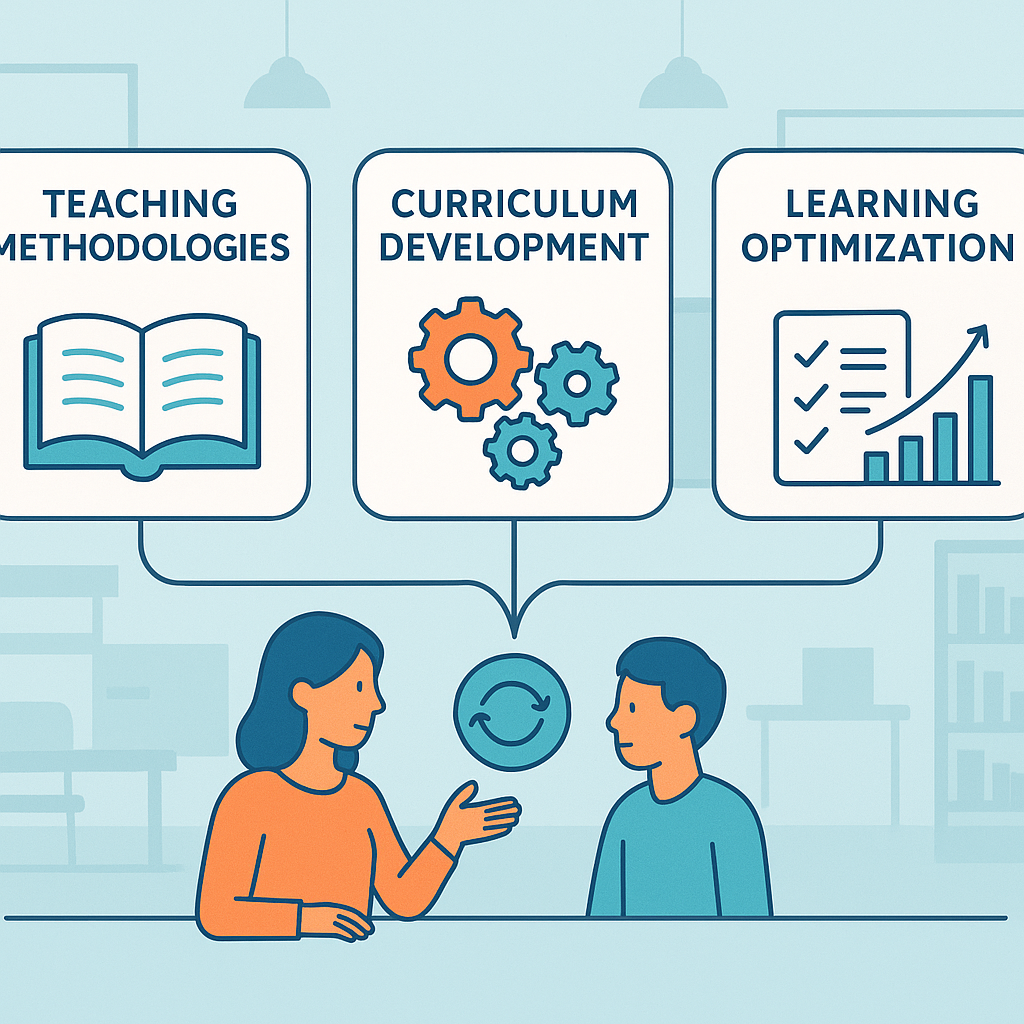
Teaching methodologies, curriculum development, and learning optimization are the practical backbone of good schooling. They are not slogans. They are the choices teachers make, the sequence of ideas students meet, and the methods that help knowledge stick, transfer, and mature into judgment. Most of the noise around education sells novelty. The real work is quieter: clear explanation, careful sequencing, useful practice, honest assessment, and human attention to the student in front of you.
Key Takeaways
- Teaching methodology is the method a teacher uses to help students learn; curriculum development is the plan for what will be taught and when; learning optimization is the set of practices that make learning stick.
- Strong teaching blends pedagogy, assessment, feedback, and student engagement into one coherent system.
- The best curriculum is not the thickest one. It is the clearest one.
- A lot of popular education advice is fashionable nonsense. Research favors explicit instruction, spaced practice, retrieval practice, and well-designed feedback.
- Education should form the whole person: intellect, character, and judgment, not just test scores.
What is Teaching Methodologies, Curriculum Development, and Learning Optimization?
Teaching methodologies are the strategies and structures a teacher uses to help students reach learning outcomes. Curriculum development is the process of deciding what knowledge, skills, and habits matter, how they are sequenced, and how they will be assessed. Learning optimization is the practical side of making instruction more efficient and more durable, so students remember, apply, and extend what they learn.
That sounds tidy. It rarely is.
When I analyzed classroom practice, the biggest error was assuming method and content are the same thing. They are not. A lecture can be excellent or useless. Group work can be brilliant or a time sink. Project-based learning can produce real mastery, or a glossy mess. The method matters, but only when it serves the curriculum and the student’s actual cognitive load.
Here’s the kicker: most classrooms do not fail because teachers do not care. They fail because good intentions outrun structure. Students need order, repeated exposure, and correction. That is not cold. It is humane. A child deserves truth, clarity, and well-paced challenge, because learning is not performance art. It is formation.
The strongest approach usually combines direct instruction, guided practice, independent practice, formative assessment, and feedback. This is not flashy. It works because the brain learns by connection, repetition, retrieval, and correction. For background on how evidence supports these methods, see Edutopia’s overview of research-backed strategies, Visible Learning’s evidence summaries, and the Education Endowment Foundation’s Teaching and Learning Toolkit.
Curriculum development adds the next layer. It asks what should students learn first, what must come before harder ideas, and how each unit connects to later knowledge. A good curriculum is not a pile of topics. It is a map of dependency. Miss the sequence, and students may appear busy while learning very little.
Learning optimization is the discipline of reducing waste. That means cutting vague tasks, lowering extraneous cognitive load, making instructions plain, using retrieval practice, spacing study over time, and checking for understanding before moving on. Frankly, a lot of “engaging” teaching is just expensive confusion.
The topic matters because classrooms are crowded with competing promises. Artificial intelligence, digital platforms, flipped lessons, and flashy apps all claim to improve learning. Some help. Some are just shiny boxes. The enduring question is simple: does the approach improve understanding, retention, transfer, and moral formation? If not, it is decoration.
Core Benefits and Importance
Strong teaching methods and curriculum design do more than raise scores. They shape whether students become thoughtful, capable, and truthful people.
- Better retention: Retrieval practice, spacing, and feedback help knowledge stay put.
- Clearer understanding: Explicit instruction reduces guesswork and keeps misconceptions from hardening.
- Stronger equity: Well-sequenced curricula help students who do not have extra tutoring at home.
- Less teacher chaos: Good methods reduce wasted time and classroom friction.
- More honest assessment: If the curriculum and assessment align, teachers can tell what students actually know.
- Higher transfer: Students can apply ideas in new settings when they learned them in connected, deliberate steps.
- Character formation: Real education trains attention, patience, and intellectual humility, not just answer-filling.
Let’s be real. Some critics say explicit teaching stifles creativity. That is only half a thought. Students are not creative in a vacuum. They need vocabulary, models, and examples before invention becomes meaningful. A child cannot improvise a sonnet before learning what a sonnet is.
The same logic applies to curriculum. A sloppy curriculum leaves gaps that widen over time. A coherent one reduces those gaps. It also supports teachers, because they are not reinventing the wheel every Monday morning.
Student engagement is important, but not in the shallow sense. Engagement is not entertainment. A class can be noisy and still hollow. True engagement means students are thinking, writing, retrieving, discussing, and revising. You can hear the difference.
There is also a moral reason to care. Every student bears dignity. That means we owe them more than convenience or trendy experiments. We owe them well-chosen content, honest feedback, and a path toward wisdom. Knowledge without character is thin. Character without knowledge is unstable. Education should do both.
For deeper reading on curriculum coherence and evidence-based teaching, consider American Educator’s piece on how learning works and What Works Clearinghouse, which reviews interventions with a harder eye than most conference speakers.

Step-by-Step Implementation Guide
If you want better teaching, stop chasing everything at once. Build the system in order.
- Define the learning outcomes clearly
Start with what students should know, do, and value by the end of a unit. Write outcomes in plain language. If you cannot explain the target, you cannot hit it.
- Map prerequisite knowledge
Break each standard into subskills and prior knowledge. I have seen too many lessons collapse because the teacher assumed students already knew terms they had never met.
- Sequence the curriculum from simple to complex
Put foundational ideas first. Then revisit them at increasing levels of complexity. This is not bureaucratic fussiness. It is how memory and understanding usually work.
- Choose the teaching method that fits the content
Use explicit instruction for new or complex material. Use discussion when students already have something to discuss. Use collaborative work when the task truly benefits from it. Do not force “inquiry” onto everything like a bad haircut.
- Plan for practice, not just presentation
Students need worked examples, guided practice, independent practice, and review. I have taught for decades, and the pattern holds: if you skip practice, you get polite confusion.
- Build in formative assessment
Check understanding often with short questions, quick writes, exit tickets, or low-stakes quizzes. The point is not to catch students out. The point is to see whether the lesson landed.
- Use feedback that says something useful
“Good job” is not feedback. Tell students what was correct, what was missing, and what to do next. Precision matters.
- Space review over time
Return to ideas after a delay. Revisit older material in new contexts. Memory strengthens when students have to pull knowledge back up, not when they merely stare at notes.
- Reduce cognitive clutter
Remove extra text, too many directions, and unrelated visuals. The mind is not an infinite bucket. It has limits.
- Adjust based on evidence
Look at assessment results, class responses, and student work. Revise the plan. If it is not working, change it. Pride is not a teaching strategy.
For teachers exploring digital support, a careful review of learning management systems can help, but the software is secondary. The teaching decision comes first.
Comparison Table
| Aspect | Teaching Methodologies, Curriculum Development, and Learning Optimization | Main Competitor: Ad Hoc Teaching |
|---|
| Planning | Coherent, sequenced, outcome-based | Improvised day to day |
| Student learning | Builds retention and transfer | Often produces shallow recall |
| Assessment | Aligned with learning outcomes | Scattered, inconsistent |
| Teacher workload | Front-loaded planning, less chaos later | Constant reinvention and stress |
| Equity | Clearer support for diverse learners | Benefits students with outside help |
| Feedback | Regular, specific, actionable | Vague or delayed |
| Classroom culture | Predictable, purposeful, calm | Reactive, uneven, noisy |
| Long-term result | Durable knowledge and better judgment | Fragments of information |
Common Mistakes to Avoid
Most bad advice in education sounds noble.
- Mistaking activity for learning: A busy classroom is not proof of understanding. Students can cut, paste, debate, color, and still learn almost nothing.
- Treating “learning styles” as doctrine: People like the idea, but the evidence does not support teaching to fixed visual/auditory/kinesthetic types as a general rule.
- Overusing group work: Collaboration has a place. So does quiet, independent thought. If students cannot think alone, group work becomes social loafing with markers.
- Skipping curriculum coherence: Random units create random results. Students need a logical order.
- Giving weak feedback: Comments should change behavior. If they do not, they are just ink.
- Using tech because it is new: New does not mean useful. Sometimes it means expensive.
- Overloading students: Too many tasks, too many slides, too many apps, and too many goals lead to confusion.
I am skeptical of anything that promises fast transformation with minimal effort. Good teaching is patient work. It asks for judgment, repetition, and restraint. That is less glamorous than slogans, but it respects how human beings actually learn.
One more thing. Curriculum and methodology should serve truth, not vanity metrics. If a system boosts attendance dashboards while students cannot write a coherent paragraph or explain a concept, then it has missed the point. Education is about forming minds, and minds are not widgets.
Frequently Asked Questions
What is the difference between pedagogy and curriculum?
Pedagogy is how you teach. Curriculum is what you teach, in what order, and toward what outcomes. They must fit together.
Which teaching method works best?
There is no single best method for everything. Explicit instruction is strong for new content, while discussion, practice, and projects have their place when used well.
How do you optimize learning for students?
Use clear explanations, retrieval practice, spaced review, specific feedback, and well-sequenced lessons. Then test what students actually learned.
Why is curriculum development important?
Because students do not learn efficiently from a pile of disconnected topics. A coherent curriculum reduces gaps and builds durable understanding.
Final Thought
The best classrooms are not the loudest ones. They are the ones where truth is treated seriously, where students are given real intellectual work, and where methods serve meaning rather than fashion. I have seen enough educational trends to know this: the durable practices are usually plain, disciplined, and a little unfashionable. They respect the student as a person, which is the whole point.
If teaching methodologies, curriculum development, and learning optimization are treated as separate chores, the result is drift. If they are treated as one craft ordered toward understanding, wisdom, and human flourishing, something better happens. Students begin to see the world more clearly. That is the measure that matters.