Teaching methodology is the plan. Curriculum is the content. Learning optimization is the discipline of making both work for real students, in real classrooms...
Teaching methodology is the plan. Curriculum is the content. Learning optimization is the discipline of making both work for real students, in real classrooms, with real limits. That sounds plain because it is. Fancy labels do not teach children to read, think, write, or solve problems. Good instruction does.
Key Takeaways:
- Teaching methodologies are not religion. They are tools.
- Curriculum development should start with learning outcomes, not decorative activities.
- Learning optimization means less waste, more retention, and better transfer.
- The best classrooms blend direct instruction, guided practice, feedback, and assessment.
- AI and edtech help only when they serve pedagogy, not when they become the main event.
What is teaching methodology? It is the pattern of instruction a teacher uses to move students from ignorance to competence. That includes direct instruction, inquiry-based learning, collaborative learning, project-based learning, formative assessment, and retrieval practice. People love to argue about methods as if one shiny approach can solve every problem. Frankly, that is nonsense. A first-grade phonics lesson is not the same thing as a high school lab discussion, and pretending otherwise wastes time.
I have reviewed enough classroom practice to know that method without judgment is just theater. A method works when it matches the subject, the learner’s age, the prior knowledge level, and the outcome you actually want. If the goal is reading fluency, students need explicit decoding practice. If the goal is historical reasoning, they need texts, evidence, and structured argument. If the goal is character and wisdom as well as knowledge, then teaching must form attention, patience, and honest thinking, not just chase test points.
Curriculum development is the larger architecture. It asks what students should know, when they should know it, and how the pieces fit. A weak curriculum is random. Topics get tossed in like spare parts. A strong curriculum builds coherently, spiraling from simple to complex, with enough review to lock in knowledge. Here’s the kicker: many schools confuse activity with rigor. Colorful tasks are not the same as intellectual challenge.
Learning optimization is the practical side of the whole enterprise. It asks how to reduce friction in learning. That means spacing practice, interleaving topics, using retrieval practice, checking for misconceptions, and giving feedback that students can use. It also means cutting the junk. Too much worksheet noise. Too many slides. Too much “discovery” when students need explanation. Learning should not feel like a maze.
For a related deep dive on study methods, see our guide to study tips and learning strategies. If you want structured planning, our piece on curriculum development tutorials is worth your time. And if you are comparing classroom platforms, check educational tools and software before buying the shiny object.
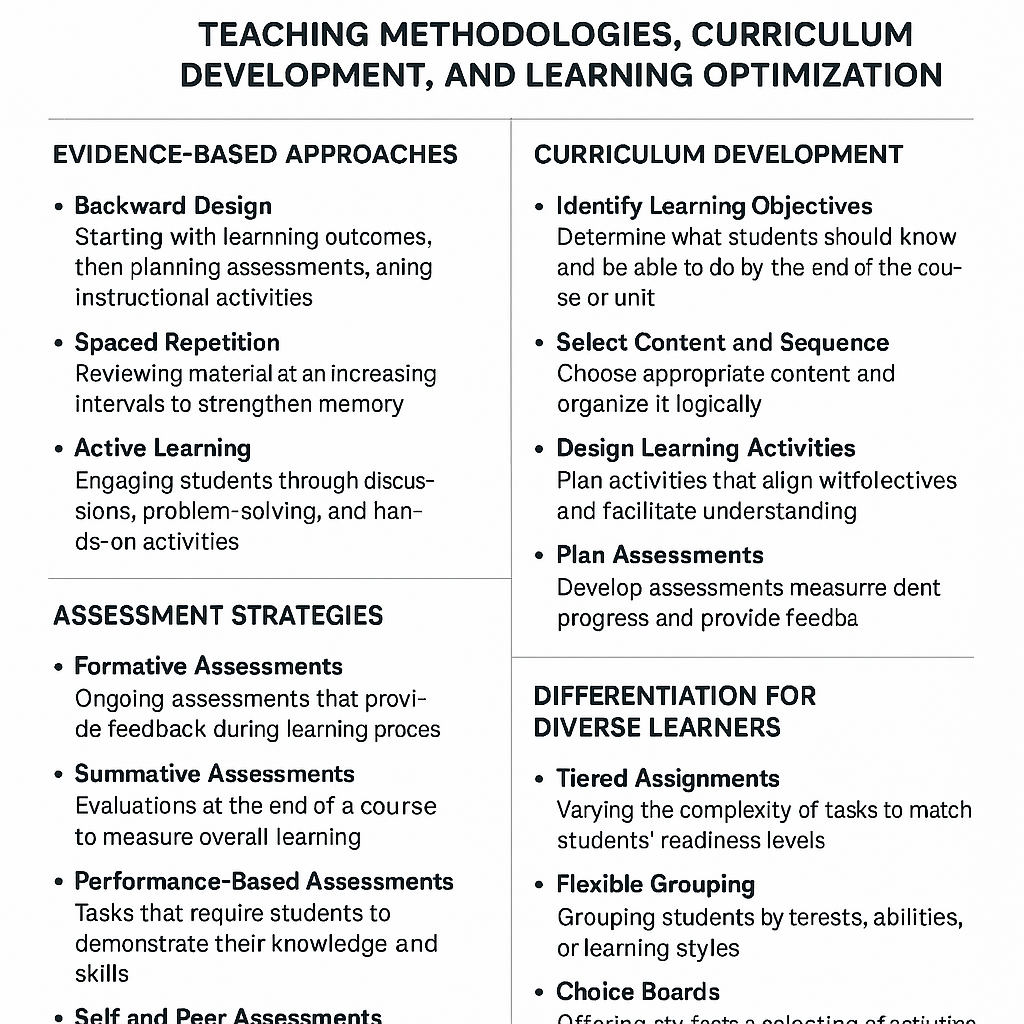
The real purpose of education is not just speed. It is formation. Students should gain skill, yes, but also truthfulness, discipline, and the ability to read the world without being fooled by it. That is a deeply human goal, and no machine, no matter how slick, replaces the teacher’s moral and intellectual responsibility.
What matters most? Alignment.
Core Benefits and Importance
- Better student outcomes. When methodology, curriculum, and assessment line up, students are less confused and more likely to meet learning outcomes. That is not theory; it is plain common sense backed by classroom results.
- Stronger retention. Spaced review, retrieval practice, and cumulative assessment help students remember what they learned. Without these, knowledge leaks out fast.
- More equitable instruction. Individualized support helps students with different starting points. Not every child comes in ready for the same pace, and pretending they do is lazy.
- Clearer teacher decisions. A coherent curriculum gives teachers a map. They can see what comes next and where students are stuck.
- More meaningful assessment. Assessment should reveal understanding, not just sort students into piles. Formative checks, exit tickets, and short writing tasks do more than a giant test ever will.
- Better use of AI and edtech. Tools like adaptive reading platforms and writing assistants help when they are tied to a clear instructional plan. Without that, they are just expensive distractions.
- Less burnout. When teachers spend less time improvising from scratch, they can focus on feedback, relationships, and actual teaching.
Most schools say they want student engagement. Fine. But engagement without learning is just noise. I’ve seen classes with high participation and low retention. That is not success. It is a performance.
The strongest classrooms usually do a few boring things very well: they explain clearly, they practice deliberately, they check understanding, and they revisit material until it sticks. Boring? Maybe. Effective? Absolutely.
If you want a practical set of classroom routines, see our retrieval practice guide. It shows how memory and practice work together, without the usual education fog.

Step-by-Step Implementation Guide
- Define the learning outcomes.
Start with the end, not the activity. What should students know, do, and value by the end of the unit? Outcomes should be observable. “Understand fractions” is mushy. “Solve fraction comparison problems and explain the process” is usable. - Map prior knowledge.
I always ask: what do students need before they can do this well? If you skip prerequisite knowledge, you force students to guess. Guessing is not learning. - Choose the instructional method with care.
Direct instruction works well for new content and foundational skills. Inquiry works better once students have some background. Group work helps when students have a real task and clear roles. Don’t worship a method. Use the one that fits. - Build the curriculum backward.
Start with assessment, then plan units, lessons, and practice. This avoids the usual mess where the course drifts away from the goal. Backward design is not magic, but it keeps you honest. - Sequence from simple to complex.
Students need small wins before hard problems. A lesson sequence should move from modeling to guided practice to independent practice. That is old-school for a reason. - Add retrieval and spacing.
Review material over time. Mix old and new questions. Use quizzes that count for feedback, not punishment. If students only see a topic once, they will forget it. - Use formative assessment.
Exit tickets, mini-quizzes, whiteboard checks, quick writes, and oral questions tell you what students actually know. I trust these more than a flashy dashboard with too many colors. - Adjust in real time.
If half the class is lost, slow down. If most students have mastered a skill, move on. Teaching is not a religious vow to the pacing guide. - Support individual learners.
Use scaffolds, reading supports, sentence frames, small-group reteaching, and adaptive practice where useful. This is where AI can help, especially in literacy. Dacia Toll’s point about AI bridging the middle grades literacy gap makes sense because middle school readers often need tailored practice at scale, not one-size-fits-all worksheets. - Evaluate and refine.
Look at assessment data, student work, and classroom observation. Then revise the curriculum. Good curriculum development is not a one-and-done project. It is maintenance.
For a more practical walkthrough of lesson planning, see our lesson planning tutorial. If you want software suggestions, our adaptive learning platforms review breaks down what is worth using and what is just marketing.
Comparison Table
| Topic | Teaching Methodologies, Curriculum Development, and Learning Optimization | Traditional Seat-Time Model |
|---|
| Focus | Mastery of learning outcomes | Time spent in class |
| Instruction | Explicit, adaptive, evidence-based | Often one pace for all |
| Curriculum | Coherent, sequenced, aligned | Fragmented and topic-driven |
| Assessment | Frequent formative checks | Mostly end-of-unit testing |
| Student Support | Differentiated and scaffolded | Limited, often reactive |
| Technology Use | Purposeful, tied to pedagogy | Add-on, often decorative |
| Retention | Built through retrieval and spacing | Weak, because review is inconsistent |
| Teacher Role | Designer, guide, assessor | Content deliverer |
The better model is not glamorous. It works because it respects how people learn.
Common Mistakes to Avoid
- Mistaking activity for learning. A lively discussion is not proof of understanding. Ask students to show their work.
- Overloading the lesson. Too many objectives turn instruction into soup. Pick fewer, teach them well.
- Ignoring prerequisites. Students cannot solve advanced problems if the basic steps are missing.
- Using tech without a reason. If a tool does not improve feedback, practice, or access, it is clutter.
- Assuming all students learn the same way. The evidence for rigid “learning styles” is weak. Most students benefit from multiple representations and good instruction.
- Skipping review. Memory fades. That is not a moral failure. It is biology.
- Treating assessment as punishment. Assessment should guide instruction and support learning.
- Believing curriculum is just a list of topics. A real curriculum is a sequence with purpose.
Let’s be real: a lot of educational advice is recycled slogans. “Make it engaging.” “Differentiate everything.” “Put students in charge.” Fine, but how? Good practice is specific. It names the lesson objective, the evidence of mastery, and the supports needed for the student in front of you.
Frequently Asked Questions
What is the difference between teaching methodology and curriculum?
Teaching methodology is how you teach. Curriculum is what you teach and in what order. One is the delivery system, the other is the plan.
How does AI help learning optimization?
AI can adapt reading practice, generate feedback, and track patterns of error. Used well, it can support individualized instruction at scale. Used badly, it becomes a shortcut with a glossy interface.
Which teaching methodology is most effective?
There is no universal winner. Direct instruction, guided practice, inquiry, and collaborative learning all have their place. The best method depends on the subject, the goal, and the students’ readiness.
How do you know if a curriculum is good?
A good curriculum is coherent, aligned to outcomes, sequenced carefully, and supported by useful assessments. If it feels random, it probably is.
What role does formation play in education?
Education should form the whole person, not just fill the head. Knowledge, judgment, patience, and truthfulness matter together. That is the only serious way to talk about learning.
Final Thought
Teaching is not just the transfer of information. It is the slow work of forming minds and habits, helping students see what is true, what is useful, and what is good. That takes patience, clear structure, and a refusal to be dazzled by educational fads. I’ve seen enough quick fixes to know they usually fail at the first sign of real classroom pressure.
The strongest educators do not chase novelty for its own sake. They build systems that help children read better, think more clearly, and act with more care. That matters because a student is not a data point. A student is a person, made for truth and capable of growth. Good teaching honors that.