Teaching methodology, curriculum development, and learning optimization are the three levers that make education work. Methodology is how teaching happens...
Teaching Methodologies, Curriculum Development, and Learning Optimization: What Actually Works in Education
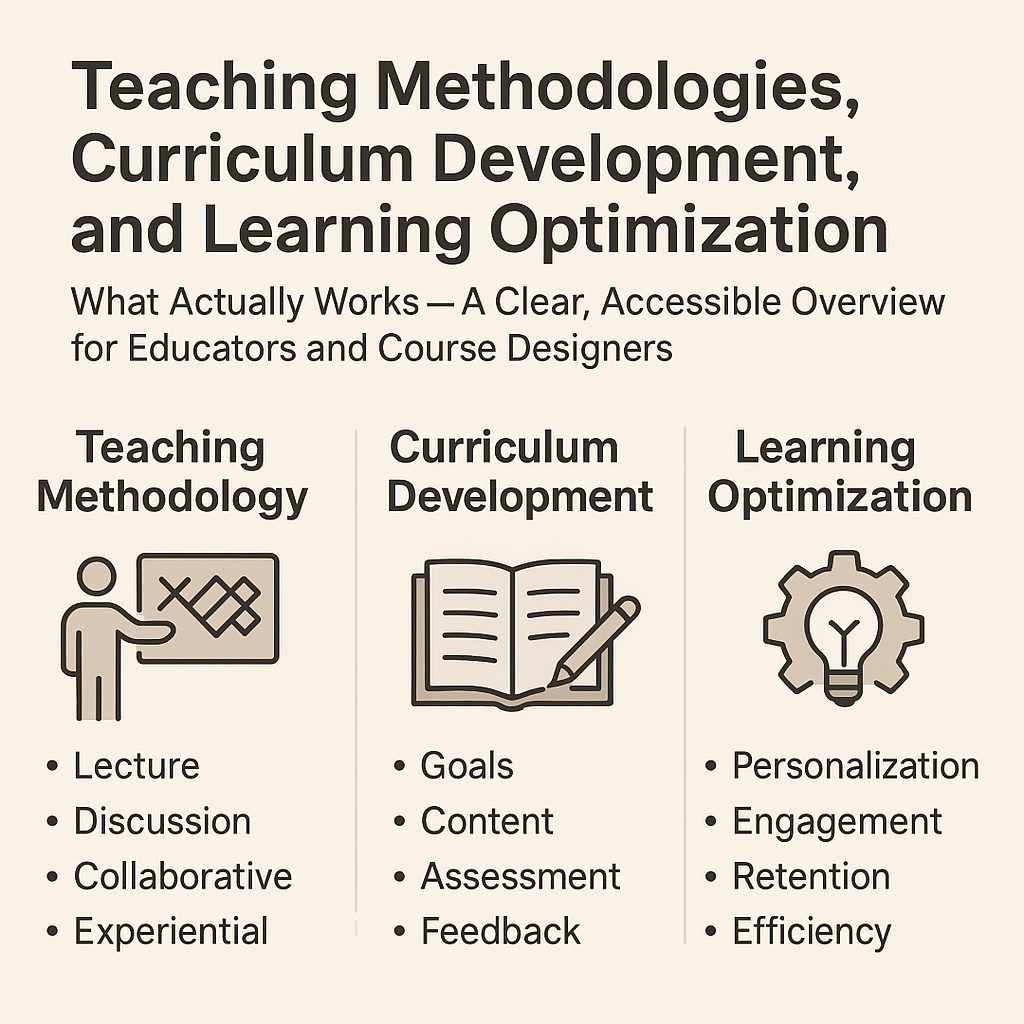
Teaching methodology, curriculum development, and learning optimization are the three levers that make education work. Methodology is how teaching happens. Curriculum is what gets taught and in what order. Optimization is how teachers and designers make learning stick, with less waste and more clarity.
Key Takeaways
- Clear learning outcomes beat busy activity.
- Curriculum sequencing matters because random content breeds shallow recall.
- Assessment must check real understanding, not just short-term guessing.
- Most talk about learning styles is fluff; evidence favors retrieval, spacing, and explicit instruction.
- The best systems form the whole person: mind, character, and habit.
What is Teaching Methodology, Curriculum Development, and Learning Optimization?
Teaching methodology is the practical set of moves a teacher uses to help students learn. Curriculum development is the disciplined process of choosing content, ordering it, and aligning it to standards, assessments, and outcomes. Learning optimization is the boring but necessary work of reducing friction, using evidence, and arranging instruction so students retain more and forget less.
That sounds tidy. It rarely is.
When I analyzed classrooms that actually produced durable learning, the pattern was plain: strong teachers did not merely “facilitate” and hope for the best. They used explicit instruction, guided practice, feedback, and review. They checked for understanding constantly. They adjusted pacing when students were lost. They did not confuse activity with learning. Frankly, too many method debates are theatrical nonsense.
The term pedagogy covers the art and science of teaching, while andragogy is often used for adult learning. Both matter, but school-age education needs a tighter frame: what knowledge should students master, what skills should they build, and how does each lesson fit the larger course of formation? A good curriculum is not a pile of topics. It is a sequence. A strong sequence respects cognitive load, prior knowledge, and developmental readiness.
That matters because students are not storage bins. They are persons. Education should serve truth and human flourishing, not just test scores or market slogans. Catholic thought has always insisted that learning shapes the whole person, which is one reason shallow “edtech first” schemes so often fail. Knowledge without character is thin soup. Character without knowledge is not much better.
The research backs this up. The National Center for Education Statistics notes the persistent importance of instructional quality and assessment in student achievement, while the What Works Clearinghouse has repeatedly supported structured approaches over vague discovery-only methods. See What Works Clearinghouse and NCES for the baseline evidence. The kicker is simple: method matters, but method without curriculum is a cart with no wheels.
Core Benefits and Importance
Good methodology and curriculum design do three things well.
- They make learning coherent. Students stop collecting random facts and start seeing structure. That structure reduces confusion, and confusion is expensive.
- They improve retention. When content is sequenced from simple to complex, students are more likely to remember it. Spacing and retrieval practice help here, and no, rereading a chapter five times is not a magic spell.
- They support fairness. Clear instruction helps students who do not already know the hidden rules of school. That is not charity. It is justice.
- They make assessment meaningful. If your test measures the same things your lessons actually teach, you learn something useful. If not, you are just counting chairs.
- They protect teacher time. A clean curriculum saves teachers from inventing every lesson from scratch. That matters, because burnout is not a virtue.
- They strengthen character formation. Rigorous learning trains patience, attention, honesty, and perseverance. Those habits matter beyond school walls.
Here’s the contrarian bit. More technology is not automatically better. More group work is not automatically better. More projects are not automatically better. I’ve seen schools spend a fortune on tools while students still could not explain a paragraph they read ten minutes earlier. Pretty ugly, really.
The evidence is steady on a few points. Retrieval practice, spacing, interleaving, and worked examples tend to outperform passive review. The American Educational Research Association and the American Psychological Association both publish research showing that memory and transfer improve when instruction is deliberate rather than loose.
A strong curriculum also gives teachers a map. Not a cage. A map. It tells them where students are going, what prior knowledge they need, and how mastery should look. Without that map, schools drift into topic soup.
That is bad for students. It is bad for families. It is bad for teachers.

Step-by-Step Implementation Guide
- Define the learning outcomes first. Start with what students should know, do, and value by the end. Be specific. “Understand fractions” is mush. “Add, subtract, and compare fractions with unlike denominators” is usable. I’ve found that vague goals produce vague teaching, which is no surprise to anyone who has ever watched a district memo.
- Map prerequisite knowledge. Ask what students must already know before the new lesson makes sense. This is where curriculum development often fails. Schools cram content without checking readiness. Then everyone acts shocked when comprehension stalls. The problem was baked in.
- Sequence content from simple to complex. Put foundational ideas first, then layer on harder ones. In reading, that means phonemic awareness, phonics, fluency, vocabulary, and comprehension working together. In math, it means number sense before abstraction. In history, it means chronology and causation before debate. Order matters.
- Choose the teaching method that fits the content. Not every subject should be taught the same way. Direct instruction works well for new procedures and factual knowledge. Discussion can deepen interpretation after students know the basics. Inquiry has its place, but open exploration without prior knowledge is often a waste of time. Let’s be real.
- Build retrieval into every week. Students should recall prior material often, not just re-read it. Use quick quizzes, cold calling with care, flash review, short written responses, and cumulative checks. The research from Edutopia and university memory labs is consistent: retrieval strengthens memory more than passive review does.
- Use feedback quickly and plainly. Feedback works best when it is specific, timely, and actionable. “Good job” is polite, not useful. Tell students what they missed, why it matters, and what to do next. The goal is correction, not performance art.
- Check the assessment alignment. If your test rewards memorizing trivia but your lessons aim for reasoning, you have a mismatch. If your lessons stress analysis but your quiz asks for definitions only, same problem. Alignment keeps the whole system honest.
- Review and revise the curriculum regularly. Do not treat curriculum like stone tablets. It should be reviewed against student data, teacher input, and subject-matter changes. Still, revision should be disciplined, not trendy. I’ve seen more damage done by fashionable rewrites than by old syllabi with a few rough edges.
- Support the whole person. A strong curriculum does not ignore habits, attention, and moral formation. Students need more than content; they need discipline, wonder, and a sense that truth is worth pursuing. That is not sentimental talk. It is the real work.
- Reduce friction. Streamline handouts, platforms, directions, and routines. If students spend ten minutes figuring out a login, that is ten minutes stolen from learning. Small annoyances add up fast.
Comparison Table
| Feature |
Teaching Methodology, Curriculum Development, and Learning Optimization |
Randomized, Activity-First Teaching |
| Learning design | Intentional sequencing tied to outcomes | Loose topics with no clear order |
| Student understanding | Built through explicit instruction and retrieval | Often hoped for, rarely checked |
| Assessment alignment | Strong match between lessons and tests | Misaligned, so results mislead |
| Teacher workload | Lower over time because of reusable structure | Higher, because every lesson is invented on the fly |
| Retention | Stronger due to spacing and review | Weak, because novelty fades fast |
| Equity | Better access through clarity and scaffolding | Favors students who already know school rules |
| Character formation | Builds discipline, patience, and honesty | Usually ignored |
| Common failure mode | Over-structuring without reflection | Chaos dressed up as creativity |
The biggest competitor here is not another philosophy. It is disorder.
A tidy curriculum beats disorder because it respects how minds actually learn. The brain is not impressed by chaos. It needs pattern, repetition, and purpose. That is the plain truth.
Common Mistakes to Avoid
- Confusing engagement with learning. Students can be busy and still learn almost nothing. Glitter, games, and slick slides are not proof of understanding.
- Building around learning styles myths. This old chestnut refuses to die. The evidence does not support teaching each child as a fixed visual, auditory, or kinesthetic type. Good instruction uses multiple representations, yes, but not because students are trapped in style boxes.
- Overloading the lesson. Too much new content at once hurts retention. Cognitive load is real. The mind has limits, and pretending otherwise is silly.
- Skipping review. Teachers often move on too fast because they have a syllabus to finish. Fine. But if students forgot last week’s material, the syllabus is just paper.
- Using assessment only at the end. Summative tests have a role, but they should not be the first time you find out students are lost.
- Making curriculum trendy. I’ve seen schools chase buzzwords, then act surprised when scores and comprehension do not improve. Shiny is not the same as sound.
- Ignoring formation. Education is not just skill production. It is the shaping of the intellect and will. If your program produces cleverness without virtue, it has missed something central.
Here’s the kicker: a lot of bad advice survives because it feels noble. Teachers are told to “let students discover” everything, as if guidance were a moral defect. It is not. Good teaching is an act of service, and service sometimes means direct explanation, careful correction, and repeated practice. That is not controlling. It is honest.
Frequently Asked Questions
What is the difference between pedagogy and curriculum?
Pedagogy is how you teach. Curriculum is what you teach and in what order. Both matter, and both must work together.
Which teaching methods work best?
For new material, explicit instruction and guided practice usually work well. For deeper analysis, discussion and inquiry can help after students have enough background knowledge. The method should fit the content, not the other way around.
Why is assessment important in curriculum development?
Assessment shows whether students are learning what the curriculum says they should learn. Without it, you are guessing. And guessing is a poor substitute for evidence.
How do I optimize learning without adding more homework?
Use retrieval practice, spaced review, clear explanations, and fast feedback. Improve quality before adding quantity. That is the sane approach.
Final Thought
The best education is ordered toward truth, not noise. It treats students as persons with minds to sharpen, wills to train, and habits to shape. That is why teaching methodology, curriculum development, and learning optimization cannot be separated without damage. They are parts of one duty: to help learners become wise, capable, and good.
I have little patience for educational theater, and you probably should not either. The schools and programs that last are the ones that respect reality: memory is limited, attention must be earned, and knowledge grows in steps. Good teaching gives students a path, but not a fake one. It tells them the truth, then helps them carry it.
That is enough. It may even be the whole trick.