Teaching works when method, content, and assessment line up. Good curriculum design makes that alignment visible, while learning optimization keeps the work...
Teaching Methodologies, Curriculum Development, and Learning Optimization: What Actually Works in K-12
Teaching works when method, content, and assessment line up. Good curriculum design makes that alignment visible, while learning optimization keeps the work efficient, honest, and focused on real understanding rather than busywork. That sounds simple because it is. The hard part is refusing the glossy nonsense that schools are sold every year.
Key Takeaways:- Strong teaching starts with clear learning outcomes, not shiny tools.
- Curriculum should sequence knowledge, skills, and assessment in a sensible order.
- Learning optimization means better retention, more transfer, and less wasted time.
- Most claims about engagement are weak unless they improve performance.
- The best classrooms form both intellect and character.
What is teaching methodology?
Teaching methodology is the set of methods a teacher uses to help students learn. It includes direct instruction, discussion, inquiry, modeling, guided practice, retrieval practice, project work, and feedback. Some methods are better for some goals than others. That is not controversial, though education vendors often pretend otherwise.
A useful methodology matches the task. If students need facts, vocabulary, or procedures, then clear explanation and practice usually beat vague discovery. If they need analysis, argument, or transfer, then guided questioning and structured problem solving help more. The trick is not picking one sacred method and defending it like a sports team. The trick is choosing the right method for the right learning outcome.
I have seen too many classrooms where “student-centered” means students are left to flail around while adults call it independence. Frankly, that is not pedagogy. That is abdication with good lighting.
The research backs a blended view. Explicit teaching is effective for novices, especially in complex subjects. Inquiry has a place, but only after students have enough background knowledge to ask useful questions. John Hattie’s synthesis on visible learning has repeatedly shown that feedback, teacher clarity, and instructional quality matter a great deal. The Education Endowment Foundation teaching and learning toolkit also points to structured feedback, phonics, mastery learning, and metacognition as high-value approaches.
A sound methodology respects the dignity of the learner. That sounds lofty, but it is practical. Students are not storage bins. They are people with minds, wills, and habits. Good teaching aims at truth, understanding, and good judgment, not mere test prep. In a Catholic frame, education serves the whole person. Knowledge matters because truth matters. Character matters because wisdom without virtue is flimsy.
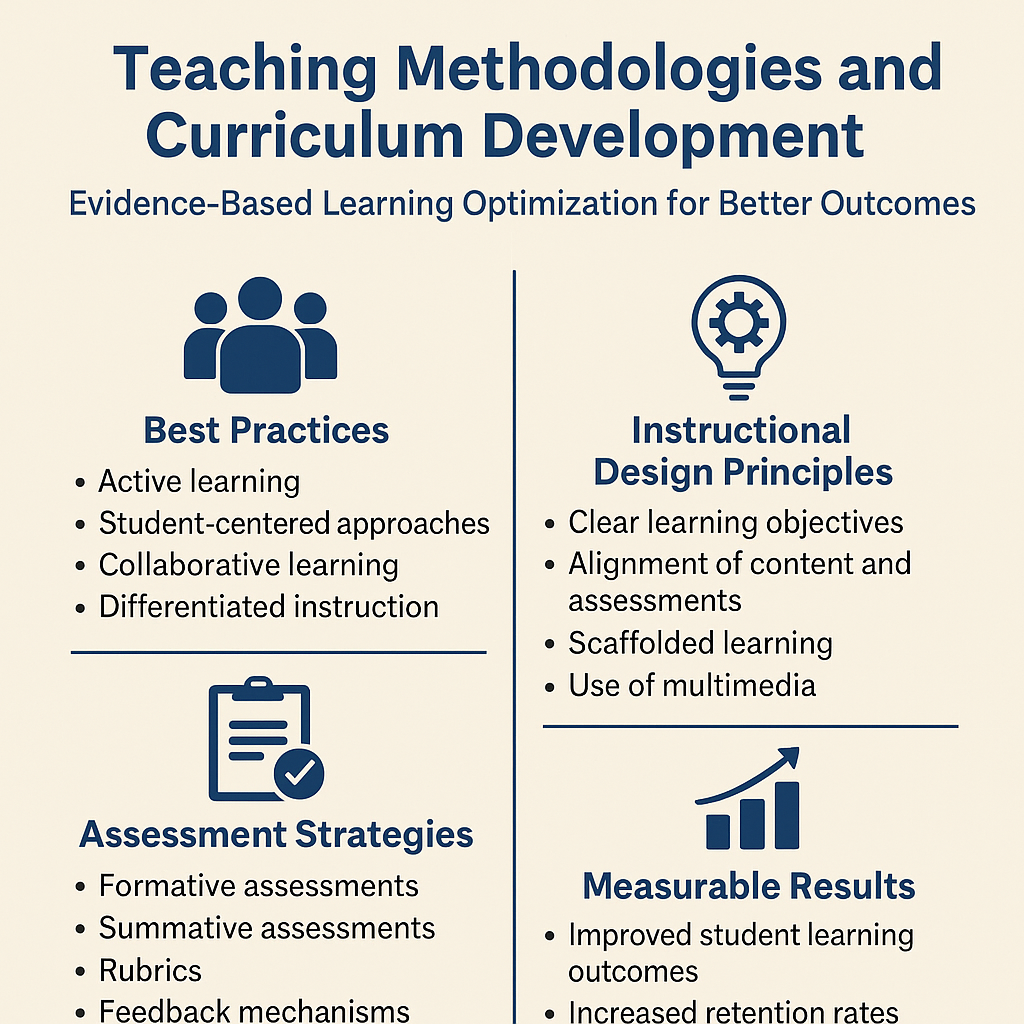
Core benefits of strong curriculum development and learning optimization
A well-built curriculum saves time. It also saves a lot of nonsense.
When the curriculum is coherent, teachers know what to teach, students know what matters, and assessments measure something real instead of random trivia. That sounds obvious, but many schools still rely on patchwork materials that never quite fit together.
Here is what good curriculum design and learning optimization actually improve:
- Clarity for teachers: Teachers spend less time guessing what comes next and more time teaching well.
- Consistency for students: Students encounter a logical sequence of concepts, so prior learning supports later learning.
- Better retention: Spacing, retrieval practice, and cumulative review help information stick.
- Stronger transfer: Students apply knowledge to new tasks when they first learned it deeply.
- Fairer assessment: Tests and tasks align with what was taught, not hidden expectations.
- Less wasted effort: Schools stop chasing every trend that pops up in a conference brochure.
The biggest benefit, though, is intellectual honesty. A good curriculum says plainly what students should know and be able to do. No fog. No gimmicks. That clarity matters because students deserve more than entertainment. They deserve formation.
Learning optimization is not about making school easy. It is about making learning efficient and durable. I have analyzed enough lesson plans to know that many teachers work hard while getting poor returns, not because they lack effort, but because their methods fight how memory works. Cognitive science has been rather stubborn on this point. Retrieval beats rereading. Interleaving beats mindless repetition. Feedback beats vague praise.
The American Educator article on how learning works is worth reading because it explains, in plain English, why background knowledge and memory structure matter. Daniel Willingham’s work is especially useful for schools that still treat “critical thinking” as a magical free-floating skill. It is not. You think with knowledge, not around it.
A final benefit is moral, though people rarely say it out loud. Schools are not factories. They are communities ordered toward human flourishing. A curriculum worthy of the name should help students grow in competence, discipline, and service to others. That is not fluffy sentiment. It is the point.
Step-by-step implementation guide
Start with the end.
Before you choose activities, tools, or assessments, define the learning outcomes. What should students know, do, and value by the end of the unit? If you cannot say it plainly, the unit is not ready. That question alone cuts through a mountain of weak planning.
- Define the outcome clearly
Write specific learning goals. Use verbs that describe observable performance. “Understand” is weak. “Explain,” “compare,” “solve,” and “justify” are better. If the outcome is fuzzy, the instruction will be fuzzy too. - Map prerequisite knowledge
Students need a base before they can build. List the facts, vocabulary, and prior skills required. I have found this step saves more grief than any fancy technology platform ever did. - Sequence content logically
Start simple, then move to more demanding tasks. Use concrete examples before abstract principles. This is boring in the best possible way. It works. - Choose methods that fit the content
Use direct instruction for new or complex material. Use guided practice for skill building. Use discussion when students have enough knowledge to talk intelligently. Use projects when there is something worth creating, not just because project-based learning sounds stylish. - Build retrieval into the plan
Review old material regularly. Ask students to recall without notes. Make them explain steps, definitions, and examples from memory. Spacing and retrieval are not exotic tricks. They are basic memory hygiene. - Check understanding early and often
Do not wait for the unit test to discover confusion. Use quick checks, exit tickets, whiteboard responses, and short written explanations. The faster you spot errors, the easier they are to fix. - Give feedback that changes performance
Feedback should point to the next move. “Good job” is not feedback. “Your claim is clear, but your evidence does not support it” is useful. The Learning Scientists have a solid explanation of retrieval, spacing, and elaboration that teachers can actually use without a PhD in decoder rings. - Measure what matters
Assess the intended learning, not just compliance. If the goal is argument writing, assess argument writing. If the goal is fraction fluency, assess fraction fluency. Otherwise, you are measuring noise. - Revise the curriculum
Good curriculum is never finished. It is reviewed, tested, and improved based on student evidence. Not vibes. Evidence. - Train teachers to use the curriculum well
A decent curriculum in weak hands still fails. Teachers need clear models, examples, and practice. Professional development should be practical, not theatrical.
Here is the kicker: implementation fails more often from poor execution than from bad ideas. Schools buy the right materials, then skip training, skip alignment, and skip review. Then everyone acts surprised when scores do not rise. Amazing, really.
If you want a more practical teaching playbook, see a good curriculum and instruction resource and compare it with your own pacing guides. The gap usually shows up fast.

Comparison table: strong curriculum design vs. trendy student-led instruction
Most schools do not need more slogans.
They need fewer contradictions between what they say and what students actually learn. So let us compare a coherent curriculum approach with the biggest rival in practice: loosely defined, highly marketed student-led instruction that sounds noble but often lacks structure.
| Dimension | Strong Curriculum Design | Trendy Student-Led Instruction |
|---|
| Learning sequence | Clear, cumulative, intentional | Often loose or improvised |
| Teacher role | Expert guide and explainer | Facilitator, sometimes too passive |
| Student support | Scaffolds, models, guided practice | Students may be expected to figure it out |
| Assessment alignment | Tight match to taught content | Can drift away from taught content |
| Equity | More reliable access to knowledge | Can advantage students with outside support |
| Retention | Built-in review and retrieval | Often dependent on student self-direction |
| Efficiency | Less wasted time | More time spent rediscovering basics |
| Best use case | New knowledge, skill building, mastery | High-background-knowledge inquiry, debate, creation |
The point is not to smear all student-led learning. That would be lazy. The point is that students benefit from structure, especially early on. Once students have the knowledge base, they can do richer inquiry, better discussion, and more independent work.
If you want a research-based case for structured teaching, look at the American Educational Research Association resources on explicit instruction. The findings are not romantic, but they are useful. Romance does not raise reading scores.
A balanced curriculum often combines direct instruction, practice, retrieval, discussion, and application. That is not a compromise. It is craftsmanship.
Common mistakes to avoid
The first mistake is worshipping novelty.
Every year, some new platform or framework arrives promising transformation, and every year teachers are told to be excited. Let’s be real. Most of it is packaging. If a tool does not improve learning, it is decorative.
Here are the usual blunders:
- Confusing engagement with learning: Students can look busy and learn almost nothing.
- Overusing projects: Projects are fine when students have enough knowledge. Before that, they can become expensive confusion.
- Ignoring prior knowledge: New learning sticks to old knowledge. If the base is weak, the roof falls.
- Using too many methods at once: Constant switching creates noise, not depth.
- Skipping review: Students forget. That is not a defect. It is human nature. Curriculum should plan for it.
- Assessing the wrong thing: If the lesson was about analytical writing, do not grade mostly on poster glitter.
- Buying into learning styles: The evidence for matching instruction to visual, auditory, or kinesthetic “types” is weak. The American Psychological Association has been clear enough on this.
I have also noticed a habit of treating technology as if it fixes weak instruction. It does not. Tablets do not cure incoherence. AI does not rescue a muddled scope and sequence. If the lesson is badly designed, software only speeds up the wrong thing.
Another mistake is forgetting that education is moral formation as well as information delivery. A classroom can produce test scores and still fail to shape patience, honesty, diligence, and respect. That matters more than people admit in staff meetings. Students should leave school more capable, yes, but also more ordered toward the good.
One more thing. Stop mistaking “choice” for rigor. Choice can be useful, but unlimited choice often hides weak planning. Students need boundaries. Good fences make good gardens.
Frequently asked questions
What teaching methodology works best?
It depends on the learning goal.
For new content, explicit instruction and guided practice usually work best, especially for novices. For deeper analysis or creation, discussion and inquiry can help once students have enough background knowledge. The best teachers mix methods with discipline, not fashion.
How do I know if my curriculum is strong?
Check for coherence.
A strong curriculum has clear outcomes, a logical sequence, aligned assessments, and planned review. If teachers constantly improvise because the materials are incomplete or confusing, the curriculum is weak.
What is the fastest way to improve student retention?
Use retrieval and spacing.
Ask students to recall material over time, not just reread it once. Frequent low-stakes quizzes, cumulative review, and short explanation tasks improve memory more than cramming does.
Should schools use AI in K-12 teaching?
Yes, but cautiously.
AI can help with lesson drafting, feedback support, differentiation ideas, and administrative load. It should not replace teacher judgment, curricular coherence, or human relationships. The real danger is mistaking convenience for quality. Schools need truth, not hype.
Final thought
The best teaching is not flashy.
It is clear, patient, and ordered toward truth. Good curriculum design does not crowd out the teacher; it gives the teacher a sane structure in which real instruction can happen. Learning optimization does not mean turning children into machines. It means respecting how memory, attention, and understanding actually work, then planning accordingly.
That is why I am skeptical of most education trends. Too many are sold with big promises and thin evidence. Too many confuse speed with depth, and novelty with improvement. But when teaching methodology, curriculum development, and learning optimization are done well, students grow in knowledge, judgment, and confidence. They become more capable of good work. They also become more capable of serving others, which is the part schools too often forget.
If education is a search for truth, then the classroom cannot be run on slogans. It has to be built on evidence, discipline, and a sober respect for the human person. That is not sentimental. It is the only serious way forward.