Teaching methodologies are the methods teachers use to help students learn, curriculum development is the design of what gets taught and when, and learning...
Teaching Methodologies, Curriculum Development, and Learning Optimization: What Actually Works
Teaching methodologies are the methods teachers use to help students learn, curriculum development is the design of what gets taught and when, and learning optimization is the practical work of improving retention, transfer, and student engagement. That is the plain version. The fancier version is mostly noise. Good teaching is not about performance tricks or buzzwords; it is about forming clear learning outcomes, choosing methods that fit the content, and making sure students can actually think with what they learn.
Key Takeaways- Good teaching starts with learning outcomes, not random activities.
- Curriculum should be sequenced, not stuffed.
- Assessment must measure what you actually value.
- Most talk about learning styles is weakly supported at best.
- Retrieval practice, spacing, and feedback beat flashy methods.
- Education should form the whole person, not just produce test scores.
What is Teaching Methodologies, Curriculum Development, and Learning Optimization?
Teaching methodologies are the structured ways instructors present content, guide practice, and check understanding. Curriculum development is the deliberate design of a program of study, including scope, sequence, objectives, assessments, and materials. Learning optimization is the process of improving how students absorb, retain, and use knowledge. Put together, these three things answer the only question that matters in instruction: what should students learn, how should they learn it, and how do we know they really learned it?
People love vague language here. Frankly, that is part of the problem. A school can spend a fortune on technology, new rooms, and clever slogans, yet still produce weak learning if the curriculum is bloated and the teaching method is mismatched to the task. I have seen classes where students are “engaged” every minute and still walk out with almost nothing durable in memory. Busy does not mean effective.
Teaching methodologies include direct instruction, inquiry-based learning, cooperative learning, project-based learning, Socratic discussion, blended learning, and mastery learning. None of these is magic. Each works under certain conditions. Direct instruction is strong when students need clear explanation and guided practice. Inquiry can be useful when learners already have enough background knowledge to ask useful questions. Project work has value when it is tied to specific outcomes instead of vague “real-world skills” talk. The useful question is not which method is fashionable. The useful question is which method best fits the subject, the learners, and the assessment.
Curriculum development is where many institutions get sloppy. A curriculum is not a pile of topics. It is an ordered path. If you teach before prerequisites are in place, students flounder. If you repeat the same content without increasing complexity, students stagnate. A strong curriculum respects sequence, coherence, and cumulative growth. That is true whether you are teaching phonics, algebra, theology, nursing, or machine learning.
Learning optimization adds the psychological layer. Cognitive science has made one thing plain: students do not learn well by passive exposure alone. They learn by retrieving, spacing, interleaving, elaborating, and receiving timely feedback. The evidence from organizations like the U.S. Department of Education’s What Works Clearinghouse and the research summaries at EEF Teaching and Learning Toolkit points in the same direction. The methods matter, yes, but the design around them matters just as much.
There is also a deeper point. Education is not merely technical training. It is formation. The old Christian view of learning, which still has more common sense than much modern policy, treats truth as worth pursuing for its own sake and the learner as a whole person, not a data point. That means a curriculum should develop judgment, discipline, memory, and character alongside knowledge. Skills alone are thin gruel.
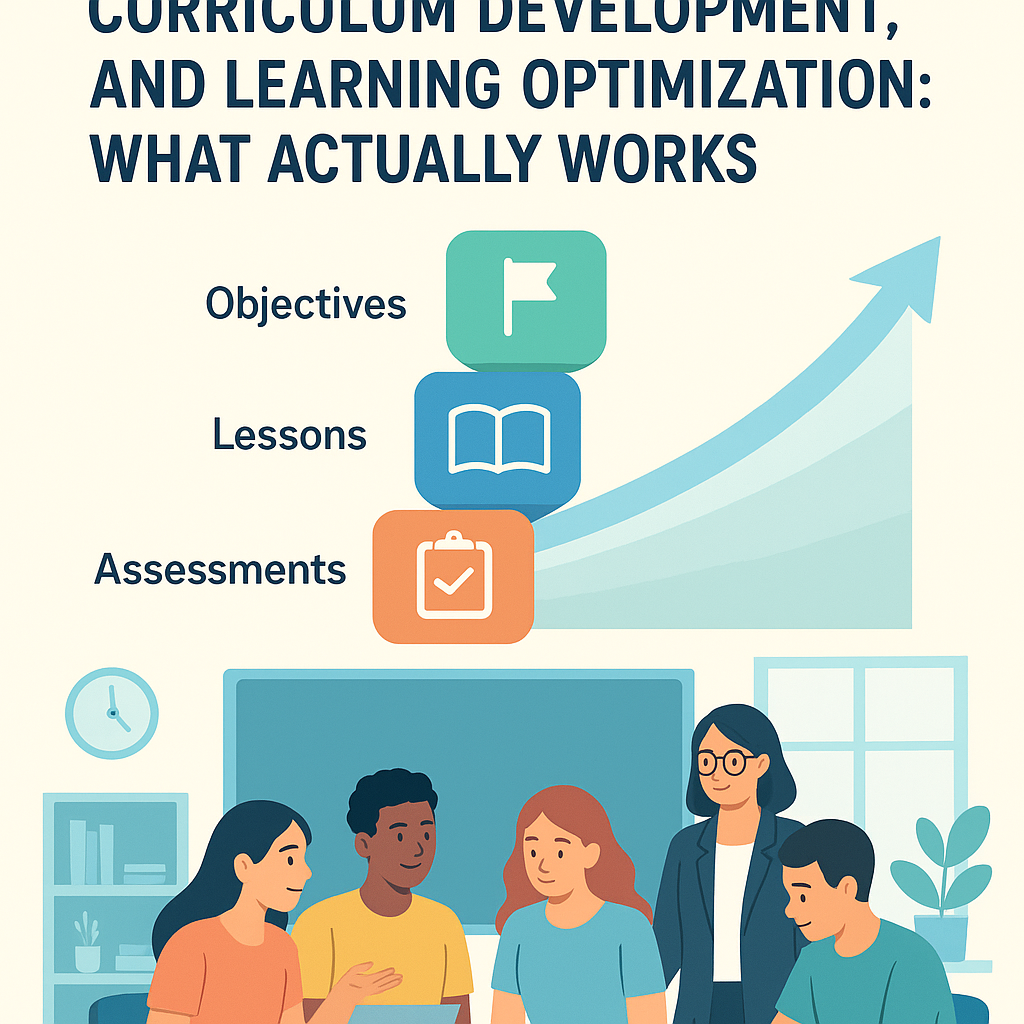
Core Benefits of Strong Teaching Methodologies and Curriculum Design
- Better retention: Students remember more when content is sequenced well and revisited over time. Spacing and retrieval are not trendy accessories. They are workhorses.
- Cleaner assessment: When outcomes are clear, assessment becomes useful instead of decorative. You can tell what students know and what they only guessed at.
- Less instructional waste: Weak curriculum often repeats, skips, or overloads. Strong design trims the fat.
- Higher engagement with purpose: Real engagement comes from meaningful challenge, not from glitter, stickers, or endless group work. Let’s be real.
- Fairer instruction: A well-designed curriculum helps reduce hidden assumptions about prior knowledge. That matters a lot for access and equity.
- Stronger transfer: Students can apply learning to new problems when the course has deliberate practice and varied examples.
- Improved teacher sanity: Good materials reduce improvisation fatigue. Teachers can teach instead of constantly inventing from scratch.
- More coherent school culture: When many classrooms follow shared learning outcomes, students experience consistency instead of whiplash.
The biggest contrarian point is this: more activity is not more learning. In many classrooms, the method has become a theater piece. Students move around, color things, post things, and share things, but the knowledge never sticks. I’ve watched this pattern for years. It is common. It is also foolish.
Another hard truth: “student-centered” does not mean “teacher absent.” Students need guidance. They need structure. They need a model, practice, correction, and a chance to try again. If the teacher disappears too early, weaker students pay the price while the strongest children silently carry the room. That is not dignity. That is abdication.
Curriculum also matters for moral and intellectual formation. A serious curriculum does more than prepare for tests or jobs. It teaches students to notice truth, distinguish good from poor reasoning, and take responsibility for what they know. That is not preaching. It is simply what education is for when it is done honestly.
For a practical companion to study behavior, see our guide on effective study habits, which pairs naturally with retrieval practice and spaced review. If you are building materials, the article on spaced repetition is useful too. And if your team is choosing digital support, look at learning management systems before buying shiny software you do not need.

Step-by-Step Guide to Implement Better Teaching and Learning
- Start with learning outcomes. Write outcomes in plain language. Not fluff. Not slogans. Ask what students should know, what they should do, and what they should be able to explain. If an outcome cannot be assessed, it is probably too vague to help.
- Map the sequence. I always check prerequisites first. What must students already know before this lesson makes sense? What gets introduced now, and what must wait? Curriculum is basically a chain. Break one link and the whole thing strains.
- Choose the teaching method to match the content. Use direct instruction for core knowledge and procedural clarity. Use guided practice for skills that need correction. Use inquiry when students have enough background to ask meaningful questions. Use discussion when analysis and judgment matter. Method should serve the content, not the teacher’s ego.
- Build in retrieval from day one. Do not wait until the exam. Pull students back to earlier material in short bursts. Ask for a definition, a sketch, a comparison, an example, a problem solution. The brain learns by effortful recall. That is the kicker.
- Space practice over time. One long cram session feels productive and is usually useless a week later. Spread practice out. Revisit essential ideas. Interleave older and newer topics so students must choose the right tool instead of spotting the answer by habit.
- Use examples, then fade support. Show worked examples first. Then remove steps gradually. Then ask students to perform independently. This is one of the most reliable methods in cognitive science, and yet people still pretend novices should “discover” everything themselves. Absurd.
- Assess what matters. If you value reasoning, assess reasoning. If you value writing, assess writing. If you value problem solving, assess problem solving. Multiple-choice tests have a place, but they should not be the whole story. Use quizzes, essays, performance tasks, oral checks, and practical demonstrations where appropriate.
- Review the data and revise. Check item results, observe confusion patterns, and note where students consistently stumble. Then edit the curriculum. Good curriculum development is not a one-time event. It is a disciplined cycle.
- Support the whole person. Students are not machines. Fatigue, anxiety, family pressures, and poor habits affect learning. A humane classroom pays attention to effort, honesty, patience, and mutual respect. That is not sentimental. It is realistic.
When I analyzed classrooms that actually produced lasting understanding, the pattern was boring in the best way: clarity, repetition, feedback, and expectations. No theatrical nonsense. No miracle app. Just sound instructional design.
Comparison Table
| Feature | Strong Teaching Methodologies + Curriculum Development | Common "Activity-First" Teaching Model |
|---|
| Primary goal | Measurable learning outcomes | Visible student activity |
| Sequence | Planned, cumulative, prerequisite-based | Often fragmented |
| Assessment | Aligned to objectives | Sometimes disconnected |
| Student support | High scaffolding, gradual release | Uneven or assumed |
| Retention | Uses retrieval, spacing, feedback | Often relies on exposure |
| Equity | Reduces hidden knowledge gaps | Can favor already-prepared students |
| Teacher workload | Lower over time, more reusable | Constant improvisation |
| Long-term results | Durable knowledge and transfer | Short-lived enthusiasm |
The competitor model here is not one brand or platform. It is the widespread habit of treating visible activity as proof of learning. That habit is everywhere. It is also weak.
The point of the table is simple. If you want student learning, build for learning. If you want a cheerful room full of motion, do something else.
Common Mistakes to Avoid
- Mistaking engagement for understanding: Students can be lively and still learn little. I know, shocking.
- Overloading the curriculum: Too many standards, too many topics, too little depth. This is how schools create forgettable clutter.
- Using one method for everything: Direct instruction is not a cure-all, and project-based learning is not a cure-all either. Context matters.
- Ignoring prior knowledge: If students do not have the background, complex tasks become guesswork.
- Skipping formative assessment: Without small checks, teachers discover confusion too late.
- Treating assessment as punishment: Good assessment diagnoses learning. It is a mirror, not a club.
- Adding technology without purpose: Software is not curriculum. A tablet does not fix a weak lesson.
- Copying “best practices” blindly: A method that works in one subject or age group may fail elsewhere.
- Overusing group work: Sometimes it helps. Sometimes it hides confusion in a crowd.
- Pursuing novelty over consistency: Students often need repetition and stability more than surprise.
Frankly, a lot of education talk is allergic to limits. Yet limits are what make learning possible. Time is limited. Attention is limited. Working memory is limited. That is not a problem to be denied; it is the design brief.
Another mistake is forgetting that curriculum is a moral act as well as a technical one. What you include signals what you value. What you omit shapes what students never get to know. A school that claims to care about the whole person should be careful, not careless.
If you want a practical way to reduce these mistakes, compare your course plan to AERA research guidance on evidence-informed teaching, then check your own lesson plans against it. You will probably find holes. Most people do.
Frequently Asked Questions
What teaching method works best?
It depends on the goal, the learner’s prior knowledge, and the subject. Direct instruction works well for explicit knowledge and foundational skills. Inquiry and project-based learning work better once students have enough background to think deeply. There is no universal winner.
How do I improve curriculum development?
Start with clear outcomes, sequence content logically, and use assessments that match your goals. Then review student performance data and revise the curriculum where gaps appear. Good curriculum development is iterative, not ceremonial.
What is the best way to improve student retention?
Use retrieval practice, spacing, interleaving, and feedback. Those methods have a strong evidence base, including summaries from the American Psychological Association and school-focused guidance from Edutopia. Memorization is not a dirty word when it supports understanding.
Are learning styles real?
Not in the popular sense people usually mean. Students may have preferences, but matching instruction to a supposed “style” has weak evidence. Better to use multiple representations, clear explanations, and varied practice.
Final Thought
Teaching methodologies, curriculum development, and learning optimization are not separate hobbies. They are one discipline. If you get the sequence wrong, students struggle. If you get the method wrong, they coast without learning. If you get the assessment wrong, you fool yourself about both.
The future of education will not be shaped by whoever buys the most software or invents the prettiest slogan. It will be shaped by people willing to ask hard questions: What is worth knowing? What helps students remember? What forms judgment, skill, and character together? Those are old questions, but they remain the only ones worth serious attention.
I’ll be blunt. We do not need more educational theatrics. We need better structure, better feedback, and better respect for how people actually learn. The student is not a content bucket. The teacher is not a stage actor. And a curriculum is not a junk drawer. When education is ordered toward truth and human flourishing, it becomes something sturdier than training. It becomes formation.
That is the part worth keeping.