Teaching methodologies shape what students actually learn, not just what teachers say. Curriculum development turns goals into a usable plan, while learning...
Teaching methodologies shape what students actually learn, not just what teachers say. Curriculum development turns goals into a usable plan, while learning optimization removes waste, clarifies expectations, and improves retention. If you want better outcomes, stop worshiping fads and start matching instruction, content, and assessment to real human learning.
Key Takeaways:
- Strong teaching rests on pedagogy, not gimmicks.
- A good curriculum aligns goals, content, and assessment.
- Learning outcomes should be specific, measurable, and worth the effort.
- Student engagement matters, but only when it serves understanding.
- The best methods are simple, evidence-based, and repeatable.
- Learning is not just skill transfer; it also forms judgment and character.
What is teaching methodology, curriculum development, and learning optimization? It is the design and practice of helping people learn with purpose, efficiency, and depth. Teaching methodology explains how instruction happens, curriculum development decides what gets taught and when, and learning optimization improves how learners absorb, remember, and use knowledge. That sounds tidy. Real classrooms are messier, and that is exactly why these three pieces have to work together.
A teaching method is not a magic trick. It is a set of choices about explanation, practice, feedback, pacing, and interaction. Curriculum development is not a binder full of standards and empty slogans. It is the architecture of learning: sequence, scope, coherence, and assessment logic. Learning optimization is the careful removal of friction—unclear directions, overloaded lessons, weak retrieval practice, sloppy feedback, and tasks that waste time.
I have seen plenty of polished programs that looked impressive and taught very little. Frankly, many schools confuse activity with learning. A lively discussion can be useful, but if students cannot explain the idea later, the lesson failed. Research keeps saying the same uncomfortable thing: durable learning comes from clarity, practice, spaced repetition, and feedback, not from noise. The U.S. Department of Education’s What Works Clearinghouse exists for a reason. So does AERA, which has spent years separating evidence from educational theater.
Here’s the kicker. Good instruction is humane. It respects attention, memory, and the dignity of the learner. A sound curriculum does not treat students like data points or factory parts. It forms the whole person, because knowledge without wisdom gets ugly fast. That idea is older than modern schooling, and it still beats a lot of fashionable nonsense.
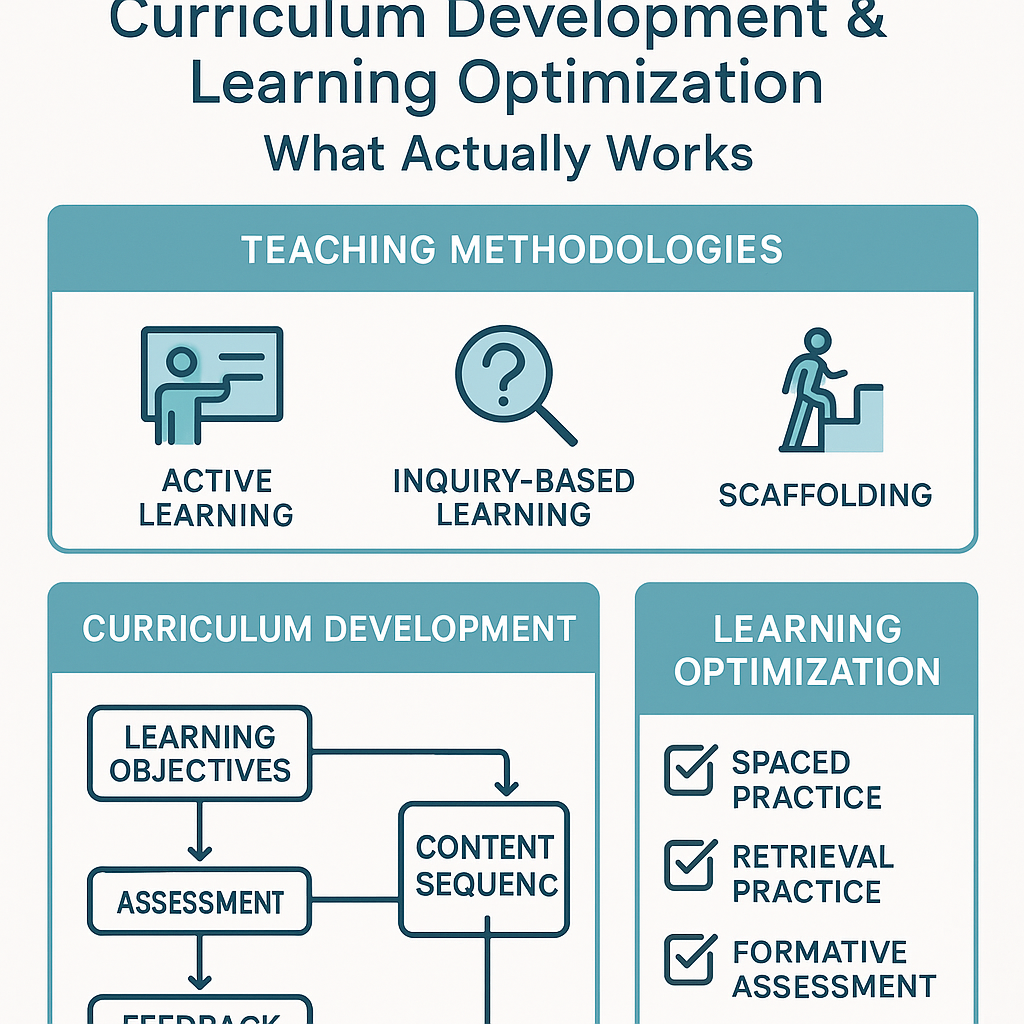
What is teaching methodology, curriculum development, and learning optimization?
Teaching methodology is the practical side of pedagogy. It covers direct instruction, inquiry-based learning, discussion, cooperative learning, modeling, scaffolding, and other approaches used to help students build understanding. The word gets abused. People often use it as a fancy label for whatever they already like. That is sloppy. A method should be judged by whether it helps learners reach a defined result, not by how trendy it sounds.
Curriculum development is the process of deciding what students should learn, in what order, and for what reason. It includes standards, units, learning progressions, materials, and assessments. A curriculum is coherent when each part supports the next. If content is random, students experience school as a pile of unrelated tasks. Nobody learns well that way.
Learning optimization is the disciplined effort to improve the efficiency and durability of learning. It draws on cognitive science, instructional design, and classroom practice. It asks blunt questions: How much should students already know? When should practice happen? What kind of feedback actually changes performance? What can be cut without hurting understanding? If a lesson is bloated, unclear, or too fast, optimization means fixing the lesson instead of blaming the students.
When I analyze strong classrooms, one pattern keeps showing up. Teachers make expectations visible. They model work before asking for it. They check for understanding instead of assuming it. They return to important ideas over time. That is not glamorous. It works.
The best framework here is simple: align learning outcomes, teaching method, and assessment. If the outcome is analysis, the method must include analysis, and the assessment must measure analysis. If the outcome is factual recall, then practice should reinforce memory. Mismatch is the silent killer of instruction.
There is also a moral edge here, though people rarely say it plainly. Education should serve truth and human flourishing. If a curriculum trains compliance but not judgment, or rewards performance but not understanding, it falls short of its purpose. A school can do more than produce workers. It can help form wise people. That matters.
Core benefits and why this matters
Why should anyone care? Because weak teaching wastes time, and weak curriculum wastes years. Students cannot afford that. Teachers cannot either.
- Better retention: When lessons use retrieval practice, spaced review, and worked examples, students remember more for longer. This is boring compared with flashy tech, but it is the truth.
- Clearer expectations: Students perform better when they know what success looks like. Vague instructions create anxiety and shallow work.
- Stronger transfer: A well-built curriculum moves from simple to complex in a way students can actually follow, so knowledge is available in new settings.
- More efficient teaching: Good design reduces re-teaching caused by confusion, and that saves time for deeper work.
- Improved equity: Clear structure, explicit instruction, and thoughtful scaffolding help more learners access the same essential content.
- Healthier student engagement: Real engagement is not giggling or constant group work. It is sustained effort on meaningful tasks.
- Better assessment quality: When teaching and testing are aligned, assessment becomes useful instead of punitive.
- Stronger teacher judgment: Good curriculum does not replace the teacher. It sharpens the teacher’s decisions.
Let’s be real. A lot of schools talk about “engagement” when they mean entertainment. That is not the same thing. Students can be busy and still be lost. They can also be quiet and learning deeply. The goal is not volume; the goal is understanding.
Here is a contrarian point worth keeping. Some methods sold as innovative are actually just repackaged confusion. Project-based learning can be excellent, but only when students already have enough background knowledge to do meaningful work. Inquiry can be powerful, but not when novices are dumped into open-ended tasks with no guidance. Collaborative learning can help, but not when one student does the work and the rest coast. The method is not the hero. The design is.
Learning optimization also protects attention, which is a limited good. In a world of interruptions, school should be one place where minds are trained to focus on what is true and worthwhile. That is not sentimental. It is necessary.
If you want a practical primer on study habits that support classroom learning, see effective study habits and retrieval practice strategies. Both pair well with classroom instruction, because learning does not stop when the bell rings.
Step-by-step implementation guide
If you want this to work, build it in order. Skipping steps is how people end up with pretty slides and weak outcomes.
- Define the learning outcomes first.
Write outcomes that describe what students should know, do, or explain by the end. Use measurable verbs. Avoid mushy language like “understand” unless you define what understanding looks like. If you cannot assess it, you probably have not defined it well. - Map the prerequisite knowledge.
Every topic depends on earlier knowledge. I have seen teachers assume students can analyze a text before they can decode its vocabulary. That is backward. Identify the gaps first, then plan support. - Choose the method that fits the goal.
Direct instruction works well for new and complex material. Inquiry works better after some grounding. Discussion is useful when students already have something to discuss. Cooperative learning helps when roles are clear. Pick the tool for the task. - Sequence content from simple to complex.
Curriculum development should follow cognitive load, not adult vanity. Start with examples, then move to abstraction. Revisit important ideas across units. This is how memory sticks. - Build in practice and retrieval.
Students need repeated chances to recall and use knowledge. Short quizzes, warm-ups, exit tickets, and cumulative review all help. APA research on retrieval practice supports what many good teachers already know from experience. - Use feedback that changes performance.
Feedback should be specific, timely, and linked to the task. “Good job” is polite and useless. Tell students what was accurate, what was missing, and what to do next. - Check for understanding during the lesson.
Do not wait until the exam to discover confusion. Ask for examples, paraphrases, quick writes, worked steps, or brief oral responses. Then adjust. This is where many teachers save the lesson. - Align assessments with the taught content.
If you teach reasoning, test reasoning. If you teach writing, test writing. Misaligned assessment creates distrust and bad data. - Review and revise using evidence.
Look at student work, item analysis, completion rates, and common errors. I have found that simple tracking tells you more than a stack of theory. Refine the plan, then teach again. - Protect the human element.
A strong curriculum is not sterile. It leaves room for conversation, curiosity, and moral formation. Students are not machines. They are persons, and education should honor that.
If you need a practical model for planning lessons, use a backward design approach. The principle is plain: begin with the end in mind, then build the path back to the starting point. ASCD’s overview of Understanding by Design remains useful because it forces coherence. Coherence beats decoration.

Comparison table
| Approach | Strengths | Weaknesses | Best Use Case | Typical Risk |
|---|
| Teaching methodologies + curriculum development + learning optimization | Aligns instruction, content, and assessment; improves retention; supports durable understanding | Requires planning and discipline; less flashy than trendy models | K-12, higher ed, training programs, and remediation | Can be undermined by poor implementation or weak teacher support |
| Trend-driven “student-centered” improvisation | Feels flexible; may increase short-term activity | Often lacks sequencing, clarity, and measurable outcomes | Occasional enrichment or brainstorming | Activity replaces learning |
| Pure lecture with no feedback | Efficient for delivering lots of information fast | Low retention, weak engagement, little adaptation | Brief overviews or expert updates | Students nod, then forget |
| Unguided discovery learning | Can build curiosity in advanced learners | Too much cognitive load for novices | Advanced projects with strong support | Confusion masquerading as independence |
| Off-the-shelf scripted curriculum used blindly | Saves planning time; easy to standardize | May ignore local needs and teacher judgment | Highly standardized settings | Mechanical teaching with shallow adaptation |
The biggest competitor is not another method. It is fragmentation. Schools often have disconnected materials, loose pacing, and assessments that measure the wrong thing. That is where the real damage happens.
A sound system avoids that mess by keeping the parts in conversation. The method supports the content. The curriculum structures the sequence. The assessment tells you whether the work actually landed. Simple. Not easy. Simple.
For educators comparing options, it helps to review evidence-based tools and supports. U.S. Department of Education guidance and university revision guidance both reinforce the same point: structure improves performance. Fancy rhetoric does not.
Common mistakes to avoid
Most errors in teaching are not dramatic. They are ordinary, repeated, and expensive.
- Confusing activity with learning. Students may make posters, discuss in circles, or click through slides, yet learn very little. Busy does not mean better.
- Using one method for everything. Direct instruction, practice, discussion, and inquiry each have a place. Treating one of them as sacred is childish.
- Ignoring prior knowledge. New learning attaches to what students already know. If that foundation is weak, the lesson collapses.
- Overloading lessons. Too many objectives, too many tasks, too many words. The brain is not a trash can.
- Skipping review. Without spaced review, students forget. The forgetting curve is not a myth.
- Writing fuzzy outcomes. If your outcome says “students will appreciate,” you have mostly written a feeling, not a goal.
- Assessing the wrong thing. If class emphasizes reasoning but the test asks for definitions only, the system lies.
- Ignoring feedback loops. Data that is never used is just paperwork.
Here’s the part people dislike. Some popular advice is just superstition with better branding. “Let students discover everything on their own.” No, not if they are novices. “Make every lesson fun.” No, not if fun gets in the way of challenge. “Use technology because students like it.” That is not a pedagogical argument. It is a sales pitch.
When I reviewed classroom designs that consistently produced strong learning outcomes, the same habits kept appearing: clear modeling, frequent checks for understanding, cumulative review, and assignments tied to the lesson goal. None of that is sexy. All of it is effective.
If you want a deeper look at how review supports retention, this NCBI article on retrieval and memory is worth your time. It is not fluffy, which is refreshing.
Frequently asked questions
What teaching methodology works best?
The best method depends on the goal, the learners, and the content. For new or complex material, direct instruction usually works well. For application and higher-order thinking, guided practice, discussion, and structured inquiry can be useful. The sensible answer is mixed methods with good sequencing.
How does curriculum development improve learning?
Curriculum development improves learning by creating a logical order of content, aligning instruction with assessment, and reducing gaps or redundancy. A coherent curriculum helps students build knowledge over time instead of bouncing from topic to topic like a loose ball.
What is learning optimization in education?
Learning optimization is the process of improving how students learn by reducing confusion, managing cognitive load, increasing retrieval practice, and giving useful feedback. It is about making instruction more efficient without cheapening the content.
Why do so many teaching trends fail?
Because they often focus on appearance instead of outcomes. A method can look modern and still be ineffective. If it does not improve understanding, retention, or performance, it is just educational decoration.
Final thought: teaching is not a stage performance, and curriculum is not bureaucracy for its own sake. Both exist to serve truth, growth, and the patient formation of persons who can think clearly, choose well, and act responsibly. That is a better aim than chasing novelty.
I have no patience for the idea that learning is mainly about convenience. It is demanding work. It asks for structure, repetition, correction, and humility. It also asks teachers to care enough to design carefully. When that happens, students get more than content. They get a chance to grow in wisdom, which is still the point, even if the spreadsheets never say so.
The truth is, excellent education is ordinary in its methods and extraordinary in its effects. It respects attention. It honors effort. It treats knowledge as something worth keeping. And it remembers that the human person is not a machine to be optimized, but a mind and soul to be formed well.