Teaching methods are not magic. They are tools for helping real people learn real things, and the best ones tie <strong>pedagogy</strong>...
Teaching methods are not magic. They are tools for helping real people learn real things, and the best ones tie pedagogy, curriculum, assessment, and learning outcomes into one coherent system. If a lesson does not change what students can do, say, or judge more accurately, it is mostly noise.
Key Takeaways- Clear learning goals come before clever activities.
- Curriculum should be sequenced, not stuffed.
- Assessment must measure the outcome you claim to value.
- Learning optimization depends on retrieval, spacing, feedback, and practice.
- Most teaching advice is overhyped; evidence matters more than slogans.
What is Teaching Methodologies, Curriculum Development, and Learning Optimization?
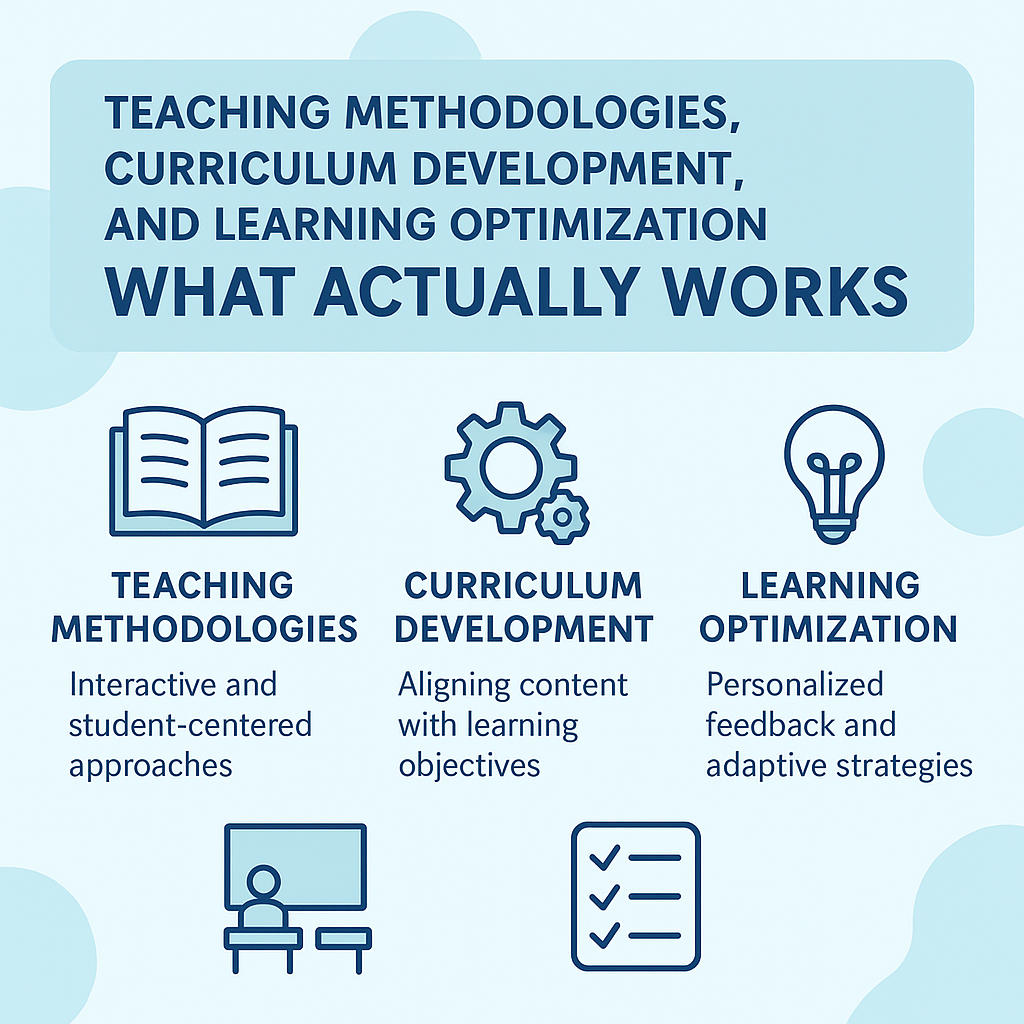
Teaching methodology is the practical design of how instruction happens, how a teacher explains, questions, models, checks, and corrects. Curriculum development is the planning of what gets taught, in what order, and for what purpose. Learning optimization is the evidence-based effort to make that instruction stick, so students remember, transfer, and use what they learned.
That sounds tidy. It rarely is.
When I analyzed how classrooms actually function, the same pattern kept showing up: weak results usually come from fuzzy goals, thin sequencing, and sloppy assessment, not from a lack of enthusiasm. People love to argue about whether a lesson is “interactive” enough, but that misses the point. A lively discussion can still produce shallow learning. A quiet worksheet can produce serious mastery if it is well timed, well framed, and followed by feedback.
The big mistake is treating teaching as performance art. It is not. It is disciplined human formation, and that includes intellect, character, judgment, and attention. Truth matters here. So does dignity. A student is not a data point to be managed; a student is a person to be taught. That distinction changes everything.
Good curriculum sequences content from simple to complex, from familiar to abstract, and from guided practice to independent performance. Good assessment checks whether students can actually do the thing, not whether they merely heard the thing. Good learning optimization uses cognitive science: spacing, retrieval practice, interleaving, worked examples, and timely feedback. The evidence for these is stronger than the noise around “learning styles,” which has been flogged to death and still does not hold up well in practice.
If you want a plain-English example, think about teaching writing. A method alone will not save you. Students need a curriculum that introduces sentence control, paragraph structure, evidence use, revision, and argument. They also need repeated practice, feedback, and models. Without that chain, the result is usually mush. Frankly, nobody needs more mush.
For a related framework on study behavior, see our guide to spaced repetition study methods. For classroom design, our piece on retrieval practice explains why recall beats re-reading. And if you want a broader planning lens, the article on curriculum mapping shows how to line up goals, lessons, and checks for understanding.
Core Benefits and Importance
Teaching methods matter because they determine whether learning is shallow, fragile, or durable. A well-built curriculum does not just cover material; it orders experience so students can actually absorb it. That is the difference between motion and progress.
Here is the kicker: good instruction often looks less exciting than bad instruction. The flashy lesson with posters, group chaos, and colorful fluff may feel modern, but if students cannot later explain the concept, it failed. Evidence from the What Works Clearinghouse practice guide on teaching secondary students to write effectively shows that explicit instruction, modeling, and feedback beat vague exhortation.
- Clearer learning outcomes — Students know what success looks like, and teachers know what to measure.
- Better knowledge retention — Spaced review and retrieval practice make memory stronger than cramming.
- Less wasted instructional time — Sequenced curriculum reduces backtracking and confusion.
- Stronger student engagement — Not the fake kind, either; the kind where students can do something with what they learned.
- Improved equity — Consistent structure helps more students access the content, especially those who do not already arrive with heavy background knowledge.
- Smarter assessment — Assessment becomes diagnostic instead of decorative.
- More durable transfer — Students can apply knowledge in new settings, which is the whole point.
The data keep pointing in the same direction. The American Educational Research Association has long supported instructional approaches grounded in evidence rather than fashion. The OECD’s work on teaching and learning also emphasizes the role of feedback, clarity, and cognitive demand in student achievement, not just “fun” activities. That matters because education is not a circus. It is a serious act of helping young people become capable, truthful, and free.
There is also a moral angle that too many schools ignore. When teaching is done well, it respects the student’s time and mind. It refuses to waste either. That is a quiet form of justice. A curriculum that is confused or bloated does not merely underperform; it can flatten curiosity and train students to expect nonsense. We should be better than that.
If you are comparing approaches, our review of instructional design fundamentals explains how structure beats improvisation in most settings. And if you want practical classroom moves, the formative assessment tools article shows how to check learning without turning every class into a test.

Step-by-Step Implementation Guide
You do not need a slogan. You need a sequence.
That sequence starts before the first lesson and ends after the last assessment, because teaching and curriculum development are systems, not isolated tricks. I have seen too many schools pile on technology, project work, or “innovative” methods without first asking whether the content is coherent. The answer is often no. Let’s be real.
- Define the learning outcomes — State what students should know, understand, and do. Use verbs that can be observed: explain, compare, solve, justify, evaluate. Avoid mushy goals like “appreciate” unless you can actually measure what that means.
- Map prerequisite knowledge — Students do not learn in a vacuum. If they lack vocabulary, background knowledge, or procedural skill, the lesson will slide off them like rain on glass. Identify what must come first.
- Sequence content carefully — Move from basic to complex, concrete to abstract, guided to independent. Cognitive load research, including work summarized by Sweller’s cognitive load theory overview, supports this approach because the brain has limits. Ignoring those limits is not bold; it is sloppy.
- Choose the method that fits the goal — Not every topic needs discussion. Not every skill needs discovery. Sometimes direct instruction is the fastest and cleanest route. Sometimes collaborative problem solving is useful. Sometimes a lab, lab report, or case study makes sense. The method should serve the learning, not your ego.
- Model first — Students often do better when they can see a worked example before they try the task themselves. This is not cheating. It is teaching.
- Build in retrieval practice — Ask students to recall prior knowledge regularly. Short quizzes, cold calling with care, exit tickets, and quick written responses help strengthen memory. The Retrieval Practice research site summarizes a large body of work showing that recall improves long-term retention better than passive review.
- Use formative assessment often — Check for understanding while instruction is still underway. Do not wait until the unit test to discover that half the class never got the point.
- Give feedback that says something — “Good job” is not feedback. Tell students what was correct, what was missing, and what to do next. Specific feedback is slower to give, yes, but it actually works.
- Revisit and interleave — Return to important ideas over time, and mix related skills rather than blocking all of one type together. That small inconvenience creates better retention and transfer.
- Revise the curriculum — A curriculum should age like a good tool, not rot like old bread. Review outcome data, student work, and teacher observations. Trim what is weak. Strengthen what produces results.
When I look at effective classrooms, I see this pattern again and again: teacher clarity, deliberate sequencing, frequent checks, and disciplined practice. None of that is glamorous. All of it is effective.
Comparison Table
The biggest competitor to evidence-based teaching is not another teaching method. It is casual, intuition-driven instruction dressed up as innovation. People keep selling it because it feels better than planning.
| Dimension | Evidence-Based Teaching, Curriculum, and Optimization | Trend-Driven, Ad Hoc Instruction |
|---|
| Learning goal clarity | Explicit and measurable | Vague and shifting |
| Sequence | Planned and cumulative | Fragmented or random |
| Assessment | Aligned to outcomes | Decorative or misaligned |
| Student retention | Built through retrieval and spacing | Relies on short-term exposure |
| Feedback | Specific and actionable | Generic or delayed |
| Teacher workload over time | Lower, because systems are repeatable | Higher, because every lesson is reinvented |
| Equity | Stronger access through structure | Uneven; rewards students with prior knowledge |
| Long-term results | More durable understanding and transfer | Shallow recall, fast forgetting |
The comparison is not flattering to fashionable teaching talk, but the evidence is stubborn. The U.S. Department of Education’s edtech guidance also stresses outcomes and evidence over gadget worship, which is refreshing for once. A shiny tool is still just a tool. If the teaching model is weak, the device only makes the weakness more expensive.
Common Mistakes to Avoid
Most teaching mistakes are old mistakes in new clothes. That is the annoying truth.
1. Confusing activity with learning — Students can be busy and still learn almost nothing. Group work, posters, and discussion are not proof of understanding. They are only methods. Measure the outcome.
2. Treating technology as a solution — Edtech can help with practice, feedback, and access, but it does not rescue a bad curriculum. The federal guidance above is useful precisely because it asks for evidence, not fanfare.
3. Overloading students with too much at once — More content is not automatically better. If students cannot process what you already gave them, adding more is just noise.
4. Skipping review — Teachers often move on too fast because pacing guides are tight and administrators breathe down their necks. Still, if you never revisit key ideas, students forget them. That is not a mystery. It is memory.
5. Using weak assessments — A worksheet that checks whether students copied notes is not an assessment of learning. It is a paper trail.
6. Pretending every learner needs a totally different method — Differentiation matters, but the “everyone learns differently” line is often oversold. Most students benefit from clear explanation, practice, feedback, and review. Special needs and language differences require real adjustment, but the core cognitive principles remain the same.
7. Ignoring character formation — This is the part many schools forget. Education is not only about performance scores. It is about helping students become attentive, truthful, disciplined, and capable of wise judgment. If a program raises scores but leaves students shallow or cynical, it has failed in a larger sense.
8. Writing bloated curriculum documents nobody uses — Curriculum should guide teaching, not sit in a folder like a museum relic. If teachers cannot read it, implement it, and improve it, it is too bloated.
Frankly, much of education suffers from paperwork fever. Schools produce plans, maps, matrices, and charts, then wonder why instruction still wobbles. The fix is not more jargon. It is tighter design and honest review.
Frequently Asked Questions
What teaching methodology works best?
There is no single best method for every subject, but explicit instruction, modeling, guided practice, and retrieval practice perform very well for core knowledge and foundational skills. For discussion-based subjects, structured questioning and carefully sequenced tasks help too. The method has to fit the goal.
How do you develop a strong curriculum?
Start with clear outcomes, identify prerequisite knowledge, sequence content logically, and align assessments with the goals. Then test the curriculum with real student work. If the evidence says students are not learning, revise it. No sacred cows.
What is learning optimization in education?
It is the use of research-backed techniques to improve retention, understanding, and transfer. That includes spacing, interleaving, retrieval practice, worked examples, and specific feedback. It is not a buzzword. It is basic cognitive sense.
Why do many teaching methods fail?
Because they are chosen for appearance instead of effect. Schools love novelty, but novelty fades fast. Methods fail when they ignore prior knowledge, overload students, or leave assessment disconnected from instruction.
Final Thought
Good teaching is humble work. It asks what the student needs, what the content requires, and what method will most faithfully connect the two. That is harder than it sounds, because ego gets in the way and fashion never stops selling itself.
When I step back and look at the best classrooms, I do not see theatrics. I see order, clarity, patience, and a respect for reality. Students are guided from ignorance toward understanding, from confusion toward judgment, and from scattered facts toward wisdom. That is not just efficient. It is decent.
And decent matters. A school should not merely produce workers, test scores, or polished resumes. It should help form people who can tell truth from nonsense, handle difficulty without panic, and use knowledge for the common good. In a culture fond of noise, that kind of formation is rare. It should not be.
So use methods that work. Build a curriculum that makes sense. Optimize learning with evidence, not superstition. The rest is decoration.