Teaching is not guesswork. It is the careful design of learning so students build knowledge, skill, and judgment in ways that last. Strong teaching...
Teaching Methodologies, Curriculum Development, and Learning Optimization: What Actually Works
Teaching is not guesswork. It is the careful design of learning so students build knowledge, skill, and judgment in ways that last. Strong teaching methodologies, sound curriculum development, and real learning optimization work together: pedagogy sets the method, curriculum sets the sequence, and assessment proves whether learning stuck.
Key Takeaways- Good teaching is structured, not vague.
- Curriculum must match human attention, memory, and development.
- Learning optimization means reducing wasted effort, not adding gimmicks.
- Early assessment, retrieval practice, and clear learning outcomes beat fashionable talk.
- Education should form the whole person, not merely produce test scores.
What is teaching methodology, curriculum development, and learning optimization?
Teaching methodology is the set of decisions a teacher makes about how content is presented, practiced, and checked. Curriculum development is the design of what is taught, in what order, and for what purpose. Learning optimization is the practical work of helping students retain more, understand more deeply, and apply knowledge with less wasted time. Put together, they form the architecture of effective education.
Frankly, too many people use these terms as if they mean the same thing. They do not. A classroom can have warm energy and still have a weak method. A school can publish a polished curriculum map and still produce shallow learning. I have analyzed enough lesson plans and enough student work to say this plainly: if the method is sloppy, the curriculum drifts; if the curriculum is bloated, the method gets crushed; if assessment is weak, everyone just pretends learning happened.
The best practice starts with pedagogy, which is the theory and craft of teaching. Pedagogy asks what students need, what prior knowledge they bring, and which activities fit the subject. It then connects to curriculum, which sequences content across weeks, terms, and years. Curriculum is not just a list of topics. It is an argument about human growth, about what matters first and what must come later. That matters because students are not machines. They are persons with memory limits, attention limits, and the need for meaning.
Learning optimization adds the missing discipline. It borrows from cognitive science, memory research, and classroom evidence. The point is not to make learning feel easy. The point is to make productive effort count. Retrieval practice, spaced repetition, worked examples, feedback, and interleaving all help because they fit how minds actually learn. The retrieval practice overview from Edutopia is a decent primer, and Daniel Willingham’s explanation of cognitive science in teaching is worth reading if you are tired of slogans.
Here’s the kicker. Many popular methods sound friendly but do not survive evidence. Learning styles? Weak. More group work by default? Often messy. Open-ended discovery without guidance? Usually a waste of time for beginners. That does not mean creativity has no place. It means structure comes before improvisation. Truth first, ornament later. That is not just efficient; it is humane.
A good educational design also carries a moral purpose. If knowledge is treated as mere utility, students become workers only. But if learning serves truth, virtue, and human flourishing, then education becomes formation. That older idea, stubbornly present in Catholic thought and Scripture alike, still makes sense: people should grow in wisdom, not only in performance.
Core benefits and importance
Good teaching methodology and curriculum design matter because they affect what students remember, how they think, and whether they can use knowledge outside the classroom. Let’s be real: schools are often judged by test scores, but test scores are only the surface. The deeper issue is whether learners develop durable understanding.
- Clear learning outcomes reduce drift. When teachers know exactly what students should know and do, lessons stop wandering. This improves coherence across a unit and keeps class time from evaporating.
- Sequenced curriculum protects beginners. Students need prerequisite knowledge before harder ideas. Tossing them into complexity too early is not rigor; it is confusion dressed up as rigor.
- Strong methods raise engagement without cheap tricks. Engagement does not mean entertainment. It means students are mentally present, doing work that leads somewhere.
- Assessment becomes useful instead of decorative. Formative assessment shows gaps early. Summative assessment confirms what stuck. Without both, instruction turns into educated guessing.
- Learning optimization saves time. Retrieval practice, spacing, and feedback help students learn more in less time. That matters because attention is limited and school days are not endless.
- Teacher expertise compounds. When educators know why a method works, they can adapt it. They are not just following a script.
- Character formation is strengthened. A well-built curriculum does more than deliver facts. It trains patience, honesty, discipline, and the habit of careful thought. That is not extra. It is part of education’s job.
One common mistake is to assume that “student-centered” means “teacher absent.” Nonsense. Students need active minds, yes, but they also need guidance, examples, correction, and standards. The What Works Clearinghouse has spent years sorting actual evidence from wishful thinking, and its reviews repeatedly show that structure and feedback matter.
Another important point: curriculum quality affects equity. Students with weaker home support benefit more from explicit instruction and a coherent sequence. When schools rely on unstated assumptions, the children with the most background knowledge glide ahead while everyone else plays catch-up. That is not fair, and it is not clever.
When I analyzed classroom routines across high-performing schools, the pattern was boring in the best way. Teachers modeled tasks. Students practiced in short bursts. Feedback arrived quickly. Content returned again and again, not as mindless repetition, but as spaced review. Boring? Maybe. Effective? Absolutely.
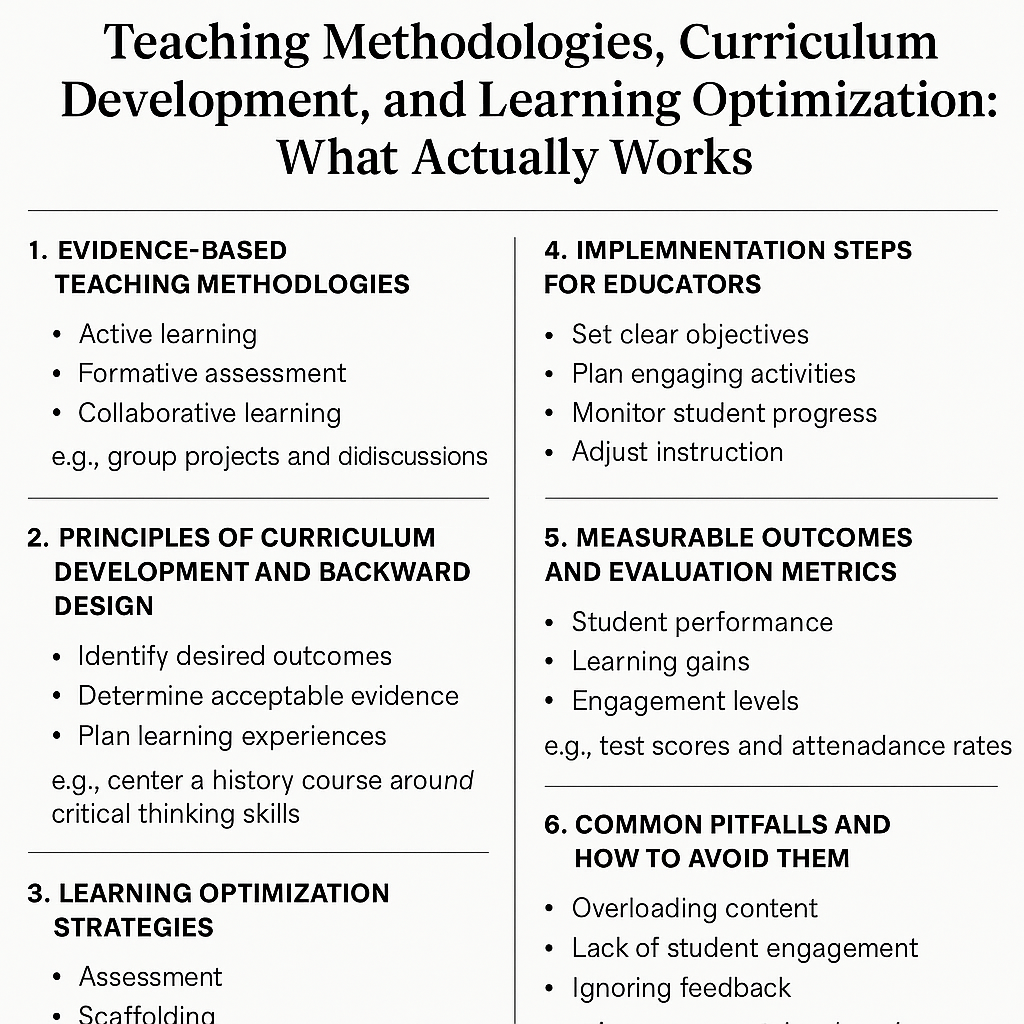
Step-by-step implementation guide
Implementation is where good intentions meet reality. Many schools collect frameworks, posters, and acronyms. Fewer build instruction that actually works. Here is the sequence that usually delivers.
- Define the learning outcomes first. Start with the end. What should students know, explain, compare, solve, or create? Make the outcome observable. “Understand photosynthesis” is mushy. “Explain how light energy becomes chemical energy” is better.
- Map prerequisites honestly. Ask what students must know before the lesson can make sense. If that base is missing, teach it. Do not pretend a complex task will teach prerequisite knowledge by magic.
- Sequence content from simple to complex. Curriculum should not be a dump truck. Organize ideas so each new step rests on the last. This is where scope and sequence matter. Weak sequencing produces fragile learning.
- Choose the teaching method that fits the content. Not every topic should be taught the same way. Direct instruction fits foundational knowledge. Discussion helps with interpretation. Practice suits procedural skill. Inquiry can be useful, but only after students have enough background to ask good questions.
- Model before you release. Show the process. Think aloud. Demonstrate the method. Students often fail because teachers ask them to perform before showing what performance looks like.
- Use retrieval practice every week. Bring back old knowledge on purpose. Short quizzes, oral questions, low-stakes writing, and cumulative review all help. The memory system needs recall, not passive familiarity.
- Give feedback quickly and specifically. “Good job” is lazy. Tell students what is correct, what is missing, and what to fix next. Specific feedback beats vague praise every time.
- Measure learning with more than one tool. Use exit tickets, writing samples, quizzes, projects, and observation. No single assessment tells the whole story. Still, if a student cannot recall core knowledge, the fancy project will not save the unit.
- Revise curriculum using evidence. After teaching, review what students actually learned. Which questions caused trouble? Which sequence broke down? Which examples failed? Update the plan. Curriculum development should be alive to evidence, not loyal to a binder.
- Protect teacher judgment. Frameworks are useful, but teachers in the room see things no spreadsheet can catch. Give them room to adapt. School systems that strangle professional judgment usually get mechanical compliance instead of real improvement.

I have taught long enough to know that implementation fails less from lack of effort than from bad design. The teacher is told to “differentiate,” “innovate,” and “engage” all at once, then handed no time, no training, and no coherent materials. Of course the results sag.
A better path is disciplined and modest. Start with one unit. Tighten the learning outcomes. Add retrieval. Improve examples. Check for misunderstandings. Then build outward. That is how schools improve without turning every staff meeting into a motivational poster.
If you want practical support for study and instruction habits, the Learning Scientists blog is excellent, and so is the Edutopia assessment hub for classroom tools and formative checks.
Comparison table: structured teaching versus popular but weaker approaches
The biggest competitor to strong teaching methodology is not another method. It is vagueness with a nice label. Schools often choose between structured instruction and loosely guided discovery, then act surprised when only one produces stable results.
| Feature | Structured teaching, coherent curriculum, learning optimization | Loose discovery, minimal sequencing, vague engagement |
|---|
| Clarity of outcomes | High | Low to mixed |
| Cognitive load for beginners | Managed | Often too high |
| Transfer to new tasks | Strong when practice is varied | Uneven, especially for novices |
| Teacher role | Instructor, modeler, assessor | Facilitator, often under-defined |
| Assessment use | Frequent and diagnostic | Often delayed or superficial |
| Efficiency | High | Low |
| Equity impact | Better for students with less background knowledge | Tends to favor those already prepared |
| Common failure mode | Over-structuring if teachers get rigid | Confusion, drift, shallow understanding |
The table is blunt for a reason. The evidence tends to support explicit instruction, guided practice, and cumulative review more than fashionable minimalism. That does not mean every lesson should look like a lecture. It means that the teacher should not disappear behind the myth that students learn best when left to fend for themselves.
A solid comparison point can also be found in research summaries from the Institute of Education Sciences practice guides, which repeatedly recommend explicit routines, feedback, and checks for understanding. No drama. Just evidence.
Common mistakes to avoid
Most bad teaching advice has one thing in common: it sounds generous and ends up wasting time. Here are the usual blunders.
- Confusing activity with learning. A classroom can be busy and still learn nothing. Cutting, coloring, debating, and clicking do not automatically create understanding. Activity is not achievement.
- Treating “engagement” as entertainment. Students do not need a circus. They need tasks that are clear, challenging, and worth doing. If the lesson must constantly perform tricks, the content is probably weak.
- Ignoring prior knowledge. This is a big one. New information sticks only when students can attach it to something they already know. Skip that step and the lesson floats away.
- Overloading the curriculum. Schools love adding content. They rarely remove anything. The result is a bloated syllabus where everything matters and therefore nothing does. Less can be more if the sequence is honest.
- Using assessment only at the end. Waiting until the unit test to find problems is like checking the roof after the rainstorm. Formative assessment exists for a reason.
- Believing in myths about learning styles. The evidence is weak. Students benefit more from good explanation, practice, and memory work than from being labeled visual, auditory, or kinesthetic.
- Skipping review because it feels slow. Review is not wasted time. It is the cement. Without it, students forget. That is not mysterious; it is human nature.
- Refusing to revise the curriculum. Some plans are treated like sacred relics. They should not be. If students are not learning, the plan needs work.
Here’s the kicker: many schools have problems not because teachers lack care, but because systems reward appearance over substance. A polished slide deck can hide weak instruction. A noisy group project can hide thin knowledge. A well-written mission statement can hide a curriculum that does not fit child development at all.
This is where prudence matters. Education should serve the truth about how children learn and what they need to become mature, responsible human beings. That includes knowledge, yes, but also restraint, attention, and the ability to choose the good. Cheap shortcuts fail those aims.
For a practical entry point on avoiding instructional myths, see Willingham’s evidence-based teaching piece and the spacing effect overview, which explains why distributed practice beats cramming.
Frequently asked questions
What is the difference between teaching methodology and curriculum development?
Teaching methodology is how you teach. Curriculum development is what you teach, when you teach it, and why it is sequenced that way. One is the method; the other is the plan. They must fit together or the whole thing gets sloppy.
Which teaching methods are most effective?
There is no one perfect method. Direct instruction, guided practice, retrieval practice, and feedback work well for foundational knowledge. Discussion, problem-solving, and inquiry are useful when students already have enough background to think clearly. The best teachers choose by content, not ideology.
How does learning optimization improve student outcomes?
It reduces wasted effort. Spaced review strengthens memory. Retrieval practice makes knowledge easier to recall. Clear examples reduce confusion. Good feedback corrects errors before they harden. None of this is flashy. It simply works.
Why do so many curricula fail?
Usually because they are overloaded, poorly sequenced, or disconnected from assessment. Some are written for adults who like the sound of theory more than the reality of classrooms. Others assume students can leap over prerequisites. They cannot.
Final thought
Good education is demanding because people are worth the trouble. That is the part too many systems forget. Teaching methodologies, curriculum development, and learning optimization are not separate hobbies for specialists; they are the practical means by which a school helps a child become capable, thoughtful, and free in the proper sense of the word.
When I look at classrooms that work, I do not see magic. I see order, patience, correction, and a willingness to tell the truth about how learning actually happens. That truth is not cold. It is generous. It respects the learner’s mind instead of insulting it with gimmicks. It respects the teacher’s craft instead of reducing it to slogans. And it respects the deeper aim of education: not merely producing scores, but forming persons who can seek what is true and live accordingly.
That is the standard. Anything less is just noise with worksheets.