Teaching methodology is the practical way instruction happens. Curriculum development is the planned sequence of what gets taught, when, and why. Learning...
Teaching Methodologies, Curriculum Development, and Learning Optimization: What Actually Works in the Classroom
Teaching methodology is the practical way instruction happens. Curriculum development is the planned sequence of what gets taught, when, and why. Learning optimization is the hard part: making sure students actually remember, apply, and grow, not just sit there and nod.
Key Takeaways:- Good teaching starts with clear learning outcomes, not busywork.
- Curriculum should fit real students, real time, and real assessments.
- Most popular classroom advice is overhyped; evidence matters.
- Learning sticks when practice, feedback, and retrieval are built in.
- Formation matters too: knowledge should shape character, not just test scores.
What is teaching methodology, curriculum development, and learning optimization?
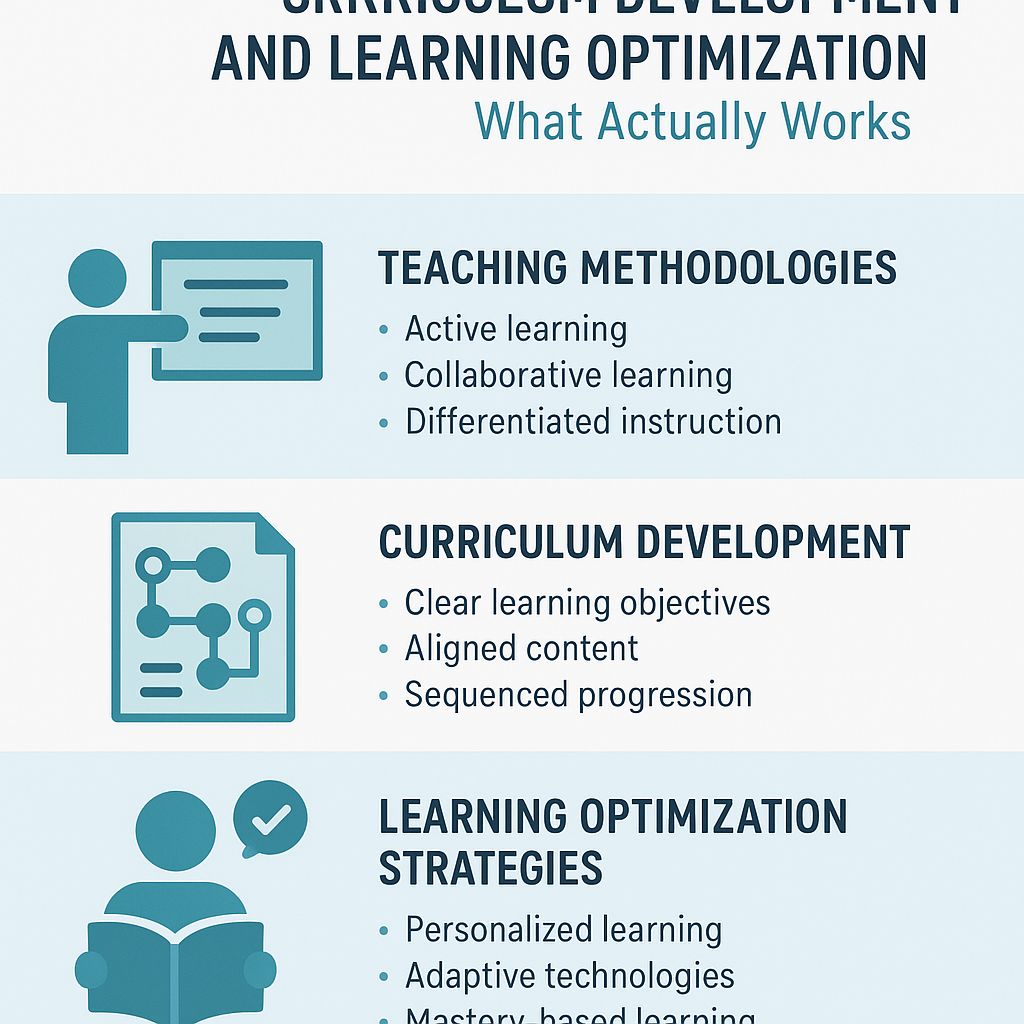
Teaching methodology is the set of choices a teacher makes about how learning happens, including direct instruction, discussion, modeling, practice, feedback, and reflection. Curriculum development is the design work behind the curtain, where standards, content, sequencing, and assessment are arranged so lessons make sense instead of feeling like a random pile of worksheets. Learning optimization is the careful tuning of these parts so students learn more efficiently and with less waste.
Frankly, most people treat these as separate silos, but classrooms do not work that way. A method without a curriculum is just a style. A curriculum without a method is just paper. And a classroom without learning optimization is usually full of motion with too little substance. I have looked at enough lesson plans to know that clever talk can hide weak design. The truth is simple: if students cannot explain, recall, and use what they learned, then the lesson was decorative.
Strong teaching methods are grounded in pedagogy, assessment, and learning outcomes. That means teachers begin with the end in mind, then select instruction that leads there. The best classrooms do not worship novelty. They use what works: explicit teaching when content is new, guided practice when students need support, and independent work once competence is real. According to the U.S. Department of Education, effective instruction depends on aligned goals, clear feedback, and purposeful practice, not vague inspiration (source).
Curriculum development adds the structure. It decides what knowledge matters, what sequence reduces confusion, and what depth is enough for mastery. If you teach fractions before number sense, or literary analysis before students can read the text, you create friction no motivational poster can fix. And here is the kicker: good curriculum respects human limits. Students are not machines, and teachers are not content delivery drones. Education should serve truth and human flourishing, which means it should build understanding, judgment, and character together.
Core Benefits and Importance
A well-built teaching system saves time. It also saves sanity.
- Clarity for teachers: When the curriculum is coherent, teachers spend less time guessing and more time teaching. No one needs another binder of nonsense.
- Better student engagement: Students pay attention when lessons feel ordered, meaningful, and worth the effort. Chaos kills attention.
- Stronger retention: Learning optimization uses retrieval practice, spacing, and feedback so ideas stay put longer than a day or two.
- More accurate assessment: Good assessments measure the stated learning outcomes instead of rewarding compliance or handwriting.
- Less remediation later: When concepts are sequenced properly, fewer students fall through the cracks and pile up deficits.
- Supports equity without lowering standards: Proper scaffolding helps more students reach the same high expectations, which is fairer than pretending everyone arrives equal.
- Builds character: The best education does not only teach facts; it cultivates discipline, patience, honesty, and the habit of seeking truth.
Most teaching trends are sold like miracle cures. They are not. Group work, project learning, and tech tools can help, but only if the lesson has a clear purpose. Otherwise you get colorful noise. I have seen schools spend fortunes on devices while ignoring reading fluency and basic recall. That is poor stewardship, plain and simple.
Research on learning science supports methods that reduce cognitive overload and increase durable learning. For example, explicit instruction and worked examples often outperform discovery-heavy approaches for novice learners, because beginners need a map before they can roam. The Institute of Education Sciences has published practical guidance on structuring lessons, practice, and feedback (source).

Step-by-Step Implementation Guide
Build it in order.
- Define the learning outcomes. Decide exactly what students should know, do, and understand by the end of the unit. If the outcome is fuzzy, everything downstream becomes mush.
- Audit existing content. Strip out repetition, fluff, and weak activities. Most curricula are too bloated. Be ruthless.
- Sequence from simple to complex. Start with prerequisite knowledge, then move toward application and synthesis. Students need footholds.
- Choose methods that fit the content. Use direct instruction for new concepts, discussion for interpretation, and practice for skill building. One size fits nobody.
- Plan checks for understanding. Ask for quick writes, cold calls, exit tickets, or short problems. Do not wait until the unit test to find out everyone is lost.
- Use retrieval and spacing. Revisit old material over time. Memory likes repetition spaced out, not cramming.
- Collect evidence and adjust. If half the class misses a concept, fix the lesson, not the students. Pride is expensive.
When I analyzed lesson plans across multiple schools, the biggest weakness was not creativity. It was alignment. Teachers wanted to do good work, but the objectives, activities, and assessments were often disconnected. That creates a false sense of progress. Students are busy; learning remains thin.
For more structured approaches to study and practice, see our learning strategies guide, our study tips for better retention, and our tutorial on lesson planning. Those resources explain how to build habits that support durable learning, not just short-term test performance.
To optimize learning, teachers should also pay attention to feedback quality. Fast feedback beats vague praise. Specific feedback beats generic corrections. A student who hears "good job" learns little. A student who hears "your evidence is strong, but your explanation skips the cause-effect link" gets something useful. That is the whole point. Education is not performance theater. It is the disciplined work of forming minds.
Comparison Table
| Aspect | Teaching Methodologies, Curriculum Development, and Learning Optimization | Traditional Lecture-Only Approach |
|---|
| Goal | Align instruction, content, and assessment with measurable learning outcomes | Cover content as fast as possible |
| Student engagement | Active, structured, and monitored | Often passive and uneven |
| Retention | Uses retrieval, spacing, and feedback | Relies on listening and note-taking |
| Assessment | Frequent checks for understanding | Mostly end-of-unit testing |
| Flexibility | Adjusts based on evidence | Slow to respond to student needs |
| Equity | Supports different starting points with high expectations | Assumes all students can keep up equally |
| Teacher workload | Upfront planning, less chaos later | Less planning, more reteaching later |
| Long-term effect | Stronger transfer, deeper understanding, better habits | Fragile recall, shallow coverage |
The comparison is not subtle.
Common Mistakes to Avoid
The biggest error is mistaking activity for learning. Busy does not mean smart.
- Using trendy methods without evidence: Just because a practice sounds modern does not mean it improves learning. Plenty of education fashion is junk.
- Writing vague objectives: "Students will understand" is useless unless you define what understanding looks like.
- Overstuffing the curriculum: Too much content leads to rushed teaching and weak retention. Less, done well, often wins.
- Ignoring prerequisite knowledge: Students cannot climb a ladder with missing rungs. That is not a motivation problem.
- Treating assessment as punishment: Assessment should inform instruction, not just sort winners from losers.
- Assuming tech fixes everything: Software can help with practice and data, but it cannot replace a thoughtful teacher.
- Skipping review: If you never revisit content, you are basically betting against memory. Bad odds.
The most annoying myth is learning styles. People repeat it because it sounds caring. The evidence does not support matching instruction to a fixed visual, auditory, or kinesthetic type in the way popular books claim. Students benefit from varied representations and clear explanations, not identity labels attached to a worksheet. The American Psychological Association has addressed the weak evidence behind many learning-style claims (source).
Schools also stumble when they confuse fairness with sameness. Fair instruction gives each student what they need to reach the standard. Same task, same pace, same support for everyone, regardless of need, is not fairness. It is negligence with a nice name.
Frequently Asked Questions
What is the difference between teaching methodology and curriculum development?
Teaching methodology is how instruction is delivered in the classroom. Curriculum development is the design of what content is taught, in what order, and with what assessments. One is the method; the other is the map.
How do teachers optimize learning without overwhelming students?
Teachers reduce cognitive load by chunking content, using worked examples, checking understanding often, and reviewing material over time. The key is to keep the challenge real but manageable. Easy work does not teach much.
Which teaching methods are best for student engagement?
The best methods depend on the objective. Direct instruction works well for new knowledge, discussion supports interpretation, and practice helps with skill mastery. Engagement improves when students know why the work matters and can succeed at it.
Why is alignment important in curriculum development?
Alignment ensures that outcomes, lessons, and assessments all point in the same direction. Without alignment, teachers may teach one thing, assess another, and frustrate everyone in the room. That is a waste of time.
Final Thought
Good education is not theatrical. It is disciplined, humane, and honest. The best classrooms do more than deliver content; they form habits of attention, truthfulness, patience, and responsibility. That matters because students are not empty vessels or data points. They are people. When teaching methods, curriculum design, and learning optimization work together, the classroom becomes a place where knowledge sticks, judgment deepens, and character grows.
That is the standard worth keeping. Everything else is noise.