Teaching methodology is the practical way a teacher gets students from ignorance to understanding. Curriculum development is the plan that decides what gets...
Teaching methodology is the practical way a teacher gets students from ignorance to understanding. Curriculum development is the plan that decides what gets taught, when, and why. Learning optimization is the careful work of making instruction stick, so students remember, transfer, and use knowledge rather than merely recite it. Too much edtech advice misses that simple truth.
Key Takeaways- Good teaching starts with clear learning outcomes and honest assessment.
- Curriculum should be coherent, not a pile of disconnected activities.
- Active learning beats passive listening for most subjects.
- Spaced practice, retrieval, and feedback improve retention.
- Technology helps when it serves instruction, not when it runs the class.
What is teaching methodology?
It is the set of methods, routines, and classroom moves a teacher uses to help students learn. That sounds obvious, because it is. Yet people keep dressing it up in jargon and calling it innovation. When I analyzed classroom practice, the pattern was plain: the best teachers did not use one magic method; they matched method to content, age, and purpose. Some lessons need direct instruction. Some need discussion. Some need lab work or writing. What matters is fit.
Teaching methodology is not the same as a fad. It is not a poster on the wall. It is the daily craft of deciding whether students need explanation, modeling, practice, questioning, or correction. Research from What Works Clearinghouse and guidance from the U.S. Department of Education keep circling the same point: students learn more when teachers make thinking visible, check understanding often, and reduce confusion before it hardens into habit. Frankly, that is just good sense.
Curriculum development is the larger design layer. It defines scope, sequence, and depth. It asks what content matters, what comes first, and how one idea prepares the ground for the next. A decent curriculum does not chase novelty for its own sake. It protects continuity. It respects memory. It assumes that children, like adults, learn by building on prior knowledge. The Church has always understood that truth forms the whole person, not just the test score; good curriculum should do the same.
Learning optimization is the practical side of memory and performance. It means using retrieval practice, spacing, interleaving, elaboration, and timely feedback so that learning lasts. The evidence is strong. AERA research summaries and the American Psychological Association repeatedly show that students forget quickly when instruction is crammed and passive. They retain more when they are asked to recall, explain, apply, and revisit ideas over time. No, students do not absorb knowledge by osmosis.
The real trick is alignment. Methodology, curriculum, and learning optimization have to point the same direction. If the curriculum says students should analyze historical causes, but the teaching method is just note copying and the assessment is multiple-choice trivia, the whole thing is a mess. You cannot call that coherence. You can call it waste.
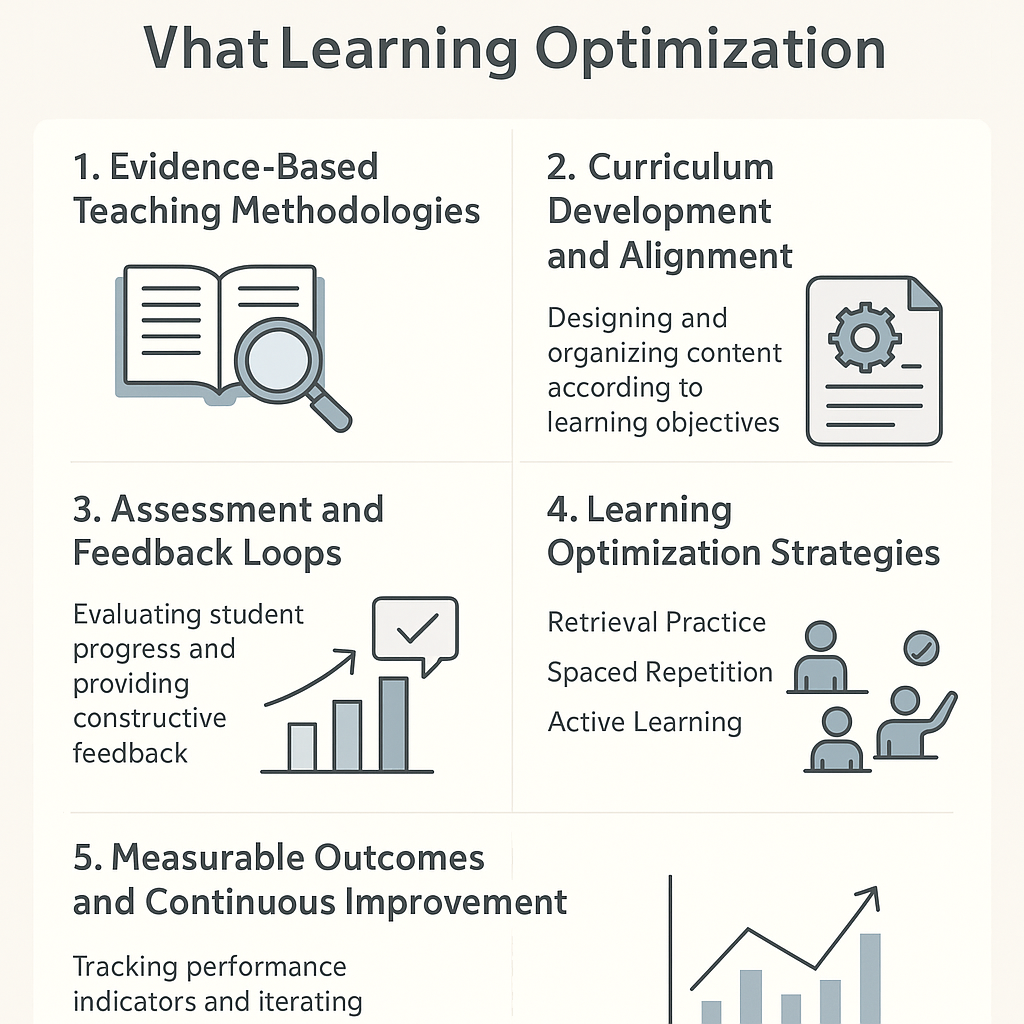
Core benefits and importance
Core benefits and importance are easy to state and hard to fake. First, clear methodology reduces classroom confusion. Students know what to do, and teachers spend less time re-explaining basic tasks. Second, strong curriculum development improves equity because every class gets access to the same essential knowledge, instead of depending on whether a student happened to land in a lucky room with a strong teacher. Third, learning optimization improves retention, which means fewer review cycles and better transfer to new tasks. Here’s the kicker: these benefits matter most for students who struggle, not the ones who already catch on fast.
There is also a moral argument, though people rarely say it out loud. Education should cultivate judgment, discipline, and care for truth. That means curriculum cannot be reduced to test prep scripts, and methodology cannot be reduced to entertainment. Students deserve more than noise. They deserve substance.
For classroom teachers, the benefits look like this:
- Better engagement when students are asked to think, write, solve, and speak.
- Cleaner lesson flow when objectives and checks for understanding are explicit.
- Stronger recall when practice is spaced rather than crammed.
- Better transfer when examples vary across contexts.
- Less burnout when teachers stop reinventing the wheel every week.
For schools and districts, the benefits are broader:
- More consistent instruction across classrooms.
- Easier onboarding for new teachers.
- Better curriculum review and revision cycles.
- Clearer data on which standards are being mastered.
- Fewer expensive tech purchases that sit unused.
Now the contrarian part. Not every method should be “student-led.” Not every lesson should be a group project. Not every topic benefits from discovery learning. Some things, like phonics, algebra procedures, and core scientific vocabulary, are learned faster with direct instruction and guided practice. The research backs that up, even if conference speakers sometimes pretend otherwise. Let’s be real.

Step-by-step implementation/guide
Step-by-step implementation starts with standards and ends with review. First, define the learning outcomes. If you cannot state what students should know or do, you are not designing a curriculum; you are improvising. Second, map prerequisite knowledge. A lesson on fractions fails if students still cannot partition wholes. Third, select teaching methods that match the content. Fourth, plan assessments before the lesson, not after. Fifth, build in retrieval and spacing so learning survives next week.
Here is the process I would actually use:
- Write the outcome in plain language.
- Identify the prior knowledge students need.
- Choose the best method: direct instruction, discussion, inquiry, lab work, or practice.
- Design a short check for understanding.
- Add independent practice with feedback.
- Schedule review a few days later, then again after more time.
- Adjust based on evidence, not vibes.
I have taught enough to know that vague goals produce vague lessons. If the goal is “understand photosynthesis,” that is mush. Better: “Explain how light energy is converted into chemical energy and use key vocabulary correctly.” Specificity matters because students cannot hit a target they cannot see.
Teaching methods should stay close to the cognitive load of the task. Beginners need structure. Experts need challenge. That is why a lesson should often move from explanation to modeling to guided practice to independent application. Sprinkle in discussion where it helps, not where it merely makes adults feel clever. When students are working with hard material, too much open-endedness slows them down. A bit of friction is useful. A swamp is not.
Learning optimization deserves its own practical habits. Use retrieval practice at the start of class. Ask students to write from memory before you re-teach anything. Mix problem types so students learn to choose strategies, not just repeat patterns. Space review across days and weeks. Give feedback that points to errors and next steps, not just a score. The evidence from cognitive science is boring in the best way: it keeps working.
Technology has a role, but it is a supporting one. Edtech can deliver practice, track progress, and offer quick feedback. It can also distract, fragment attention, and tempt schools into buying shiny tools instead of fixing instruction. If you want practical guidance on this, see the edtech implementation guide, the learning strategies resource hub, and the curriculum planning checklist. Those pages are useful because they focus on what teachers actually do, not on vendor poetry.
Comparison table
Here is the comparison table, because plain comparisons beat vague cheerleading:
| Feature | Strong Teaching Methodology + Curriculum Development | Competitor: Tech-First, Script-Light Instruction |
|---|
| Main focus | Understanding, practice, and transfer | Software use and surface engagement |
| Lesson design | Aligned outcomes, instruction, and assessment | Tool-driven activities with loose goals |
| Teacher role | Expert planner and guide | Facilitator watching the dashboard |
| Student role | Think, recall, write, solve, discuss | Click, watch, respond, move on |
| Retention | High, when spaced and retrieved | Often weak without follow-up |
| Equity | More consistent across classes | Depends on access and teacher confidence |
| Cost | Uses planning time well | Can become expensive fast |
| Best use | Core instruction and mastery | Practice support, tracking, remediation |
Common mistakes to avoid
Common mistakes are predictable. People copy fashionable methods without checking the evidence. They confuse engagement with learning. They use tech to decorate a weak lesson. They write curricula full of activities but light on knowledge. They assess trivia and then wonder why students cannot think. Honestly, that is not a mystery; it is bad design.
A few errors show up again and again:
- Treating learning styles as if they were settled science. They are not.
- Assuming discussion automatically means deep thinking. It often does not.
- Packing curricula with too many standards and too little time.
- Ignoring review because it feels less exciting than new material.
- Measuring what is easy instead of what matters.
I have a special irritation for the myth that students should discover everything themselves. Discovery has a place, but it is a poor default for novices. If you ask students to invent the wheel every day, they will mostly make mud pies. Explain the core, then let them wrestle with it.
Frequently asked questions
Q: What is the difference between teaching methodology and curriculum development?
A: Teaching methodology is how instruction happens in the room. Curriculum development is the plan for what gets taught and in what order.
Q: Which teaching method works best?
A: It depends on the content, the age of the students, and their prior knowledge. Direct instruction often works well for beginners and complex procedures; discussion and inquiry work better once students know the basics.
Q: How does learning optimization improve student outcomes?
A: It improves retention and transfer by using retrieval practice, spacing, interleaving, and feedback. Students remember more and forget less.
Q: Is edtech necessary for good instruction?
A: No. It can help when used with purpose, but it does not replace clear teaching, coherent curriculum, or solid assessment.
Final thought
The final thought is simple. Good education is not about entertaining children until the bell rings. It is about forming minds, habits, and judgment so students can meet reality with clarity and courage. Teaching methodologies, curriculum development, and learning optimization are the tools that make that possible when they are used with discipline, humility, and respect for truth. The classroom deserves less hype and more craftsmanship.