Teaching methodologies shape how students learn. Curriculum development decides what they learn and why. Learning optimization ties the whole thing together...
Teaching methodologies shape how students learn. Curriculum development decides what they learn and why. Learning optimization ties the whole thing together, so effort turns into actual progress instead of busywork. Frankly, most schools talk about these ideas like they are magic. They are not. They are tools, and tools only work when people use them with discipline, evidence, and a clear aim toward truth and human growth.
Key Takeaways:
- Good teaching begins with clear learning outcomes, not clever slides.
- Curriculum alignment matters more than random activities.
- Assessment should measure understanding, not just compliance.
- The best classrooms use retrieval practice, spaced review, and feedback.
- Learning optimization is about reducing waste, confusion, and false confidence.
- Student dignity matters. Knowledge is not just utility; it forms the person.
What is teaching methodology?
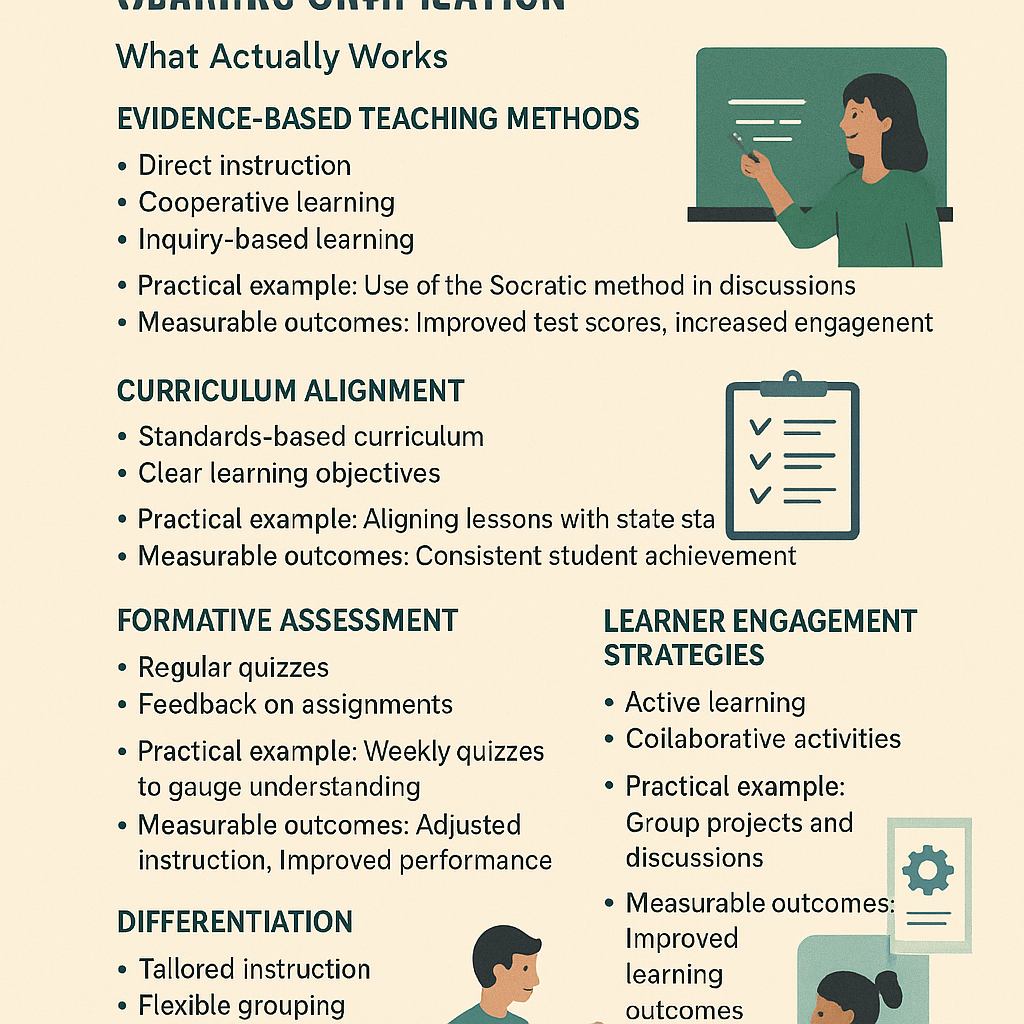
Teaching methodology is the set of principles and practices a teacher uses to move students toward learning goals. It includes direct instruction, discussion, inquiry-based learning, cooperative learning, modeling, guided practice, and feedback routines. A method is not the same thing as a mood. It is not “whatever feels modern.” It is a deliberate way of organizing attention, explanation, practice, and assessment.
Here’s the kicker: many people treat methodology as a contest between camps. Lecture versus discovery. Traditional versus progressive. That framing is sloppy. In real classrooms, the better question is simpler: what method fits this content, this group of learners, and this learning outcome? I’ve analyzed plenty of lesson plans, and the weakest ones are the flashy ones with no mechanism. Students cannot absorb what was never clearly taught.
A sound methodology respects cognitive load. If the material is complex, students need structure. If the goal is analysis, they need examples and non-examples. If the goal is skill, they need repetition, correction, and timely feedback. That is not glamorous. It is effective.
Good methodology also respects the learner as a person, not a score factory. That is where a healthier philosophy of education comes in. Human beings are made for truth, not just performance. Teaching should form intellect, judgment, and character together. A classroom that produces cleverness without virtue has missed the point.
Methodology is also inseparable from pedagogy. Pedagogy asks how people learn best. Curriculum asks what is worth learning. Assessment asks what evidence proves learning has occurred. Break those apart and the system starts leaking. Keep them aligned and the classroom has a fighting chance.
For a strong research base, see the U.S. Department of Education’s overview of evidence-based teaching practices at What Works Clearinghouse, and the EEF’s practical guidance on teaching and learning at EEF guidance reports.
Core benefits and importance
Teaching methodology matters because students remember patterns, not intentions. A teacher may care deeply, but if the lesson lacks structure, the class drifts. A curriculum may be ambitious, but if it is not sequenced well, the content collapses under its own weight. Let’s be real: good intentions do not teach fractions.
- Clarity improves retention. Students learn faster when the teacher makes goals, models, and success criteria plain.
- Consistency lowers confusion. Predictable routines reduce wasted mental effort, especially for younger learners and students with learning gaps.
- Alignment strengthens outcomes. When instruction, curriculum, and assessment match, grades mean something.
- Feedback speeds correction. Timely feedback stops errors from hardening into habits.
- Equity improves when structure improves. Clear teaching helps students who do not have tutors, stable home support, or prior academic advantages.
- Higher-order thinking depends on basics. You cannot analyze a text you cannot comprehend.
- Teacher workload becomes more manageable. Strong systems reduce chaos, which is nice because chaos is expensive.
A contrarian point: not every “student-centered” idea is wise. Some versions of open-ended learning are just under-explained learning with nicer wallpaper. Students are not served by pretending struggle is noble when the task is simply unclear. Research on explicit instruction, formative assessment, and retrieval practice keeps saying the same thing: students learn more when the teacher sequences content carefully and checks understanding often.
Curriculum development matters for the same reason. A curriculum is not a pile of topics. It is a map of intellectual formation. What comes first? What must be secure before the next idea can land? Where do students need spiral review? If you ask those questions honestly, the curriculum gets sharper.
This is where learning optimization enters. The goal is not speed for its own sake. It is durable learning. Students should remember what matters, use it in new settings, and retain it long enough to build wisdom. That is a better standard than a quick quiz win.
Step-by-step implementation guide
A working system is built, not wished into existence. I’ve seen teachers burn hours on trendy materials and still get mediocre results because the sequence was wrong. Start with the basics. Then test them. Then refine them.
- Define the learning outcome first. Be concrete. “Understand history” is mush. “Explain three causes of the Reformation” is usable. Outcomes should identify knowledge, skill, or transfer. If you cannot assess it, it is not ready.
- Backward-map the curriculum. Decide what final performance matters, then work backward to the knowledge and subskills students need. This is classic curriculum design, and it still works because human brains need sequence. See Understanding by Design for a practical framework.
- Chunk the content. Small units beat giant dumps. I’ve watched too many classes fail because teachers covered too much, too fast. Chunking reduces cognitive overload and gives students room to process.
- Choose the method that matches the task. If the content is factual, use explicit explanation and retrieval. If the skill is argumentative writing, use modeling, guided practice, and revision. If the task is lab-based, use demonstration, supervision, and feedback. The method should serve the objective, not the other way around.
- Model the thinking. Think aloud. Show how experts solve the problem, identify errors, and make decisions. Students often do not fail because they are lazy. They fail because the mental process was invisible.
- Build in practice. Practice is where learning stops being fragile. Use low-stakes quizzes, worked examples, oral review, short writing, problem sets, and discussion prompts. If students never retrieve the material, they will not keep it.
- Use spaced review. Review after one day, then after a week, then after a month. This is not fancy. It is basic memory science. The Learning Scientists explain retrieval practice and spacing in plain language, which is rare and refreshing.
- Assess early and often. Assessment is not a punishment. It is a mirror. Use exit tickets, quick checks, and short tasks to see what students actually know. If the class is lost, the teacher needs evidence fast.
- Adjust instruction using the evidence. Re-teach what is weak. Extend what is secure. Drop what is ornamental. That last part matters. Too many curricula are stuffed with decorative content that impresses adults and slows students down.
- Optimize the environment. Seating, routines, materials, transitions, and noise levels all affect learning. The classroom is not sacred in the sentimental sense, but it is serious space. Order helps students attend, and attention is the doorway to learning.
- Protect feedback quality. Feedback should be specific, timely, and usable. “Good job” is not feedback. “Your claim is clear, but your evidence needs a page reference” is.
- Review the whole system each term. Ask what worked, what stalled, what students forgot, and where time leaked. Curriculum development is not a one-time event. It is maintenance.
If you want a broader policy angle, the OECD’s work on curriculum and learning is useful at OECD Education and Skills, and the IES practice guides are worth a look at WWC Practice Guides.
Comparison table
| Feature | Teaching Methodology + Curriculum + Learning Optimization | Competitor: Trend-Driven Instruction |
|---|
| Primary goal | Durable learning and clear outcomes | Novelty, engagement, or appearance |
| Lesson design | Sequenced, assessed, revised | Often improvised or copied |
| Curriculum structure | Coherent, cumulative, aligned | Fragmented, topic-heavy |
| Evidence use | Research-informed, student data reviewed | Anecdotes and staffroom folklore |
| Cognitive load | Managed carefully | Frequently ignored |
| Assessment | Frequent, formative, diagnostic | Mostly summative or performative |
| Student support | Explicit scaffolds and review | Assumes students will “figure it out” |
| Long-term impact | Better retention and transfer | Short-lived excitement, weak recall |
The table is blunt for a reason. One approach treats learning like craft. The other treats it like theater. Students may clap for theater, but they usually remember craft.

Common mistakes to avoid
Most teaching mistakes are not dramatic. They are ordinary. That is why they linger. People keep repeating them because they sound reasonable. Frankly, that is the problem.
Mistake 1: Confusing activity with learning. A worksheet, group project, or discussion is not proof of understanding. Students can be busy and still learn almost nothing. The task must force thinking tied to the objective.
Mistake 2: Overusing “discovery” without support. Pure inquiry sounds noble, but it often leaves novices stranded. Research consistently shows that beginners need guidance. Otherwise they guess, get frustrated, and call it growth.
Mistake 3: Treating curriculum as content coverage. Coverage is shallow. A strong curriculum is selective, sequenced, and cumulative. It builds on prior knowledge instead of stamping on it.
Mistake 4: Ignoring prior knowledge. Students are not blank slates. They bring gaps, misconceptions, language barriers, and partial understanding. Good teachers surface those issues early.
Mistake 5: Assuming one method fits all subjects. Reading comprehension, algebra, science labs, and rhetoric class do not need identical teaching moves. A rigid method is often a lazy one in a clean shirt.
Mistake 6: Using assessment only at the end. By the time the final exam arrives, it may be too late to fix the problem. Formative assessment exists so teachers can correct course while learning is still in motion.
Mistake 7: Forgetting character formation. This is where the deeper view matters. Education should shape honesty, patience, courage, and attention to truth. A student who can solve problems but not tell the truth about them is not truly educated.
Mistake 8: Chasing tools instead of habits. Digital platforms, apps, and dashboards can help. They can also distract. The tool is secondary. The teaching habit is primary.
If you need practical classroom research on avoiding ineffective habits, the EEF’s summaries are clear at Teaching and Learning Toolkit. It is not glamorous. It is useful.
Frequently asked questions
What is the difference between pedagogy and curriculum?
Pedagogy is how you teach. Curriculum is what you teach and in what order. They are related, but not identical. A weak curriculum can sabotage strong teaching, and a weak method can ruin a good curriculum.
Which teaching methodology works best?
There is no single best method for every subject or age group. Direct instruction, discussion, inquiry, and cooperative learning all have uses. The right method depends on the learning goal, the students’ prior knowledge, and the amount of guidance they need.
How do you optimize learning without making class boring?
Use retrieval practice, short explanations, meaningful practice, and frequent feedback. Boredom usually comes from confusion, passivity, or aimless activity. Students often like clarity more than adults expect.
Why does curriculum alignment matter so much?
Because students cannot be tested on what was never taught well. Alignment between standards, instruction, and assessment makes learning visible. Without it, schools end up measuring noise.
Final thought
Teaching is not a costume. It is a serious act of formation. The best methodology serves truth, the best curriculum orders knowledge well, and the best learning optimization strips away waste so students can actually grow. That growth is not merely technical. It is moral and intellectual, because a person is not a machine with better study habits.
I’ve spent enough time around classrooms to know this: the strongest teaching is usually plain, disciplined, and a bit unromantic. It explains. It checks. It reviews. It corrects. It respects the student enough to demand real understanding, not just the appearance of it. That is a harder standard than popular education slogans admit, but it is also a better one.
And that matters. Education should not just produce competent workers, though competence is good. It should form people who can think clearly, choose well, and serve the common good with humility. That is the quiet aim behind sound teaching, sane curriculum design, and serious learning optimization. Everything else is decoration.