Teaching works when method, curriculum, and assessment line up.
Teaching Methodologies, Curriculum Development, and Learning Optimization: What Actually Works
Teaching works when method, curriculum, and assessment line up.
A clever lesson plan means little if the goals are fuzzy, the practice is weak, and the assessment measures the wrong thing, because students learn through repetition, feedback, and meaning, not through decorative slides or fashionable terms. Frankly, the job is to form capable people, not to collect trendy buzzwords.
Key Takeaways:- Teaching methodologies are the routines and structures teachers use to move students from first exposure to real understanding.
- Curriculum development sets the sequence, depth, and coherence of what gets taught, and why.
- Learning optimization means improving retention, transfer, and performance through better practice, feedback, spacing, and assessment.
- The best systems align learning outcomes, instruction, and assessment.
- Most weak teaching advice sounds smart and fails in the room.
- Good teaching serves truth, habit, and human flourishing, not just test scores.
What is Teaching Methodologies, Curriculum Development, and Learning Optimization?
Teaching methodologies are the concrete ways a teacher helps students learn. Curriculum development is the deliberate design of what is taught, in what order, and to what depth. Learning optimization is the practical work of making learning stick, through feedback, retrieval practice, spacing, and clear expectations.
Simple enough?
That sounds tidy, but the reality is messier, because schools often mix these terms as if they were the same thing, which they are not. A teaching method is not a curriculum, and a curriculum is not a test prep packet dressed up in nicer clothes. When I analyzed classroom practice across different settings, the strongest results came when teachers used a clear method, a coherent sequence of content, and assessments that measured understanding rather than memorization alone.
Here’s the kicker: most public arguments about education focus on tools and slogans, while ignoring structure. A teacher can use discussion, direct instruction, project-based learning, or inquiry, but none of it works well if students do not know the purpose, the prior knowledge required, and the standard for success. Pedagogy is not a costume. It is the craft of helping another mind grow.
Good curriculum also carries moral weight. If education is meant to serve truth and human flourishing, then it must form the whole person—reason, judgment, discipline, and character—not merely produce correct answers on command. That is a very old idea, and a sane one. It means content must be chosen carefully, sequenced wisely, and taught with patience.
For a broader practical angle, see Edutopia on assessment, Reading Rockets on teaching students with learning disabilities, and AIR on formative assessment. Those sources do not solve everything, but they do remind us that evidence beats guesswork.
Core Benefits and Importance
Strong teaching methodology matters.
Why? Because students do not absorb knowledge by accident, and schools do not improve by wishful thinking, which is annoying but true.
- Clear learning outcomes help teachers decide what matters most, and what can be cut without guilt.
- Coherent curriculum sequencing reduces confusion, because students build one idea on top of another instead of bouncing around like loose change.
- Better retention comes from spaced review, retrieval practice, and cumulative checks, not from one giant exam at the end.
- Higher student engagement often follows clarity, routine, and challenge, not constant novelty. Novelty has its place, but it is overrated.
- Fairer assessment is possible when teachers measure the intended skill, rather than whatever happens to be easy to grade.
- Stronger teacher consistency appears when teams agree on essential content and common benchmarks.
- Improved transfer happens when students apply knowledge in new contexts, which is the whole point of learning, really.
Most people think “engagement” means entertainment. It does not.
A good lesson can be quiet, disciplined, and demanding, yet still deeply engaging because it gives students a foothold into a difficult idea. That is especially true in literacy, math, and science, where shallow activity can hide weak thinking. I’ve seen classrooms packed with movement and noise where almost nobody could explain the lesson five minutes later. Not great.
The importance of curriculum development is often underestimated because it is less flashy than teaching tricks. But if the sequence is broken, the best method gets dragged down. A child cannot analyze a text well if vocabulary, syntax, and background knowledge were never built. A student cannot solve algebraic problems if the earlier concepts were patchy. No mystery there.
For schools, the payoff is real: fewer gaps, cleaner instruction, and less time wasted re-teaching the same mess. For families, the payoff is trust. For students, the payoff is dignity. Learning should not feel like stumbling around in the dark.
If you want another practical angle, the Understanding by Design framework is still useful because it starts with the end in mind, then builds backward with discipline. That is not flashy, but it works.
Step-by-Step Implementation Guide
Start with the end.
That means identify the learning outcome first, then choose the instruction, practice, and assessment that fit it, because random activity dressed as pedagogy wastes everyone’s time.
- Define the learning outcome precisely
Write the outcome in plain language. Not “students will understand.” That is mush. Use verbs you can see: explain, compare, solve, justify, write, classify, evaluate. When I review weak lesson plans, the first problem is almost always vague targets. If you do not know what success looks like, you cannot teach toward it. Simple as that. - Identify prior knowledge
Students need something to attach new learning to. If the prior knowledge is missing, the lesson will skid. So check prerequisites before you teach. In practice, that may mean a short diagnostic quiz, a warm-up problem, or a quick discussion. This is not busywork; it is diagnostic medicine for instruction. - Select the teaching method that fits the task
Different goals need different methods. Direct instruction works well for foundational skills, while discussion works better when students already have enough knowledge to think clearly. Inquiry can be powerful, but only when students possess enough background to ask informed questions. Project-based learning can deepen transfer, but it is weak when used as a substitute for teaching core content. Here’s the thing: method should serve content, not ideology. Teachers should not pledge allegiance to one style like it is a sports team. - Sequence the curriculum logically
Move from simple to complex, concrete to abstract, known to unknown. That sounds obvious because it is. Yet many curricula throw students into complex tasks before building enough schema. Good sequencing saves time later. It also protects student confidence, which matters more than people admit. - Build in practice, retrieval, and feedback
Students remember what they pull from memory. So use low-stakes quizzes, oral questioning, practice problems, and cumulative reviews. Give feedback while the task is still fresh, not a week later when the error has already hardened. For more on this, see Carnegie Mellon on assessing learning and Edutopia on retrieval practice. - Align assessment with instruction
If you teach analysis, test analysis. If you teach problem solving, test problem solving. If your exam only rewards memorized definitions, students will study definitions and ignore the rest. That is not a student failure. That is a design failure. Blunt, but fair. - Review and revise
Curriculum is not sacred stone. It should be stable enough to trust and flexible enough to improve. Use student work, assessment data, and classroom observation to revise weak spots. I’ve found that the best teams discuss errors without drama, then fix the sequence instead of blaming the kids. That habit alone can change a school.
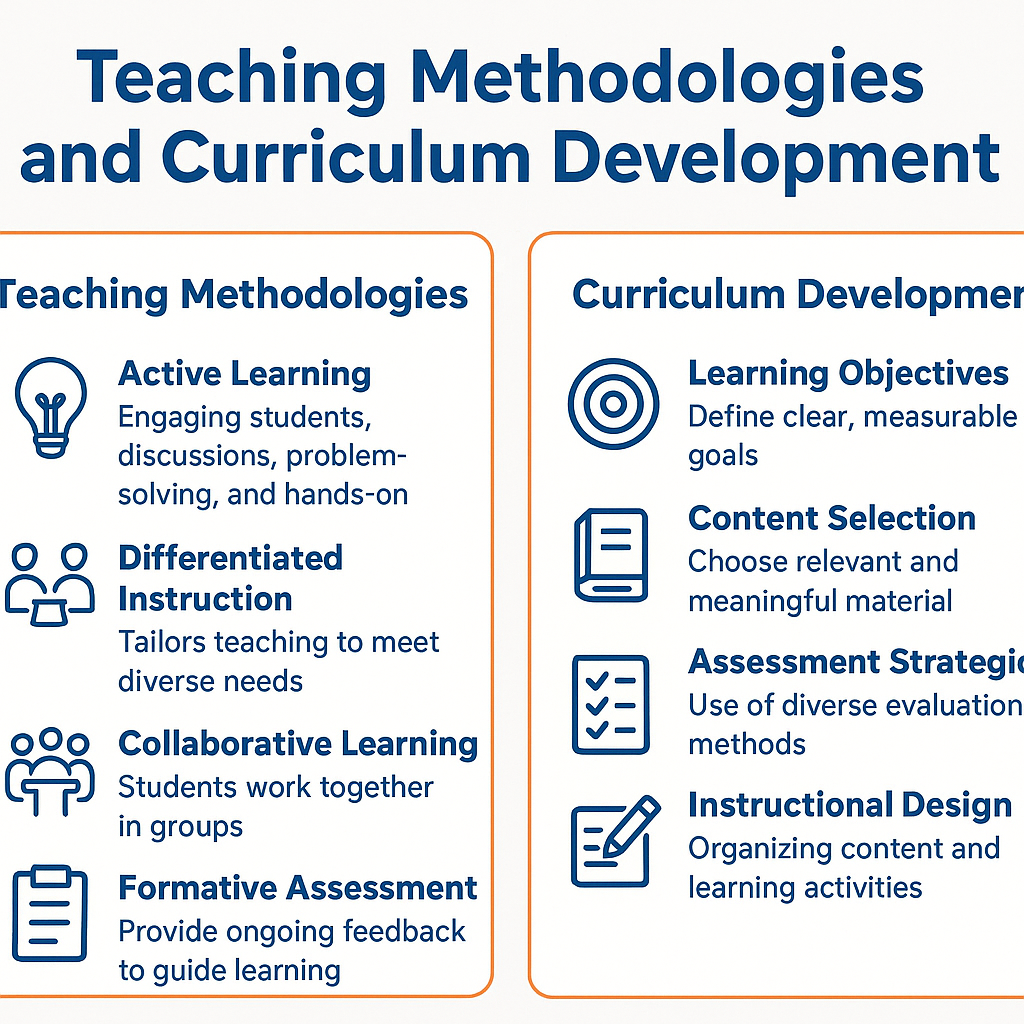
Comparison Table: Strong Curriculum vs. Random Activity-Based Teaching
Let’s compare the real thing with its biggest fake cousin.
| Feature | Strong Teaching Methodology + Curriculum | Random Activity-Based Teaching |
|---|
| Goal clarity | Explicit learning outcomes | Vague or shifting goals |
| Sequence | Carefully planned progression | Disconnected tasks |
| Student memory | Uses retrieval practice and spacing | Hopes exposure will stick |
| Assessment | Aligned to what was taught | Often measures the wrong skill |
| Teacher role | Designer, guide, and diagnostician | Activity facilitator only |
| Student effort | Structured challenge | Busywork or shallow participation |
| Long-term retention | Stronger, because review is built in | Weak, because practice is thin |
| Transfer to new problems | More likely | Less likely |
| Classroom clarity | High | Low |
| Common failure mode | Overplanning without adaptation | Chaos with nice labels |
Frankly, the table tells the story.
The competitor here is not a single curriculum vendor or method; it is the sloppy habit of mistaking activity for learning. That habit is everywhere, and it causes a mess. Students may enjoy the lesson, but enjoyment is not the same as mastery. A well-built curriculum, paired with deliberate methodology, produces better long-term results because it respects how memory and understanding actually work.
For a deeper evidence base, the American Psychological Association’s teaching and learning resources and What Works Clearinghouse are worth your time. No magic there—just evidence.

Common Mistakes to Avoid
Most bad advice sounds confident.
That is the problem. People love slogans, and schools are full of them, but slogans rarely improve learning.
- Mistaking student activity for learning. Group work, posters, and colored markers do not prove understanding. They are props unless the thinking is visible.
- Using “learning styles” as a planning rule. The evidence for rigid style matching is weak. Students benefit more from strong content, clear explanation, and practice across formats.
- Overusing discovery before foundation. Inquiry without background knowledge can waste time and frustrate students. A little friction is good; confusion is not a plan.
- Testing trivia instead of thinking. If the assessment only asks for recall, you will train recall. Shocking, I know.
- Ignoring cumulative review. Students forget quickly when review is absent. Memory needs repeated contact.
- Treating curriculum like a script. Teachers need judgment, not robotic compliance. Good design supports professional skill; it does not replace it.
- Chasing constant novelty. New apps, new games, new routines—some schools keep changing the wrapper while the learning problem stays the same. That gets old fast.
Here is what nobody tells you: more complexity is not always better. A cleaner lesson, tighter sequence, and sharper feedback often beat an elaborate lesson that tries to impress adults. I have seen too many teachers bury good content under layers of bells and whistles.
The deeper issue is formation. Education should train the mind toward truth, patience, and responsibility. That means we owe students real knowledge, not theatrical noise.
For a practical source on misconceptions, the Learning Scientists site is useful, especially on spacing, retrieval, and interleaving. Plain language, solid ideas. Rare enough.
Frequently Asked Questions
What is the difference between teaching methodology and curriculum development?
Teaching methodology is how you teach. Curriculum development is what you teach, in what order, and to what depth.
Which teaching methodology works best?
There is no single winner for every case. Direct instruction, guided practice, inquiry, and collaborative learning each have a place, but the best choice depends on the content, the learners, and the stage of learning. Foundational skills usually need more explicit instruction. Higher-order application often needs discussion and problem solving.
How does learning optimization improve student performance?
It improves retention and transfer through better practice, spacing, retrieval, and feedback. That means students remember more, make fewer repeat errors, and apply knowledge more accurately in new settings. Not glamorous, but effective.
Why do so many teaching reforms fail?
Because they focus on appearance, not structure. Schools often buy tools or announce frameworks without changing sequencing, assessment, or teacher training. Then everyone acts surprised when scores barely move.
Final Thought
Good teaching is not theatrical.
It is disciplined, humane work, and it asks teachers to think clearly about content, sequence, practice, and the real needs of students, who are not data points or clients but persons with minds worth training well. That is why teaching methodologies, curriculum development, and learning optimization belong together; separated, they weaken each other, but aligned, they produce something sturdy.
I’ve spent enough time around classrooms to know this: students thrive when adults tell the truth about what matters, set a sane path, and insist on actual understanding. Not every lesson will sparkle. Fine. Sparkle is cheap. But a well-built curriculum, taught with judgment and patience, can shape habits of attention and responsibility that last far beyond the test. That is the point, isn’t it?