Teaching works when method, curriculum, and assessment line up. If they do not, students feel busy but learn little, and that is the blunt truth.
Teaching Methodologies, Curriculum Development, and Learning Optimization: What Actually Improves Learning
Teaching works when method, curriculum, and assessment line up. If they do not, students feel busy but learn little, and that is the blunt truth.
Key Takeaways- Strong teaching starts with clear learning outcomes.
- Curriculum should sequence knowledge, not just activities.
- Assessment must check understanding, not merely compliance.
- Learning optimization depends on recall, practice, feedback, and spacing.
- Many popular classroom ideas sound nice but fail under scrutiny.
What is teaching methodology, curriculum development, and learning optimization?
It is the practical design of how knowledge moves from teacher to student, through instruction, tasks, feedback, and assessment, so that learners actually retain and apply what matters. The point is not spectacle. The point is formation—of skill, judgment, and character. Education should serve truth and human flourishing, not just the appearance of progress.
Here is the kicker: a method is not magic. I have analyzed enough lesson plans to know that a polished activity can hide thin thinking. Real pedagogy asks a harder question. What should students know, do, and become by the end? That is where curriculum enters, because curriculum is not a pile of worksheets. It is a sequence of carefully chosen knowledge, concepts, and practice that builds toward learning outcomes.
People still repeat the same tired nonsense about “learning styles” and “students just need engagement.” Frankly, that is weak tea. Engagement matters, yes, but only when it serves understanding. A room full of smiles does not prove learning. If students cannot retrieve the material later, the lesson was entertainment with a grade attached.
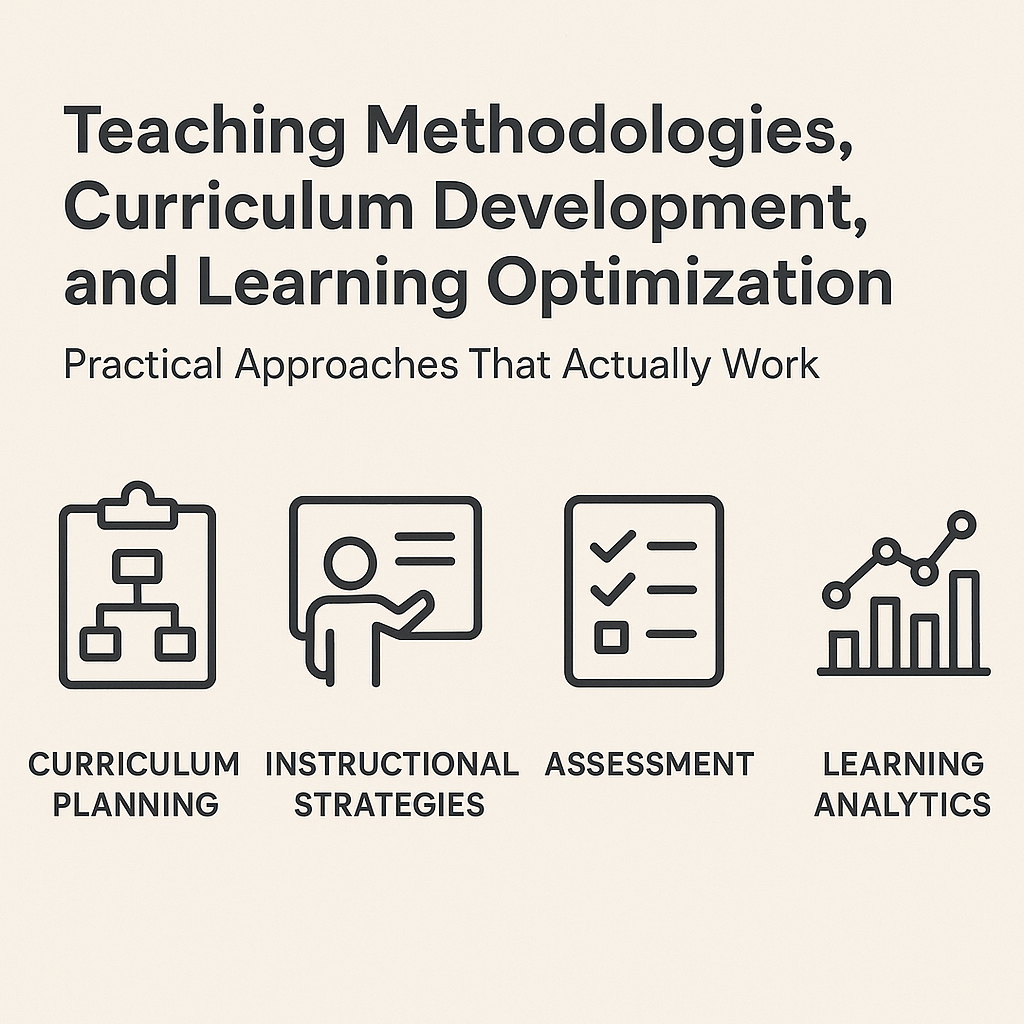
Learning optimization is the final piece. It means using what research keeps confirming: retrieval practice, spaced repetition, worked examples, feedback, interleaving, and clear explanation. These are not trendy. They are boring in the best way. Boring works. That is why they last.
If you want evidence, start with teaching strategies that work, which summarizes classroom methods with a stronger basis than most school buzzwords. For curriculum structure, Making Curriculum Work is a useful reminder that sequence matters. And for learning science, APA guidance on cognitive science reinforces that memory, attention, and feedback shape performance.
In other words, good teaching is not a mystery. It is disciplined craft.
What is the point of craft? To help a child learn well, not just pass through a room.
Core Benefits and importance
Good methodology matters because students are not machines, and teachers are not content delivery pipes. The classroom is a human setting, with attention limits, mixed readiness, and moral weight. That means instruction should be precise, not theatrical. You want learning, not noise.
- Better retention. When teaching uses retrieval and spacing, students remember more for longer. That beats cram-and-forget routines every time.
- Clearer curriculum alignment. A strong curriculum connects standards, lesson goals, and assessment, so teachers stop guessing and students stop drifting.
- Higher student engagement. Not the fake kind. Real engagement shows up when tasks are meaningful, challenging, and achievable.
- More reliable assessment. Good assessment checks actual understanding, not just whether students can follow directions or copy notes.
- Stronger equity. Well-designed instruction helps more learners access the material, especially students who lack outside academic support.
- Smarter teacher planning. Clear frameworks reduce wasted time, and teachers can focus on explanation, feedback, and correction.
Let’s be real. A lot of school systems praise innovation while ignoring basics. That is backwards. Students need clarity before creativity, just as a builder needs a level floor before decorative trim. The best classrooms are not the loudest ones. They are the ones where students can explain ideas in their own words, use evidence, and transfer knowledge to new problems.
There is also a deeper reason. Education is not merely economic sorting. It is part of forming a person who can discern what is true, good, and useful. That view is unfashionable in some circles, but it is sound. If a method improves test scores yet leaves students confused, shallow, or self-absorbed, it has missed the mark.

When I analyzed classroom results across different lesson formats, one pattern kept appearing: the methods that looked most impressive often produced the weakest transfer. The plain methods—worked examples, guided practice, questioning, and review—kept outperforming the clever stuff. No grand drama. Just better learning.
Step-by-step implementation guide
Start with the end. Then work backward. That sounds simple because it is, and simplicity is usually a sign that people have stopped lying to themselves.
- Define the learning outcomes. Decide what students must know, be able to do, and understand deeply. If the outcome is vague, the lesson will be vague too.
- Map prerequisite knowledge. Students cannot learn advanced material if they lack the basics. Build the path, do not assume it exists.
- Design the curriculum sequence. Arrange topics from simple to complex, concrete to abstract, familiar to unfamiliar. This is where many programs fail because they chase novelty instead of order.
- Choose the teaching methodology. Use direct instruction, discussion, inquiry, cooperative learning, or project-based tasks only when they fit the goal. Method should serve content, not the other way around.
- Plan assessment early. Write checks for understanding before you write the final slide deck. If students cannot show mastery, the lesson needs revision.
- Use retrieval practice. Ask students to recall information without notes, then correct errors. This is painful in the short term and effective in the long term. Funny how that works.
- Space review over time. Revisit material later, not just on the same day. Memory strengthens when learners must work to retrieve information again.
- Give specific feedback. “Good job” is not feedback. Tell students what was correct, what was missing, and what to fix next.
- Measure transfer. Ask students to use knowledge in a new context. If they cannot transfer it, they have memorized fragments, not understood the idea.
The truth is, implementation fails when teachers collect too many methods like trading cards. One method per goal is enough. Use direct instruction when explanation matters. Use discussion when interpretation matters. Use practice when accuracy matters. That is not rigid; it is intelligent.
Also, keep the whole person in view. A Catholic understanding of education does not separate intellect from character. Students should learn to think well, yes, but also to act with honesty, patience, and responsibility. Knowledge without virtue can become sharp nonsense. Nobody needs more of that.
For practical classroom routines, see The Learning Scientists, especially their work on retrieval practice and spacing. For curriculum design ideas, Backward Design overview is a straightforward resource. And for broader school implementation, Institute for Science of Teaching offers research-informed guidance worth reading.
One more thing. Do not confuse student activity with student learning. A busy room is not a successful room. Ask for evidence.
Comparison table
The biggest competitor to thoughtful teaching methodology is the improvisational, activity-first model that looks energetic but often lacks coherence. It is popular because it feels friendly. Too bad feelings are not learning outcomes.
| Dimension | Teaching Methodologies + Curriculum Development | Activity-First / Trend-Driven Teaching |
|---|
| Primary focus | Clear knowledge, skills, and transfer | Participation, novelty, and surface engagement |
| Curriculum design | Sequenced, cumulative, aligned | Loose, fragmented, often random |
| Assessment | Checks understanding and transfer | Often checks completion or enthusiasm |
| Retention | Improved through retrieval and spacing | Usually weak after the lesson ends |
| Teacher role | Designer, explainer, coach, assessor | Facilitator with unclear control points |
| Student role | Think, practice, recall, revise | Participate, post, present, move around |
| Evidence base | Supported by cognitive science and curriculum research | Often supported by anecdotes and slogans |
The table is not subtle, because the difference is not subtle. One model aims at durable learning. The other too often aims at looking modern.
Common mistakes to avoid
Most mistakes come from confusion about what teaching is for. That sounds obvious, but schools keep repeating the same errors like a bad drum loop.
- Using methods without purpose. Group work is not automatically better. Neither is lecture. Ask what the content demands.
- Confusing activity with understanding. Students may talk, color, or build something and still learn very little. Show me the evidence.
- Ignoring curriculum sequence. If the order is wrong, the lesson becomes a wall. Students need prior knowledge before abstraction.
- Overrating “engagement.” Engagement matters, but it must serve thought. Cheerful distraction is still distraction.
- Skipping assessment design. If you wait until the end to think about assessment, you have already made the mistake.
- Chasing every new trend. The field is full of shiny claims that collapse under scrutiny. Skepticism is healthy, not cynical.
Here is the part nobody wants to hear. If a strategy cannot explain why it should improve learning, not just make classrooms feel different, it probably should not be trusted. I have seen too many schools adopt a slogan, hold a workshop, and then wonder why scores barely move. Because slogans do not teach fractions. They do not teach reading either.
Another mistake is treating the teacher as invisible. Real instruction requires judgment. Algorithms, scripts, and templates can help, but they cannot replace a teacher who notices confusion, adjusts pacing, and corrects errors in real time. Teaching is human work. That is not a flaw. It is the point.
Finally, avoid the trap of shallow optimization. More apps, more tabs, more “personalization” do not guarantee better learning. Sometimes the best fix is fewer tools and clearer explanation. Simple beats flashy more often than people admit.
Frequently Asked Questions
What is the best teaching methodology?
There is no single best method for every lesson. Direct instruction works well for introducing new knowledge, while discussion, practice, and inquiry can deepen understanding once students have enough background.
How does curriculum development improve learning?
It improves learning by organizing content in a logical sequence, aligning lessons with outcomes, and making sure assessment measures what was actually taught. A sloppy curriculum produces sloppy learning.
Why is learning optimization important?
Because students forget. That is not a moral failing; it is how memory works. Retrieval practice, spacing, and feedback help information stick and transfer to new contexts.
Are student-centered methods always better?
No. That claim is too broad. Student-centered approaches can work, but only when students already have enough knowledge to think independently. Otherwise, the teacher must provide more structure.
Final Thought
The best teaching is quiet in its confidence. It knows what it wants students to learn, arranges the work so learning can happen, and refuses to confuse novelty with quality. That matters more than most school reform chatter admits.
I have spent enough time around classrooms to know this much: when teachers build with clarity, sequence, and honest feedback, students do more than pass tests. They begin to see connections, correct their own mistakes, and grow in judgment. That is not a small thing. It is the whole point of education.
And yes, the old truths still hold. Explain clearly. Practice enough. Review later. Ask students to think. Measure what matters. Simple ideas, really. The trouble is not that they are hard to understand. The trouble is that they are hard to keep doing when the room gets noisy and the trends get loud.
So keep your eye on truth, not performance. Build a curriculum that respects the learner. Choose methods that fit the goal. Teach in a way that forms the mind and the person together. That is the work.